

This is the reporting crisis. It is not a creative problem or a strategy problem. It is a technical gap that directly leads to agency client retention issues. When your tracking data does not match their bank account, trust evaporates. Research from the Harvard Business Review shows that increasing customer retention rates by just 5% can increase profits by 25% to 95%. For an agency, that retention starts with marketing data hygiene.
To keep your best accounts, you must move past “trust us” and start providing proof they can see. If you are struggling to prove value because of reporting gaps, you are likely suffering from a failure to shift from creative to quantitative accountability. When dashboard revenue fails to match the bank account, you end up optimizing based on hallucinations rather than financial reality.
What is Marketing Data Hygiene?
Marketing data hygiene is the process of ensuring your tracking signals are accurate, deduplicated, and consistent across every platform. It is the difference between guessing where a lead came from and knowing exactly which touchpoint triggered the sale.
When an agency manages a brand, they are often stepping into a Franken-stack problem, a messy ecosystem of old pixels, conflicting scripts, and broken tags. Without a high standard of data hygiene, your optimization efforts are based on flawed information. This usually starts in the container itself; if you don’t have strict Google Tag Management SOPs, you risk legacy tags slowing down the site or breaking the checkout flow entirely.
3 Signs of Technical Integrity
If your data is clean, it should meet these three standards:
- Platform Parity: The gap between your ad platform (like Meta or Google Ads) and the backend CRM is less than 10%.
- UTM Persistence: Tracking parameters do not drop off when a user moves from a landing page to a checkout flow.
- Source Clarity: Your GA4 “Unassigned” or “Direct” traffic accounts for less than 15% of your total volume.
But technical cleanliness is not just about being tidy; it is about protecting your revenue.
“The cost of bad data is not just a messy spreadsheet; it is the loss of a client who no longer believes in your ability to drive growth.”
The Link Between Data Accuracy and Client Lifetime Value (LTV)
Most agencies focus on better hooks or higher budgets to improve retention. While performance matters, reliability is what keeps a founder paying your invoice for years. When you fix a client’s data hygiene, you are doing more than just organizing folders.
You are increasing their Client Lifetime Value (LTV) by proving your worth in a language their CFO understands. If you can show that a “Direct” sale was actually influenced by three different paid campaigns, you become an essential partner. This clarity prevents you from having to defend your hours or explain why you bleed margin on scope creep trying to reconcile mismatched reports.
The Old Way vs. The Strategic Way
| Feature | The Old Way (Status Quo) | The Strategic Way (Growth Focused) |
|---|---|---|
| Attribution | Last-click only; ignores the middle of the funnel. | Multi-touch; captures the full path to purchase. |
| Reporting | Static screenshots from Meta Ads Manager. | Live dashboards synced with CRM truth. |
| Problem Solving | The algorithm is just learning. | We fixed the signal loss from cookie banners. |
| Client Trust | Fragile; depends on the last 30 days of sales. | High; based on transparent, verified systems. |
Looking at the comparison above, it is easy to assume your agency falls into the ‘Strategic’ column. But assumption is the enemy of retention.
In our experience, even sophisticated agencies often have ‘silent errors’ running in the background – pixels firing twice, redirects stripping tags, or consent banners blocking data unnecessarily. You do not need a full engineering team to find these initial leaks. You just need to know exactly where to look before your client does.
The 5-Minute Tracking Hygiene Self-Audit
Don’t wait for a client to catch a data discrepancy. Use this 1-page ‘Red Flag’ checklist to spot duplicate pixels, broken redirects, and signal leaks right now.
Why GA4 Data Discrepancy is Killing Your Credibility
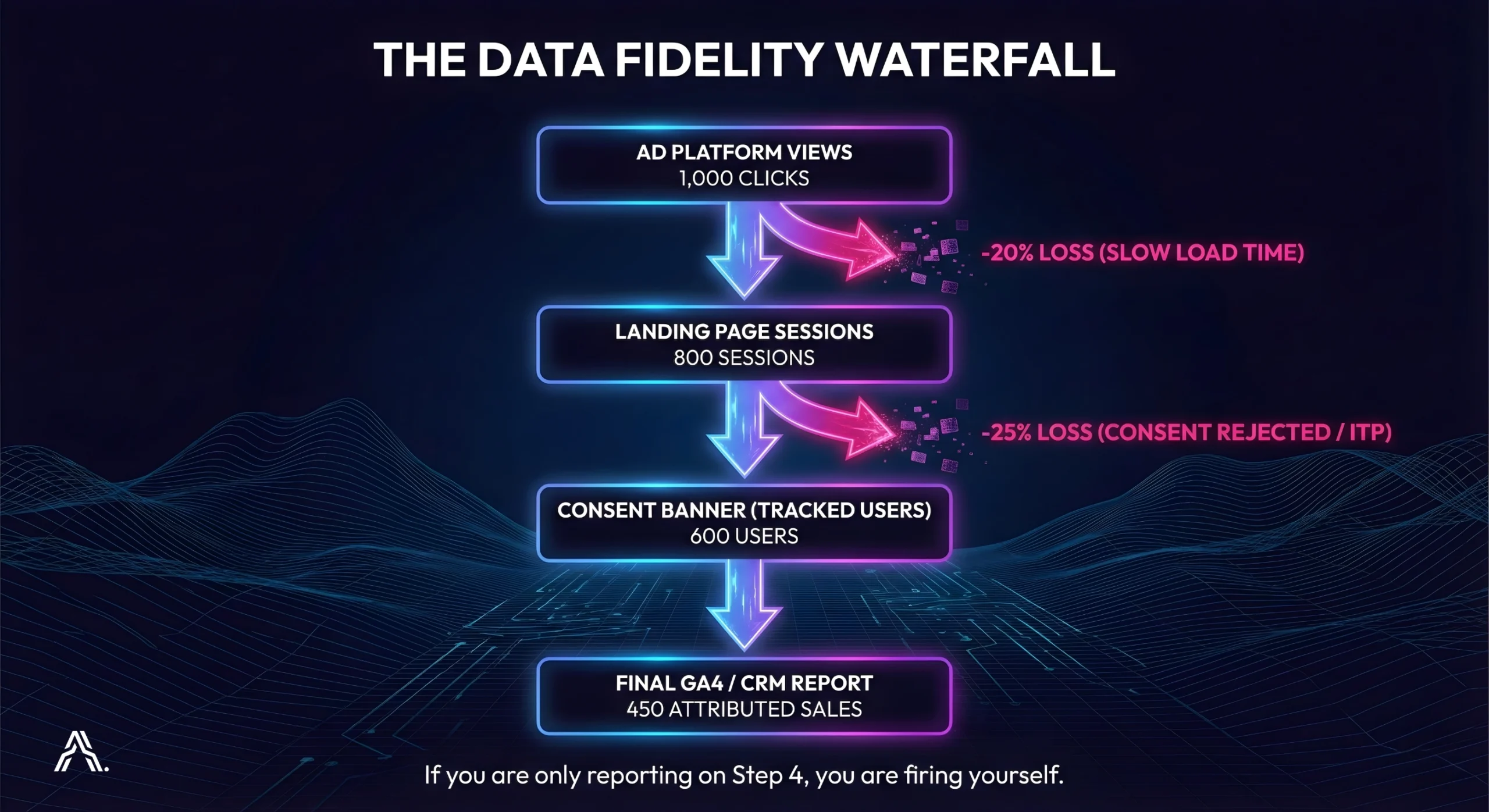
While the checklist above allows you to spot immediate configuration errors, passing it does not guarantee your data is safe. You can have a perfectly installed container and still miss half your conversions. This happens because the problem isn’t always in the setup; often, it is in the browser itself. Specifically, the GA4 data discrepancy many agencies face is often caused by browser level privacy changes. Apple’s Intelligent Tracking Prevention (ITP) and similar updates have fundamentally changed how we track users. According to Search Engine Land, these privacy updates can strip tracking data in as little as 24 hours.
When a user clicks an ad on an iPhone, browser privacy settings often strip the tracking parameters. By the time that user buys something, GA4 cannot see the original source. It marks the sale as “Direct.” To the client, it looks like your ads did nothing.
If your reports look empty, you are likely suffering from these technical gaps. Understanding the nuances of Segment vs. GA4 and signal loss prevents the dreaded lead attribution gaps where your hard work is credited to ‘luck’ or ‘organic brand power.’
So, how do you explain this “gap” to a frustrated client without sounding like you are making excuses?
The Client Reporting Crisis Script
When the numbers do not match, do not get defensive. Use this “Strategic Architect” talk track to shift the conversation from “why are the numbers wrong” to “how we are fixing the system.”
The Context: Use this when a client says, “My CRM says we had 10 sales, but your report says 20.”
The Talk Track:
“I hear your concern, and it is a valid point. There is a gap between what the ad platform sees and what your CRM records. This is a common issue called ‘Signal Loss,’ caused by recent browser privacy updates that strip tracking tags before the lead reaches your site.
Most agencies would just tell you to trust the ad manager. We don’t do that. We are implementing a ‘Data Hygiene Protocol’ to bridge this gap. By setting up server-side tracking, we can ensure that your CRM and our ads speak the same language. Our goal is to get these numbers as close to a 1:1 match as possible so you have total confidence in your return on investment.”
However, a script is only a temporary shield. To permanently solve the retention problem, you must back up your words with infrastructure.
Solving Lead Attribution Gaps with Server-Side Tracking
To truly fix reporting accuracy, agencies must move away from browser-side pixels. Think with Google has stated that relying solely on cookies is no longer a viable long-term strategy.
Server-side tracking allows your client’s website to send conversion data directly to the ad platform server. This bypasses the browser filters that cause lead attribution gaps. If you are ready to move from messy browser tags to a clean system, you need to follow a blueprint for building scalable infrastructure. This ensures that even if a user refuses cookies, the conversion event is still captured securely.

Moving to server-side tracking is the ultimate goal, but you cannot rebuild a house if you don’t know where the foundation is cracked.
Technical Audit: Identifying the Gaps
Before you can fix the retention problem, you have to find where the data is leaking. A Strategic Architect does not guess; they audit. Here are three common technical barriers to watch for:
- Redundant Pixels: Sometimes a client has three different versions of a Meta pixel firing on the same page. This inflates your ROAS and makes your reports look like fake news.
- Broken Redirects: If your ad points to a “pretty link” that redirects to a long URL, the UTM parameters are often dropped during that jump.
- CRM Disconnects: Often, the issue isn’t the ad, but the backend. Your Client’s CRM Might Be a Silent Killer if it isn’t configured to catch the data you are sending, sabotaging your lead generation results.
Conclusion: Stop Defending, Start Documenting
The agencies that thrive in the next few years will be the ones that act as technical anchors for their clients. You are no longer just the person running ads. You are the guardian of the growth engine. This is where white-label marketing ops can become your greatest asset, allowing you to deploy sophisticated tracking without hiring a full engineering team.
When you solve the reporting accuracy problem, you remove the primary reason clients leave. You provide clarity in a world of “Direct” traffic and “Unassigned” leads. You turn the reporting call from a moment of stress into a moment of strategy. This is the foundation of long-term agency client retention.