
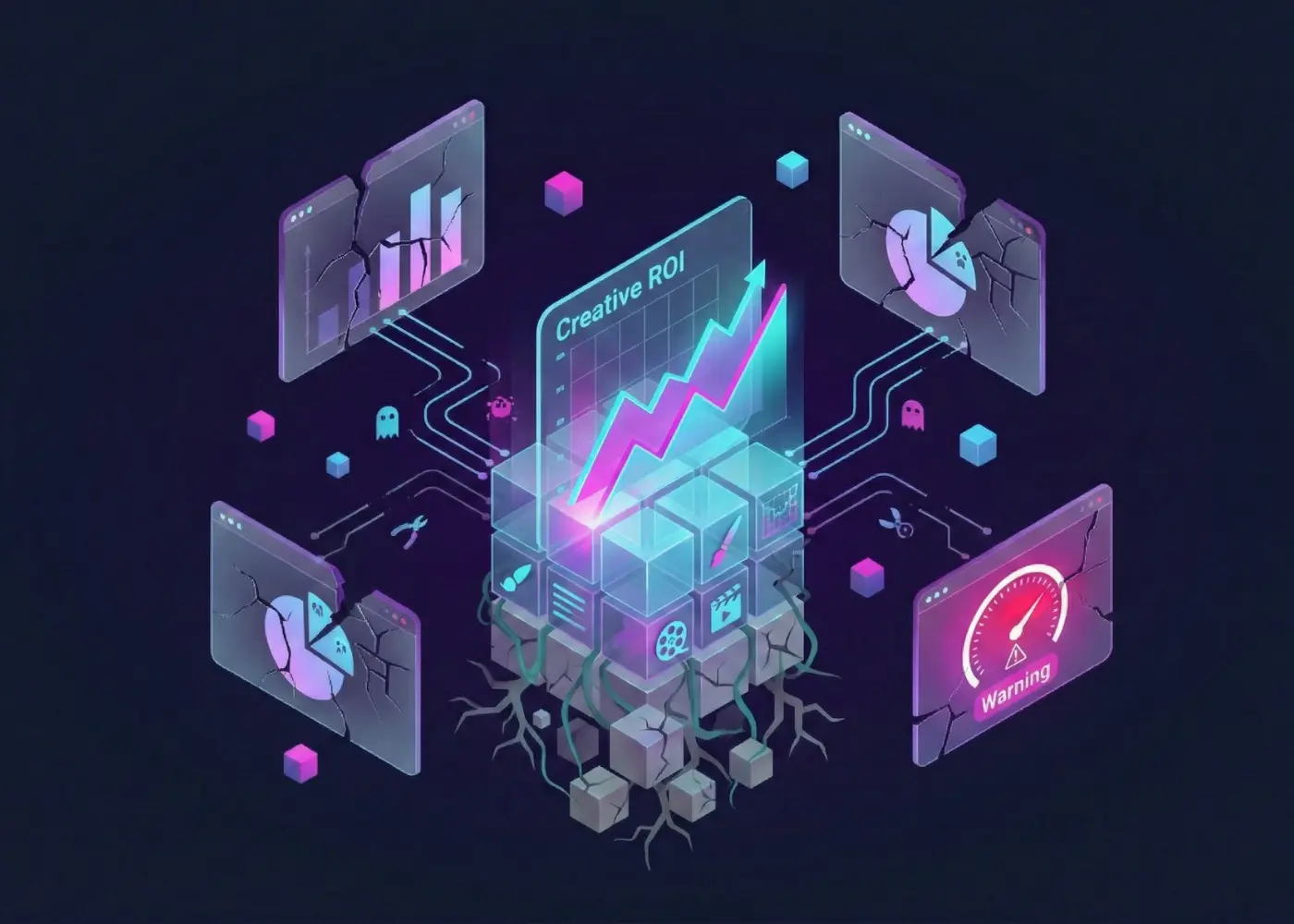
Open Meta Events Manager. Check the Purchase EMQ. If it is under 7, you are losing money every single hour the ads are live.
You can keep refreshing creative and hoping for a miracle, or you can fix the system your ads depend on. One is gambling. The other is engineering. If you want to stop Client ROI Dropping, you have to look under the hood.
This is a core part of building a data-first culture in your agency and moving away from the black box problem where GA4 and Meta don’t match.
When the ROAS dips, we usually blame the creative. We panic-order new hooks and assume the message isn’t landing. But if your tracking is broken, you aren’t reacting to the market, you’re reacting to bad math.
If Meta only sees 60% of your conversions, the algorithm is flying half-blind. You can’t ‘out-creative’ a broken signal. If the machine doesn’t get the data, it can’t find your buyers. It’s that simple.
Why Client ROI Drops When Tracking Breaks
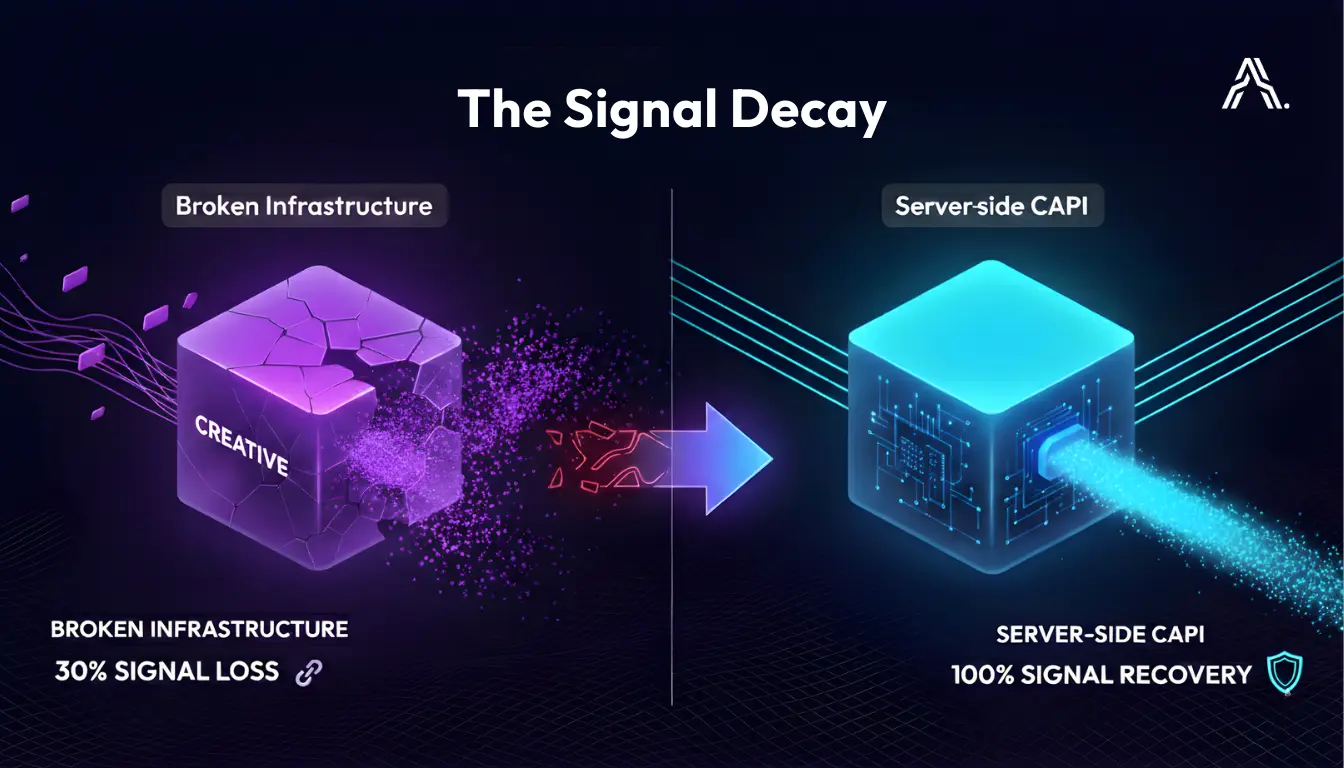
If you are running ads today, you are missing conversions. Usually 15–30%. This isn’t because people stopped buying; it is because the browser never told the platform they did. This creates a massive gap in your Account Management strategy.
When the system sees a partial truth:
- CPAs creep up: The algorithm thinks it is failing and tries harder (and more expensively) to find a win.
- Retargeting shrinks: Your pools dry up because the “signal” of a site visit was blocked. Your pools dry up because the “signal” of a site visit was blocked.
- Optimization drifts: You start making decisions based on 70% of the data, which is effectively a guess.
Clients do not care about the technical “why.” They just see worse results and start looking for the exit. This makes Client Retention nearly impossible.
Why “Good Ads” Stop Working
Broken tracking causes a domino effect that eventually kills even the best campaigns. It leads to:
- Lost Signals: The platform doesn’t know who bought it.
- Bad Attribution: Credit goes to the wrong campaign or nowhere at all.
- Wasted Spend: You pour money into “dead” audiences.
- Algorithm Decay: The AI stops learning because it isn’t being “fed” successful conversion data.
The platform isn’t stupid. It is blind.
Symptom | Creative Agency Response | Infrastructure Response |
|---|---|---|
High CPA | "We need new hooks and better video." | Check the signal. Are we missing 20% of sales? |
Shrinking Audiences | People are bored of the brand. | Browser pixels are being blocked. Move to CAPI. |
Poor Attribution | The client's offer isn't strong enough. | "Fix the deduplication and event IDs." |
Unstable Performance | Let's test five new interests. | "Increase EMQ to stabilize the algorithm." |
How Broken Tracking Destroys Client Trust
Meta says one thing. GA4 says another. Shopify says something else. You spend your weekly calls explaining discrepancies instead of discussing growth strategy. This is where Performance Debugging becomes your full-time job instead of marketing.
When the numbers don’t match, clients get nervous. Trust erodes. That is not a communication issue; it is a structural failure. You cannot have a high-level partnership if you are constantly defending the “math” of the dashboard.
The Browser Pixel Problem You Can’t Ignore
Browser pixels used to be “good enough.” That world is gone. Privacy updates, iOS restrictions, and ad blockers suppress tracking—especially on mobile. Less signal reaches the platform, and your optimization weakens quietly.
Performance doesn’t usually crash overnight. It decays. This slow bleed is the silent killer of Client ROI Dropping. It makes your Account Management feel like a constant uphill battle against a machine that refuses to work.
Server-Side Tracking: The Agency Game Changer
Server-Side Tracking sends conversion data from the backend, not the browser. If you want to read more it is covered in our Server-Side Tagging Architecture Guide.
What agencies actually see when they fix the infrastructure:
Here is how the strategic approach differs from the standard operational approach:
- More conversions captured: You suddenly “find” the missing 20%.
- Stronger matching: Meta knows exactly which user clicked.
- Stable attribution: You can finally prove which ad drove the sale.
- Platforms that learn: The AI gets the feedback loop it needs to find more buyers.
Fix the signal, and the performance follows. It makes Troubleshooting much simpler because you are working with a full deck of cards.
The GTM Governance S
Event Match Quality (EMQ) and Your Bottom Line
Most ad accounts sit at an EMQ of 4 or 5. That is a failing grade. Low EMQ means weak matching, poor learning, and higher costs. Clients never ask about EMQ—they just feel it in the CPA and the eventual churn.
When you implement proper Server-Side Tracking, EMQ moves into “Great” (8.0+). Costs usually move down with it. This is the most effective way to ensure Client Retention—by actually making the ads work again.
If you ignore these signs, you are not just risking bad data; you are risking the integrity of your entire CRM. For more on that, read 5 Signs Your Client’s CRM is Sabotaging.
Stop Scaling Until the Foundation is Fixed
We see this constantly with agencies. They bring in a new client, launch new ads, and get the same mediocre results. They are trying to build a skyscraper on a swamp. You cannot scale what you cannot see.
If a client spends $10,000 a month and you miss 20% of conversions, that is $2,000 of spend that is completely invisible to the algorithm. That is a massive waste of resources. Fixing the tracking is a one-time infrastructure investment that pays for itself by stopping the bleed.
We don’t sell tech help. We build systems that run businesses, automate the boring, and scale what works, especially for agencies. If your Performance Debugging is leading you in circles, it is time to change the way you collect data.