

Stop guessing if a prospect is going to be a technical nightmare. On your next call, run this five-question diagnostic. Listen for the hesitation, not just the answer.
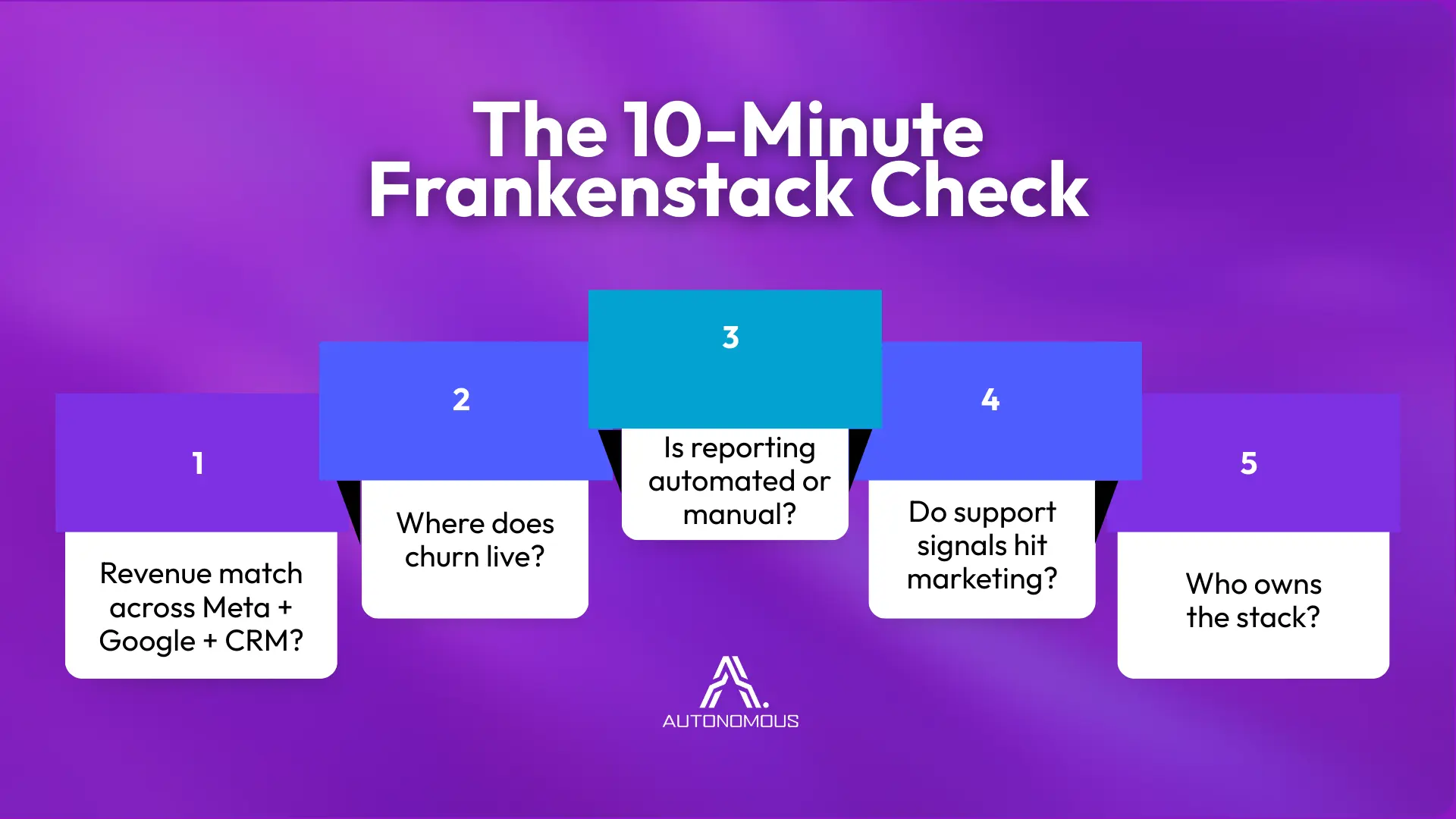
1. Do Meta, Google, and the CRM show the same revenue?
If the ad platform, the eCommerce backend, and the CRM can’t agree on how much money was made last week, stop right there. You aren’t looking at “normal attribution variance.”
You are looking at broken infrastructure.
This means missing tracking pixels, server-side gaps, or offline revenue that never syncs back. If the client tries to debate Segment vs. GA4 before they can even reconcile basic cash flow, they are rearranging deck chairs on the Titanic. Fix the data trust issue first.
2. Where does “Churn” live?
If the answer involves a manual spreadsheet or a vague “we track it in Stripe,” your lifecycle strategy is dead on arrival.
If the stack doesn’t automatically flag who is at risk and when that risk started, you can’t run retention. You’re just guessing. You cannot automate a win-back campaign based on data that relies on a human remembering to update a cell.
3. How is the weekly report built?
Ask them to describe the workflow.
- Good answer: “It automates into a dashboard.”
- Bad answer: “Steve exports three CSVs, cleans them up, and pastes them into Excel.”
That isn’t reporting; that is margin erosion. If the numbers are “assembled” rather than “produced,” they are prone to human error. You will eventually be blamed for a reporting error that was actually a copy-paste failure.
4. Do support tickets feed into marketing?
If a customer screams at support or requests a refund, does the ad platform know to stop targeting them?
If support data and marketing data are siloed, you will end up upselling unhappy customers. That is how you burn brand equity. Furthermore, if your creative and media teams are looking at different reality sets than the product team, true data-driven decision-making is impossible.
5. Who owns the stack today?
“Everyone” means “No one.”
If they can’t name a specific owner, the stack is decaying. Tags are breaking, tokens are expiring, and tools are being added without proper mapping.
This is usually when technical scope creep starts to bleed your margins
Here is the hard truth: If the answer to any of these is unclear, you are dealing with a Frankenstack.
Are you scaling a strategy? Or a “Frankenstack”?
Download the Autonomous Agency Martech Health Checklist
The Infrastructure Boundary (Or: Stop working for free)
We see this constantly: Agencies afraid to draw a line between Strategy and Infrastructure.
If you don’t draw that line, you become an unpaid data plumber. You spend 20 hours a month fixing broken pipes inside a retainer meant for growth marketing. Worse, you get judged on performance metrics that the system isn’t capable of measuring accurately.
Stop absorbing technical cleanup as “part of the job.” It kills your effective hourly rate and burns out your team.
Three Better Moves for Your Agency
Check the stack before you commit
Don’t wait until onboarding to find out the tracking is garbage. Add a “Stack Check” to your sales process. Flag the risk early so you don’t lock yourself into KPIs based on imaginary numbers.
Make the fix a defined service
Data hygiene is not a favor; it is engineering. It has scope, complexity, and value. Scope it, price it, and bill for it. When you put a price tag on it, clients treat it with the respect it deserves.
Use a technical partner instead of stretching your team
Your strategists are not engineers. Your account managers are not IT support. Stop asking them to be. You need a partner to handle the plumbing and keep the stack stable so your team can focus on what they actually sold: Growth.