

If you run paid media, analytics, or CRO for clients, this moment will feel familiar. You send a clean looking report. The client nods. Then one day their backend revenue does not match your dashboard. The first doubt appears. After that, every number is questioned.
This is why the debate around Segment vs GA4 for agencies keeps growing. Founders hear that a CDP will fix tracking. Agencies lean on GA4 because it is free and already installed. Both have value and both can fail.
The real issue is not the tool.
It is data integrity.
The Segment vs GA4 Cheat Sheet for Agencies
This is the fast truth your clients actually need.
| Feature Category | Segment (The Infrastructure) | Google Analytics 4 (The Report Card) | The Agency Strategic Take |
|---|---|---|---|
| Core Function | Customer Data Platform. Captures data once and routes it everywhere. | Analytics software. Captures data to visualize and report on it. | Do not choose between them. Segment feeds clean data into GA4. |
| Data Integrity | High and immutable. Raw data is sent to a data warehouse exactly as captured. | Medium. GA4 applies modeling and thresholding. | Use Segment for billing and attribution truth. Use GA4 for trend analysis. |
| Identity Resolution | Deterministic. Users are stitched with owned User IDs. | Probabilistic. Google Signals estimates identity. | If the client has logins or SaaS users, Segment is required. |
| Destination Support | 400 plus tools across ads, CRM, email, and product analytics. | Limited. Mostly inside the Google stack. | Segment reduces vendor lock in risk for the client. |
| Implementation Cost | $$$ based on monthly tracked users. | Free to start. GA4 360 is enterprise priced. | Agency upsell: Governance keeps Segment costs controlled. |
The Strategic Comparison Matrix: Segment vs GA4
Verdict for Agencies:
Many clients believe they must choose between Segment and GA4. This is false. Autonomous defines the relationship this way: Segment is the plumbing. GA4 is the dashboard.
For a scalable agency data stack, Segment should act as the primary data collector. It protects raw historical data in a data warehouse so clients can switch tools in the future without losing their past. Relying only on GA4 creates data debt because raw data is difficult to extract and migrate.
Clients Do Not Buy Tools. They Buy Trust.
Clients do not care how data is collected. They care if the number they see is real.
Once trust in reporting slips, everything else tightens. Budgets pause. ROAS gets questioned. Retainers come under pressure. This rarely comes from bad strategy. It almost always comes from broken tracking.
The failures are consistent across most accounts:
- Duplicate events inflate revenue.
- UTMs disappear and paid traffic shows as Direct.
- Consent mode breaks and EU data goes dark.
- Old pixels continue firing without anyone knowing.
- Hard coded events leave no audit trail.
This is why data integrity best practices matter more than any platform decision. Segment does not fix poor tagging on its own. GA4 does not cause bad data either. The breakdown happens at the implementation layer.
What GA4 Is Built For and Where It Stops
GA4 is an analytics platform. Its role is to receive events, store them, and display them in reports. It assumes the data arriving is already correct.
It works well because it is fast to deploy, tightly connected to Google Ads, flexible with events, and free to use at scale. For many agency clients, it is more than sufficient.
The platform does not govern how events are created, which means it depends heavily on GTM and development teams. Additionally, misconfigurations occur easily across many pages. Agencies should also note it has no native system to warn you when data becomes unreliable.
What Segment Is Built For and Who It Is For
Segment is a CDP or customer data platform. It sits between the site, app, or backend and every destination that receives data. Its job is standardization and routing.
This works best when several tools need the same clean event stream. It gives tighter control over event naming and consistency across platforms. It is designed for stacks where product, growth, and marketing all depend on shared data.
Where agencies must be careful is scope. Segment adds cost. It adds setup time. It still depends on correct front end instrumentation. If your GTM container is broken, Segment will simply forward broken events more efficiently.
Segment is not a repair tool. It is an infrastructure layer.
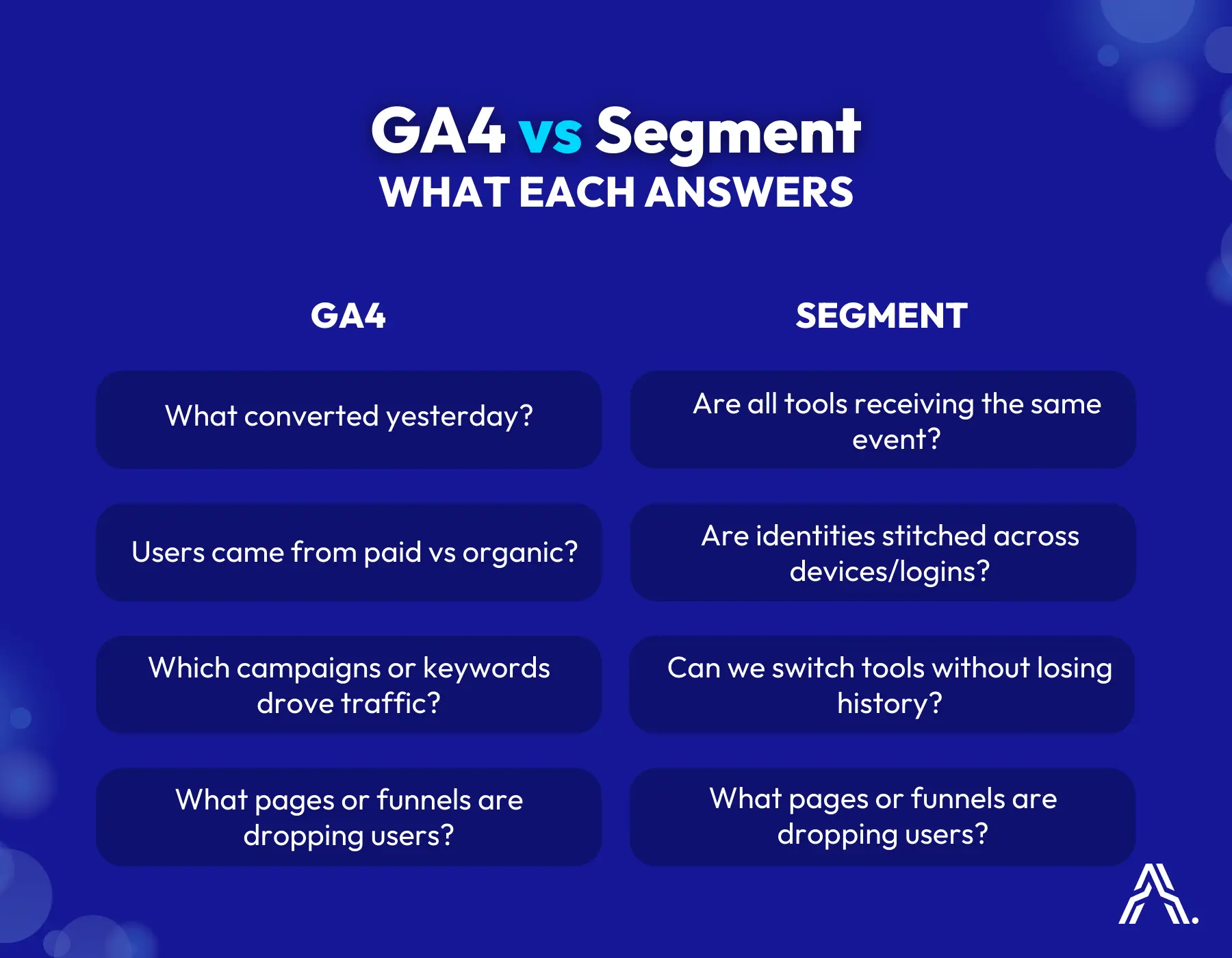
GA4 vs Segment Comparison in Plain Terms
When clients ask for a GA4 vs Segmentcomparison, the clean explanation is this.
Why Most Agencies Stay on GA4
Agencies default to GA4 for simple reasons.
It is already installed on most sites. Paid media platforms depend on it. There is no additional license cost. Teams already know how to use it.
For most agency clients, GA4 is not the bottleneck. The bottleneck is the health of the GTM container, the UTM structure, and the consent logic around it.
We audit live stacks weekly. Most dashboards look clean. The failures only appear when we inspect real firing behavior at the page level.
That is where revenue gets inflated, traffic gets misattributed, and compliance breaks quietly.
When Segment Actually Makes Sense
Segment becomes the right move when the stack is already complex.
It fits best when a client has:
- Web, app, and backend events
- Many tools depending on the same data
- Shared ownership between marketing and product
- Legal or compliance constraints
- In house data or engineering support
If your client runs a simple ecommerce or lead generation site, Segment usually adds cost without fixing the main source of risk. Clean GTM, clean GA4, and tight governance deliver faster gains.
The Shared Blind Spot in Both Setups
Here is the risk few teams plan for.
Both Segment and GA4 can show clean dashboards with numbers that are still wrong.
Dashboards only show what was collected. They do not show what was lost.
This is how agencies end up reporting performance that feels right but is wrong:
- Events fire but do not match backend behavior.
- Purchases double fire in edge flows.
- Consent blocks full regions without alerts.
- Legal or compliance constraints
- Server-side tracking slowly drifts out of sync.
Hence, this is why server-side tracking for clients must be held to the same standard as browser tracking. It can reduce data loss, but it can also multiply errors if controls are loose.
What Clients Actually Need Before Choosing a Tool
Before debating Segment vs GA4, every client needs the same first step.
A real tracking health audit.
Not a dashboard review.
But, a code level inspection of what fires on the page, in what order, and under what rules.
A proper audit includes:
- A traffic light score for GA4, Meta Pixel, and conversion tracking.
- A ghost tag scan to surface legacy vendors and hidden scripts.
- A ranked fix list focused on revenue risk, attribution risk, and compliance risk.
Without this, tool debates are guesswork.
Stop guessing. Start diagnosing.
We turned this exact framework into a step-by-step PDF to help you find errors fast.
Where Agencies Win or Lose Trust
Clients rarely leave because of bad ideas. They leave because the numbers stop making sense.
Once reporting trust breaks, every conversation gets harder. Performance debates turn into data debates. Decisions slow down. Confidence fades.
If clients are asking about Segment vs GA4 for agencies, the smarter move is to pause. First confirm whether the data they have can be trusted at all.
Everything else is just tools layered on top of uncertainty.