

Most tracking problems don’t look like problems.
Your dashboards still populate. Conversions still “show up.” ROAS still has a number. Then you compare against backend revenue, CRM closes, or subscription starts and the story starts drifting.
That drift is exactly why server-side tracking keeps coming up in agency conversations. It’s often framed as a magic fix for iOS, ad blockers, cookie loss, and consent mode.
It can help with all of that.
But server-side tracking isn’t a repair tool. It’s an infrastructure upgrade. If you move broken logic from the browser to the server, you don’t get cleaner data, you get faster, more confident wrong data.
The goal is still the same: data integrity. Server-side tracking is just one way to defend it.
What Server-Side Tracking Actually Is
In client setups today, most tracking is browser-side:
- A user loads a page
- Tags fire in GTM (or hardcoded scripts)
- Events go to GA4, Meta, TikTok, etc.
Server-side tracking changes the middle of that flow:
- The browser sends events to your endpoint (server container, API, gateway)
- Your server decides what to forward, to whom, and under what rules
- Destinations receive events from a controlled, consistent source
It’s basically moving “event routing” into a place you can govern.
What Server-Side Tracking Is Good For
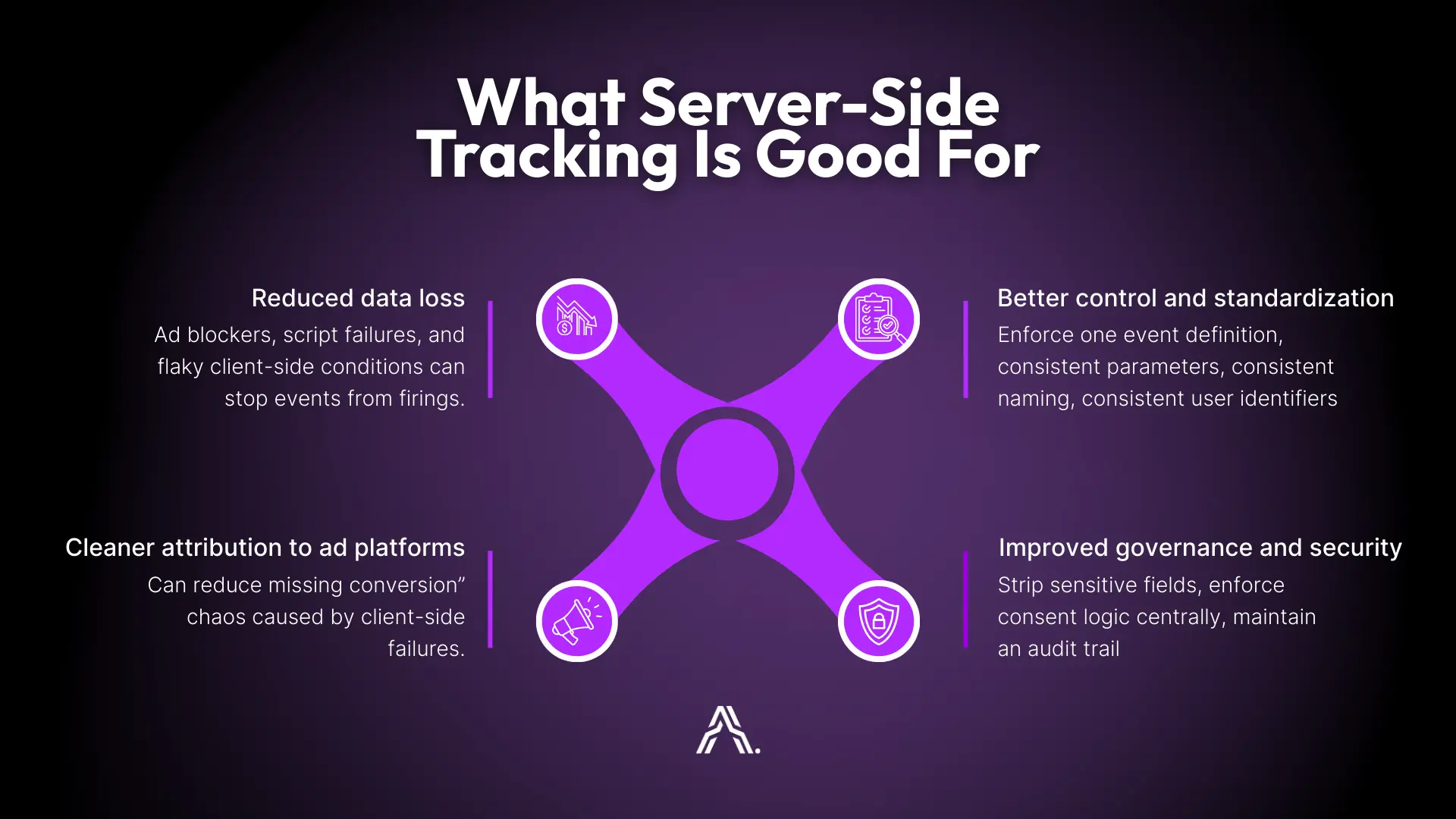
When implemented well, server-side tracking helps agencies solve four common integrity issues:
- Reduced data loss: Ad blockers, script failures, and flaky client-side conditions can stop events from firing. A server pipeline can recover some of that, especially when paired with backend events.
- Better control and standardization: Instead of 15 tags each interpreting the same event differently, you can enforce one event definition, consistent parameters and consistent naming.
- Cleaner attribution handoff to ad platforms: Many ad platforms work better when conversions arrive reliably and consistently. Server-side can reduce “missing conversion” chaos caused by client-side failures.
- Improved governance and security: You can strip sensitive fields, enforce consent logic centrally, and maintain an audit trail of what data was sent.
Where Server-Side Tracking Fails (And Why Agencies Get Burned)
Server-side tracking creates a new failure mode: silent duplication and drift. Here’s what breaks most often:
Duplicate events
The classic mistake is forwarding the same conversion from the browser pixel, server event, and backend system (Stripe/CRM) and counting them all. Your dashboards look “great”; your client’s finance team does not.
Identity mismatch
If your server events don’t use the same identifiers as your client-side events, you create two partial realities. Reporting becomes fragmented and optimization suffers.
“We turned it on” without governance
Server-side requires rules for deduplication logic, event versioning, parameter requirements, and destination-specific mappings. Without those, errors spread faster.
Compliance gaps
Moving tracking server-side doesn’t automatically make it privacy-safe. Consent still matters. If consent logic is loose, server-side can become a compliance liability instead of a fix.
When Server-Side Tracking Actually Makes Sense
Server-side tracking is usually worth recommending when:
- The client spends enough paid media for attribution drift to be expensive.
- There’s a multi-surface product (web + app + backend events).
- There’s a real need for deduplication (browser + server + CRM).
- The client has engineering support (or your agency provides it).
- Compliance requirements demand tighter control over what gets sent.
If the client is small, simple, and mainly needs better UTMs + cleaner GTM + correct event firing, server-side is often overkill.
The Agency Checklist for “Safe” Server-Side Tracking
If you do one thing, do this: treat server-side like a data product, not a tag install
Minimum standard for integrity:
- A single conversion taxonomy (what events exist, what they mean)
- A deduplication plan (exactly how “purchase” is counted once)
- A source-of-truth decision (backend vs browser vs both)
- A consent enforcement rule (what is allowed to be sent, when)
- Monitoring (alerts for drops, spikes, and schema changes)
Server-Side Isn’t the Upgrade: Governance Is.
Clients don’t buy “server-side GTM.” They buy confidence. Server-side tracking is only valuable when it improves:
- Accuracy of conversion counts
- Reliability of attribution inputs
- Consistency across tools
- Auditability when something breaks
If you can’t define how the numbers become more trustworthy, then it’s just more plumbing. And more plumbing without governance is how agencies end up with two dashboards and zero trust.