

Every Monday, the report shows a 4x ROAS.
The client smiles. You relax. Everyone pretends the numbers are real. Then month-end hits. The client checks their bank account and their CRM, and that “4x” ROAS? It doesn’t exist.
The revenue in the backend is 20% lower than what Meta claims. Now you look like you’re either clueless… or lying. This is how creative agencies get fired. Not because the “creative stopped working” or the “targeting needs refinement,” but because your ROAS accuracy is being sabotaged by broken data silos.
For teams running paid media, this scenario has become the new (and dangerous) normal. Privacy rules and platform shifts have stripped visibility from traditional tracking. If you’re making budget decisions based on ghost conversions and double-fired pixels, you’re not optimizing. You’re guessing.
The Real Cost of Bad Tracking Data on ROAS Accuracy
ROAS Accuracy isn’t a “nice-to-have.” It’s the difference between scaling what works and lighting money on fire.
If you’re still relying on standard browser-side tracking, you’re playing roulette. Between iOS updates, ad blockers, and cookie loss, your dashboard is seeing a distorted version of reality. In iOS-heavy markets like North America and Western Europe, it’s common for 15–30% of conversions to never reach Meta, TikTok, or GA4 at all.
When tracking breaks, it usually breaks in two ugly ways:
1. Over-reporting (The False Hero):
Your tags fire twice on a “Thank You” page. Meta applauds. You brag. Then the client audits actual sales and realizes the numbers were inflated. You lose all credibility instantly.
2. Under-reporting (The Silent Killer):
Your ads are driving revenue, but the browser blocks the signal. The dashboard says the campaign is failing, so you kill it—effectively murdering your best performer.
Either way, your reporting becomes pure fiction.
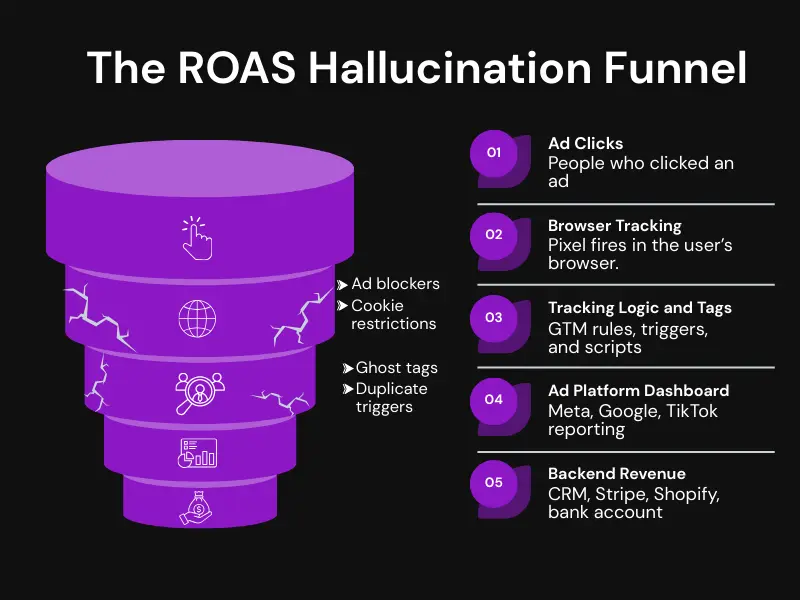
Why Ad Dashboards Misreport Conversions and ROAS
Most GTM (Google Tag Manager) containers are junk drawers. They are filled with old tags from previous agencies, random scripts “tested once,” and half-finished tracking from vendors who vanished years ago.
These ghost tags don’t just sit there; they collide. If a Meta pixel, a Google tag, and an ancient LinkedIn script are all fighting to claim the same conversion with no hierarchy, your attribution becomes a hallucination. You can’t scale a brand on messy code and crossed wires
You can’t scale a brand on messy code and crossed wires. You’re building on sand.
Why Browser-Side Tracking Is Falling Apart After iOS and Cookie Loss
The Browser-Side Collapse Post-iOS 14 iOS 14 didn’t just “change the game”—it broke the entire infrastructure. Browsers are moving away from third-party cookies entirely. If your setup depends on a browser “remembering” a user, your tracking has an expiration date.
The fix isn’t “add another tag.” The fix is Server-Side Tracking.
When tracking runs through a server, you take back control:
- Eliminate Data Discrepancy: Align your dashboard with backend truth.
- Signal Recovery: Stop losing critical data to ad blockers.
- Improved Match Rates: Help platforms identify exactly who converted to lower your CPAs.
This is where Conversion API (CAPI) comes in because a shaky browser pixel isn’t enough anymore to maintain ROAS accuracy.
Your ROAS Is Lying.
Run the Tracking Health Score and catch the leaks before they torch your budget (and your credibility).
Simple Steps to Audit Your Setup
You don’t need to be a technical lead to spot obvious leaks. Start here:
1) Check for duplicates
Run a test purchase and use a pixel helper/debugger. If “Purchase” fires more than once from one action, your ROAS is inflated. Period.
2) Verify match quality
Open Meta Events Manager. If Event Match Quality is below 6.0, your targeting and retargeting are probably hitting the wrong people or or missing your best customers entirely.
3) Audit site speed
If your GTM container is packed with old scripts, your pages slow down. That kills conversion rate before users even see the offer. You’re paying for clicks that bounce.
Moving From Guessing to Knowing
Your goal isn’t “more data.” It’s clean, actionable data. You need a system where each conversion is counted once, the dashboard matches the CRM, and reporting doesn’t collapse when the CFO checks the books.
When your numbers match the client’s financial reality, trust goes up. And trust is the only currency that keeps agency partnerships alive. If you can’t name the person responsible for this infrastructure, you are likely dealing with a frankenstack that will eventually decay and fail.
The Tracking Health Checklist
Want a quick reality check? Here’s what to look at:
- GA4 Audit: Is GA4 tracking real conversions… or just page views dressed up as “events”?
- GTM Health: Are there tags from vendors who aren’t even under contract anymore?
- Consent Mode: Are you losing users who decline cookies or do you have a plan for measurement gaps?
- CAPI Status: Do you have a real Conversion API setup for Meta (and TikTok), or are you betting everything on the browser pixel?
The 5-Minute Tracking Hygiene Self-Audit
Don’t wait for a client to catch a data discrepancy. Use this 1-page ‘Red Flag’ checklist to spot duplicate pixels, broken redirects, and signal leaks right now.
Reclaim Your Performance
Technical debt ruins campaigns quietly. You can have the best copy on earth. The prettiest ads. The smartest media buyer. But if the signal dies before it reaches the platform, your ads don’t get credit for the work they’re doing.
Fixing your tracking is often the fastest way to improve CPA. Not because the ads changed, but because the truth finally showed up in the data.
We don’t sell “tech help.” We build systems that run businesses, automate the boring stuff, and scale what works.