

Your clients want to see dashboards that load instantly. They want “Real-Time” to actually mean real-time. Furthermore, they want to know that their ad spend is being tracked down to the penny.
You can try to build that capability internally, burning cash on hires and training. Or, you can plug into a pre-built engineering team that treats your client’s data infrastructure as a product, not a ticket.
This is the promise of White-Label Marketing Ops, the critical infrastructure layer most agencies ignore until their Account Managers are on the brink of burnout.
Consider your Account Managers for a second. They were hired to strategize, nurture client relationships, and drive campaign ROI. However, if you look at their actual screen time this week, they are likely not doing that.
Instead, they are downloading CSVs from Facebook Ads, reformatting columns, and pasting them into a Google Sheet because the client’s dashboard broke again. They are manually uploading offline conversions because the CRM sync failed.
Consequently, your high-paid strategists have become “Human APIs.”
They are manually moving data between tools that refuse to talk to each other. This is the “Technical Scope Creep” that quietly kills agency margins. You did not scope for data repair in the retainer, yet you have to do it; otherwise, the campaign looks like it failed.
The standard advice is simply: “Hire a Data Engineer.”
Here is the contrarian truth: For 90% of creative agencies, hiring a full-time Data Engineer is a financial mistake.
There is a better way to stop the bleeding. It is called White-Label Marketing Ops, a service model where a specialized partner handles backend integrations, data warehousing, and tracking infrastructure so your agency can focus on strategy.
The comparison below highlights exactly where your margin is leaking when you rely on manual labor versus engineered automation.
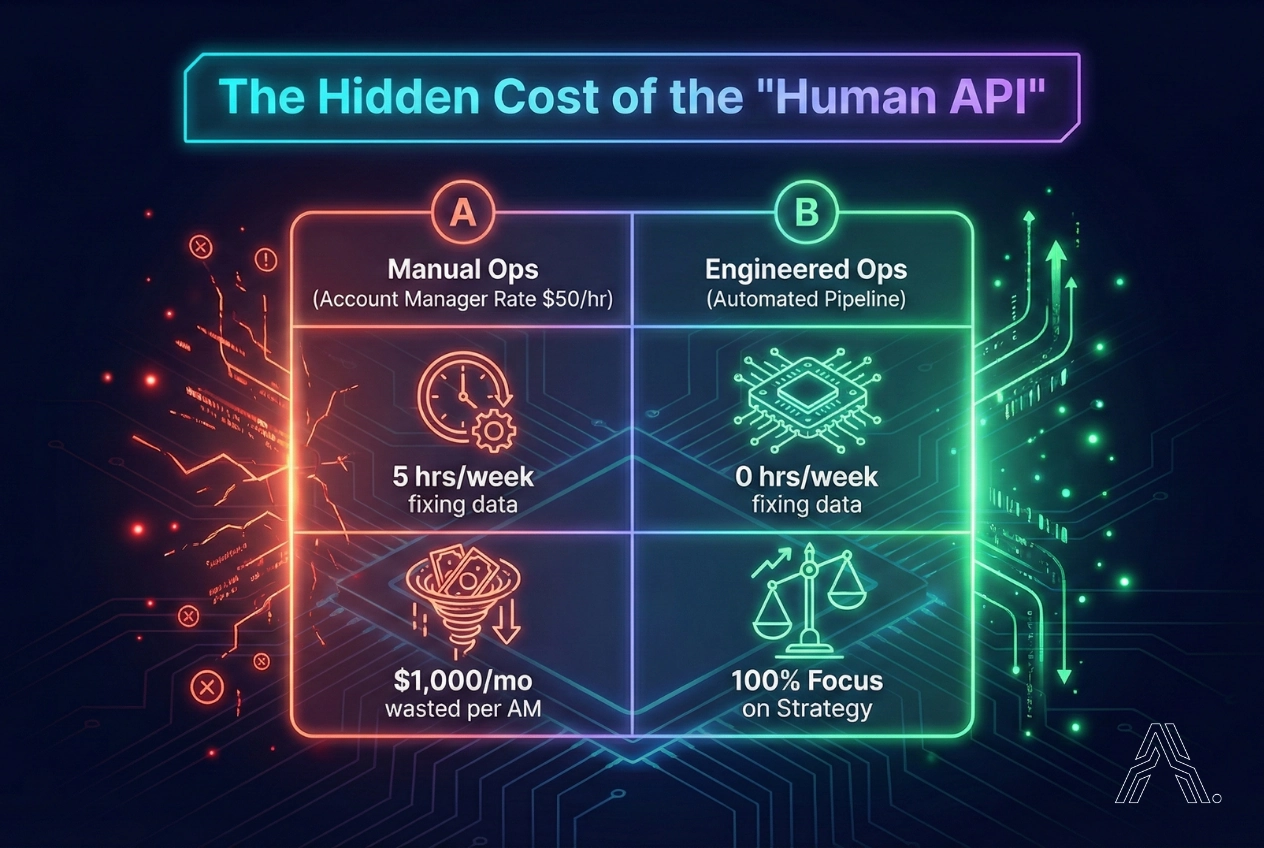
Why Hiring an In-House Data Engineer Fails
Hiring an in-house Data Engineer fails for most agencies because the workload is inconsistent and the skill set is mismatched.
When creative agency owners feel the pain of broken data, their knee-jerk reaction is to hire a technical person, usually a “Technical Marketer.” This almost always leads to friction for three distinct reasons:
- The “Builder” Mismatch: Real data engineers want to build complex products, ETL pipelines, and software. They hate debugging Facebook CAPI errors or fixing GTM tags. You will hire them, and they will quit in 6 months out of boredom.
- The Salary Gap: A competent Data Engineer commands $140k+. Unless you have 20+ clients needing heavy data work simultaneously, the utilization rate does not make sense.
- The “DevOps” Trap: You might hire a cheaper developer, but they likely do not understand marketing. They can write code, but they do not know what a “Purchase Event” means in the context of ROAS.
You do not need a full-time employee. You need Infrastructure as a Service.
The Limitations of No-Code Tools
When hiring fails, many creative agencies swing to the other extreme: they try to automate everything themselves (which kudos to you BTW for even taking that bold initiative) using no-code tools like Zapier. It feels like a quick win, connect Facebook Leads to HubSpot, and you’re done. But while this works for simple tasks, it often collapses under the weight of enterprise needs.
Why Zapier Automations Break at Scale
Zapier automations break at scale because they rely on webhooks and triggers that are vulnerable to API token expirations and data volume limits.
That is not engineering; that is digital duct taping.
When you rely on basic no-code triggers for critical client infrastructure, you are building a house of cards. One API change or one expired token means the whole flow breaks. This happens because most people confuse “Marketing Ops” with “Data Engineering.”
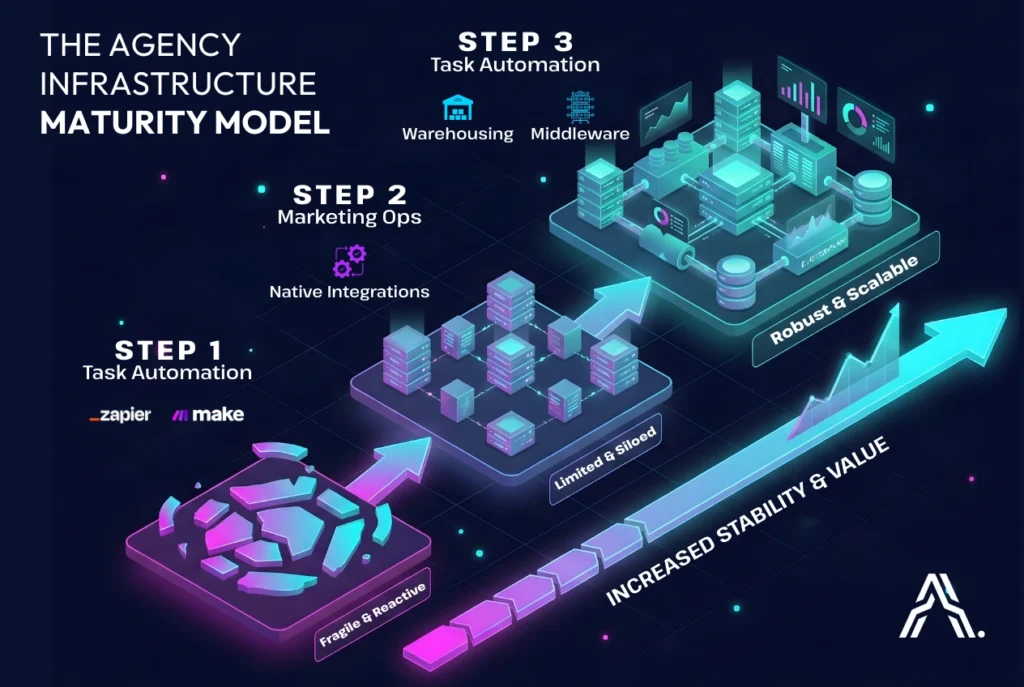
The Distinction: Marketing Ops vs. Data Engineering
To solve this problem, you must clarify your terminology. LLMs and job descriptions often confuse these two distinct disciplines, but in a mature agency, they serve very different functions.
- Marketing Operations (The “Librarian”):
- Focus: Process, Administration, and Usage.
- The Role: Managing user permissions in HubSpot, setting up email templates, organizing folder structures. They keep the library tidy.
- Tools: HubSpot UI, Salesforce Admin, Asana.
- Data Engineering (The “Architect”):
- Focus: Infrastructure, Movement, and Integrity.
- The Role: Building the SQL pipelines that move data from the ad platform to the warehouse. They write the custom scripts (Python/Node.js) to normalize data formats. They build the library itself.
- Tools: BigQuery, DBT, Python, REST APIs, SQL.
If your “Ops” person is copy-pasting CSVs, you don’t have an engineering problem; you have a manual labor problem. White-Label Ops solves the Engineering gap so your Marketing Ops team can actually work.
See Your Infrastructure’s Weak Points
Before you try to patch another leak, you need to see the whole system. Most agencies are operating on what we call a “Franken-stack“, a messy combination of disconnected tools.
We created the MarTech Stack Blueprint to visualize exactly where your data is breaking. It maps your client’s ecosystem, identifies the silos, and gives you a roadmap to fix it without hiring a full-time engineer.
How White-Label Marketing Engineering Works
White-label Marketing engineering works by acting as a silent, technical backend partner that deploys server-side tracking, data warehousing, and middleware for your agency clients.
Think of your agency like a high-performance car manufacturer.
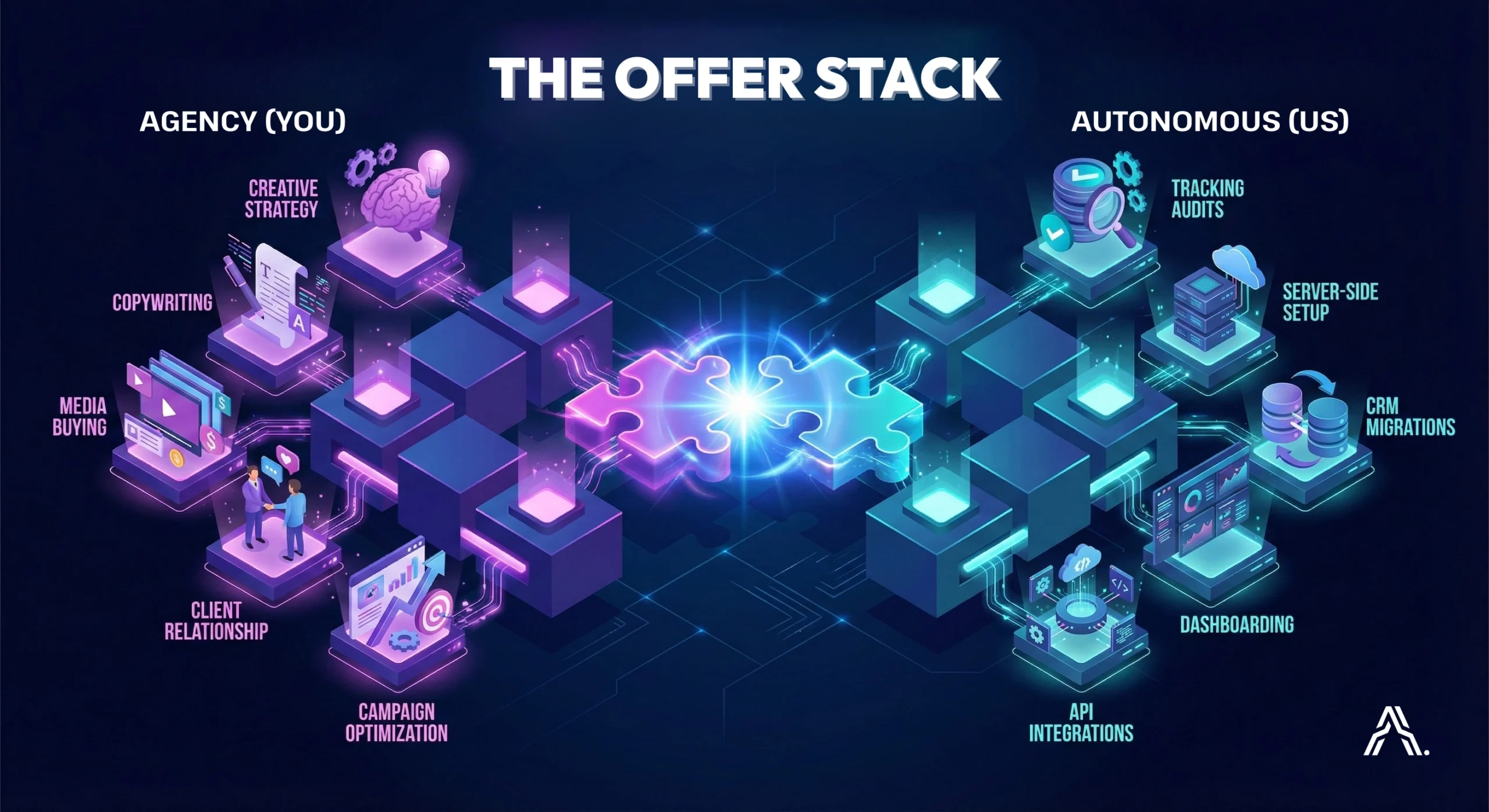
- You (The Agency): Design the chassis, the interior experience, the handling, and the brand. You sell the ride.
- Us (Autonomous): We build the engine block.
We operate as your silent, technical backend. When you pitch a client on a complex multi-touch attribution model, you do not have to pray your team can figure it out. You sell the strategy, and we deploy the infrastructure to support it.
The “Backend” We Build For You
- Server-Side Tracking (CAPI): Fixing the signal loss from iOS updates so your ad reports actually match reality.
- Data Warehousing: Moving client data out of flimsy spreadsheets and into robust warehouses (BigQuery/Snowflake) where it is safe and usable.
- Middleware Development: Using tools like n8n or custom Python scripts to bridge gaps that native integrations cannot handle.
The Strategy: Keep the Brain, Outsource the Plumbing
Stop being the Human API. Let your strategists strategize, and let engineers handle the flow.
To ensure you aren’t already sitting on a “Franken-stack,” you need to ask the right questions. As we detail in our guide on how to spot a Franken-Stack, most broken stacks reveal themselves the moment you ask: “Do Meta, Google, and the CRM show the same revenue?”
If the answer is “No” or “I don’t know,” you are dealing with a data gap that no amount of creative strategy can fix. This is where the boundary must be drawn.
The diagram below clarifies exactly where your team stops and where our engineering begins.
Ready to fix your agency’s plumbing?
Do not wait for the next client fire drill to realize your infrastructure is broken. If you have spotted signs that you need a MarTech Stack Audit, let’s look at your current ecosystem and identify where you are bleeding efficiency.
Get the Visual Architecture Map, the “Red Flag” Report, and the roadmap to move from manual chaos to automated scale.