

Then the emails start coming in.
“Can you just help us verify this domain for email sending?” “The Facebook Pixel isn’t matching our Shopify data. Can you take a look?” “We need to connect this lead form to Salesforce real quick.”
Your account manager wants to be helpful, so they say yes. Your designer or strategist stops working on the campaign to watch a YouTube tutorial on DNS records. Three hours later, they are still stuck, frustration is high, and you have just burned $600 of billable time on a task you are not getting paid for.
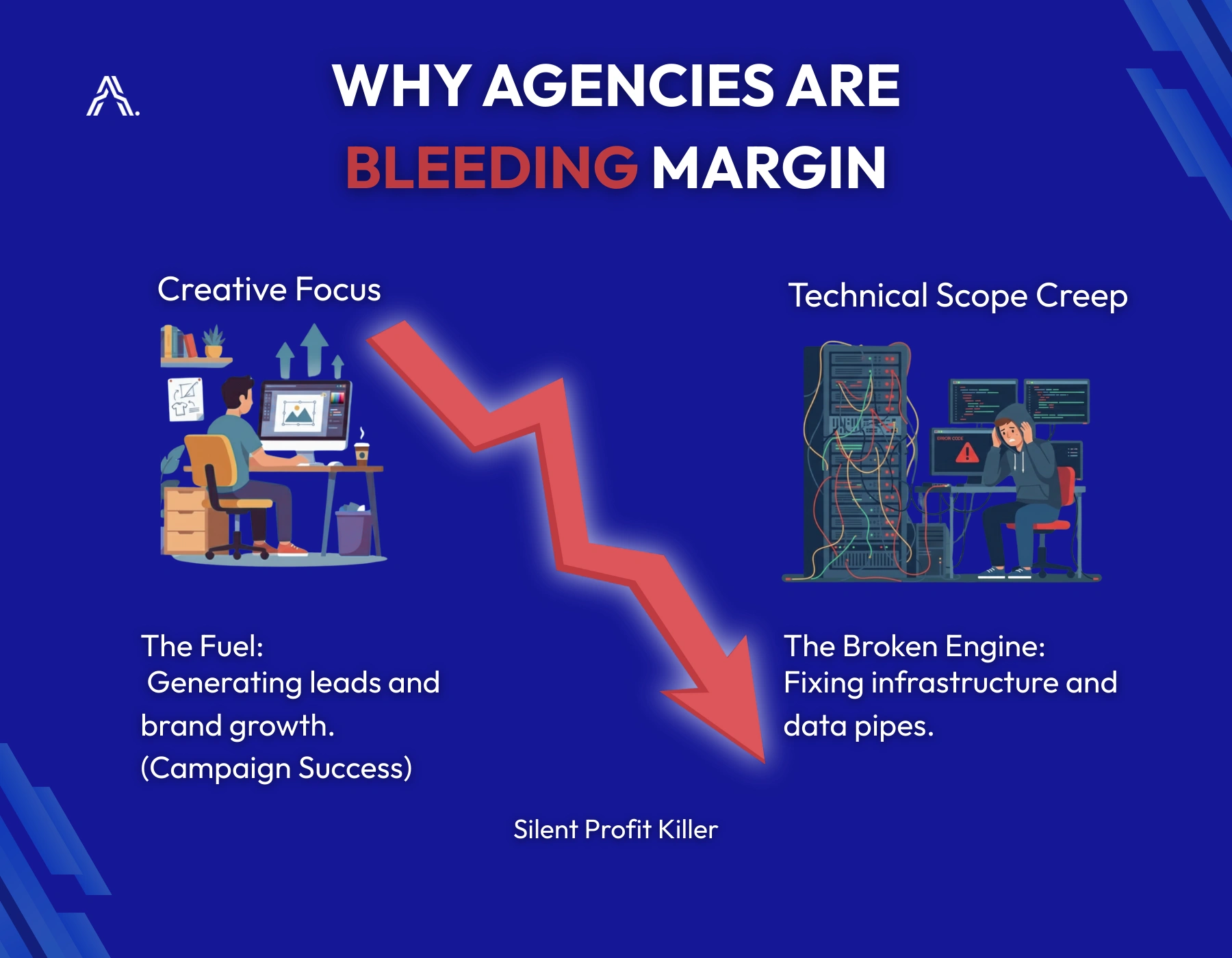
This is technical scope creep. It is the silent killer of agency margins.
What Is Technical Scope Creep?
Technical scope creep happens when a creative or advertising agency agrees to handle backend infrastructure tasks that fall outside their core competency. These tasks often seem small during the sales process but turn into massive time sinks during execution.
Agencies are great at strategy, copy, design, and media buying. They are usually not built for data engineering, API integration, or server management. Yet, clients expect modern campaigns to work across a dozen different software tools. When those tools don’t talk to each other, the client looks at you to fix it.
Common examples include:
- Fixing broken Google Tag Manager containers.
- Debugging API connections between Facebook Ads and a CRM.
- Migrating email lists from Mailchimp to HubSpot.
- Setting up server-side tracking because browser pixels stopped working.
The Math Behind the Loss
The problem isn’t just that these tasks are annoying. The problem is that they destroy your unit economics.
Let’s look at the numbers.
Suppose your Senior Strategist bills out at $200 per hour. Their job is to plan campaigns that generate ROI. If they spend five hours trying to fix a broken Zapier integration, that is $1,000 of billable time erased.
It gets worse. Because they are not engineers, the task takes them five times longer than it should. An expert could fix that integration in 30 minutes. Your strategist takes all afternoon.
You are paying a premium rate for amateur technical work.
If this happens once, it is an annoyance. If it happens across 10 clients every month, you are bleeding six figures a year in lost productivity.
The Scope Creep Calculator
Use this simple formula to quantify how much technical scope creep is really costing your agency:
Unbilled Technical Hours × Fully Loaded Hourly Rate = Monthly Margin Leak
Here’s what that looks like in real terms:
- 20 unbilled technical hours per month
- × $150 fully loaded internal hourly rate
- = $3,000 per month in lost margin
- = $36,000 per year in silent revenue loss
Now multiply that across:
- Multiple strategists
- Multiple clients
- Multiple months
This is how agencies quietly lose six figures a year without ever seeing a red flag on a P&L.
If this happens once, it is an annoyance. If it happens across 10 clients every month, you are bleeding six figures a year in lost productivity.
Why Agencies Say “Yes”
Most agency owners know this is a problem, yet they keep agreeing to do the work. There are three main reasons why:
- Fear of the Halt: You need the pixel working to run the ads. If you don’t fix it, the campaign stops, and you don’t get paid your media management fee.
- The “Just One Thing” Trap: It starts with a simple request. But backend tech is messy. One fix often breaks something else, and suddenly you own the entire infrastructure.
- Lack of Resources: You don’t have a data engineer on staff because you can’t justify a $120,000 salary for sporadic work. So, the burden falls on the creative team.
How to Stop the Bleeding
You need to draw a hard line between “Campaign Strategy” and “Technical Infrastructure.”
Your agency provides the fuel (the creative and the ads). The client needs to provide the engine (the tech stack). If their engine is broken, you should not be the one down in the grease trying to fix it for free.
Here is the new playbook:
- Audit Before You Sign Don’t wait until onboarding to find out their data is a mess. Use a simple intake process to check their tech stack. If their tracking is broken, flag it immediately.
- Productize the Solution Instead of doing the work for free, sell it. Create a “Technical Onboarding” package. If they need their CRM connected, that is a specific service with a specific price tag.
- Get a Technical Partner You don’t need to hire a full-time engineer. You need a partner who speaks your language but knows the code.
The Bottom Line
Your margins depend on efficiency. Every hour your team spends fighting with software is an hour they aren’t spending on the creative work that actually retains clients.
Stop treating technical infrastructure as a favor. Treat it as a specialty. Your bank account will thank you.