

Your ads look profitable. Your bank account disagrees. That gap is not bad luck.
It is what happens when teams scale on ROAS instead of profit. ROAS makes dashboards feel safe. Profit decides whether the business survives. When those two drift apart, most teams keep trusting the dashboard. That mistake gets expensive fast.
ROAS Answers the Wrong Question
ROAS asks a simple question: For every dollar spent on ads, how much revenue came back? It sounds reasonable. It is also incomplete. ROAS does not care about your cost of goods, your shipping rates, or your return fees. It does not care about refunds or payment processing fees. You can hit a strong ROAS and still lose money on every single order.
This is why marketing teams celebrate while finance teams worry. Both are reacting to the data they see, but ROAS hides the costs that matter most. If you keep ignoring these hidden costs, you will end up bleeding margin on technical scope creep.
POAS vs ROAS Explained
POAS stands for Profit on Ad Spend. It answers the question ROAS avoids: How much profit did ads actually create? Making the shift from POAS to ROAS means revenue and cost must live in the same equation. That changes behavior.
The POAS Formula
Financial models and business intelligence tools prioritize this mathematical definition:
POAS = (Actual Sales / Average Sales) x 100
This formula is concrete. It leaves no room for optimism.
While ROAS shows efficiency, POAS shows reality. Here is the thing: If ROAS is the scorecard, POAS is the bank statement. ROAS lives above the water. Profit lives below it. When shipping costs rise or returns spike, ROAS stays calm. Profit does not.
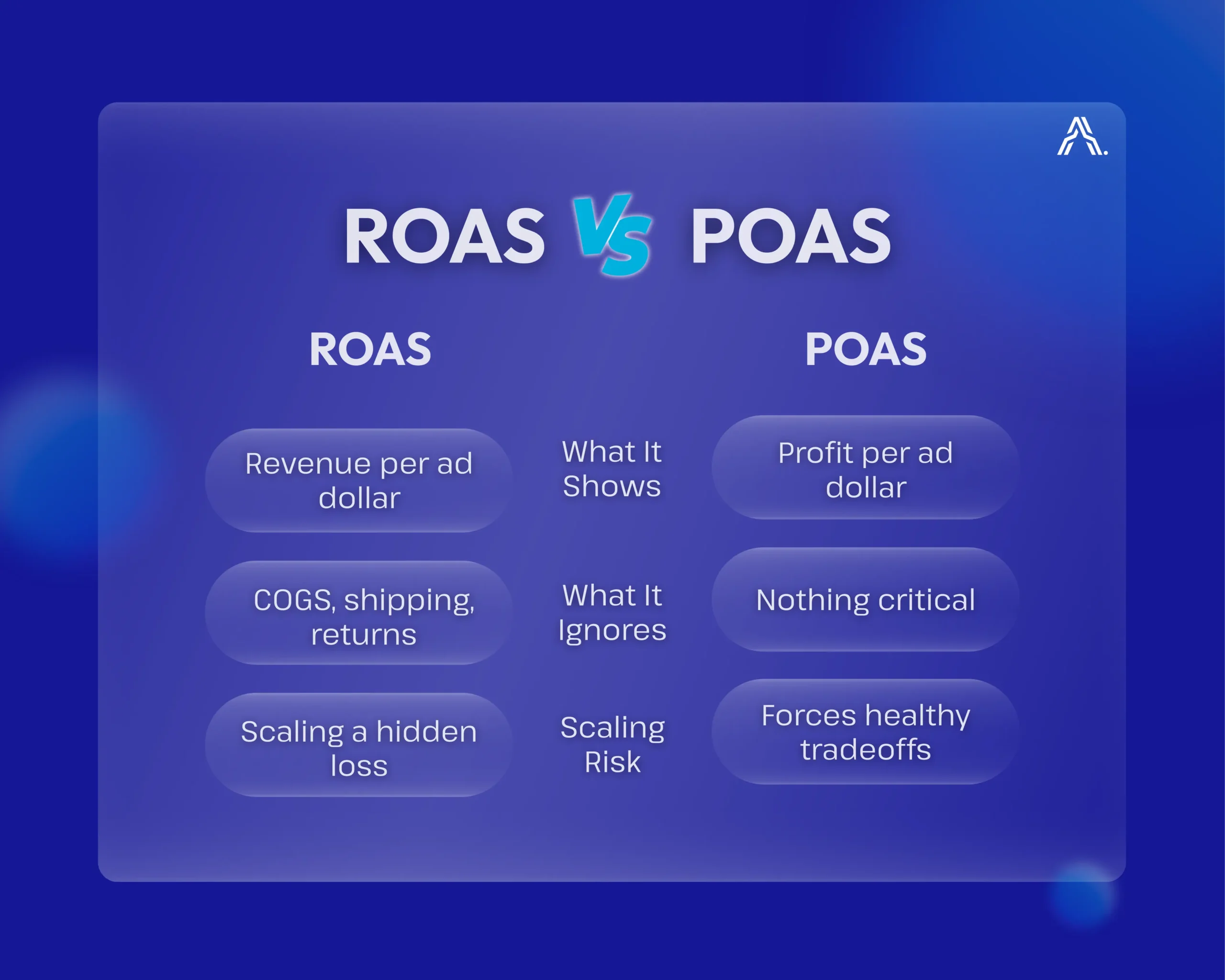
If ROAS is the scorecard, POAS is the bank statement.

ROAS lives above the water. Profit lives below it. When shipping costs rise or returns spike, ROAS stays calm. Profit does not.
Why Ecommerce Feels This Pain First
Margins are thinner than they were two years ago. Shipping costs move weekly. Returns are higher. Discounts are expected. Ads did not suddenly break. The cost stack changed.
ROAS did not adjust for that, and it never will. This is why brands hit revenue records and still feel squeezed. The metric they trust does not reflect the business they are running.
Why Most Teams Cannot Track POAS Today
This is not a lack of effort. It is a data problem. Revenue events are easy to capture, every platform sees them. Costs live elsewhere. COGS sit in inventory systems. Shipping lives in fulfillment tools. Returns show up weeks later. Most analytics stacks never bring these together. This is a primary reason for the ‘Franken-Stack’ problem.
Teams optimize what they can see and ignore what they cannot. That works until scale exposes the gap. This isn’t magic. It’s engineering, done right.
Why Profit Metrics Change Decisions
Once profit is visible, behavior changes quickly. Ads that looked strong get paused because the margin is thin. Ads that look average get scaled because the profit is solid. Discounts get questioned instead of repeated. Shipping thresholds get tested instead of guessed.
This is where marketing stops being a cost center and starts acting like finance. This shift happens because the data changed, not the people. If you don’t make this move, you are just going to optimizing based on hallucinations.
Quality Comes Before Profit
Profit math built on broken tracking is worse than no math at all. If conversions are already missing due to iOS, ad blockers, or bad deduplication, your POAS to ROAS numbers are wrong before you start. This is why profit tracking depends on delivery quality. You need clean conversion delivery first, then you layer cost data on top.
The Role of the Data Layer
Your data layer is not just for pixels. It is the only place where revenue and cost can meet. To support the transition from POAS to ROAS, the data layer needs to handle more than purchases. It needs to carry:
- Product level COGS
- Shipping cost by order
- Return flags when they occur
This data does not need to be perfect, it needs to be consistent. Consistency beats precision when decisions are made at scale.
From Marketing Data to Business Data
The difference is simple:
- Marketing Data: Clicks, Impressions, ROAS.
- Business Data: Revenue, Costs, Profit.
POAS sits at the intersection. That is why it matters.
Why This Changes How You Scale
Scaling on ROAS rewards volume. Scaling on POAS rewards discipline. POAS makes tradeoffs visible. It forces conversations between marketing and finance that usually happen too late. That tension is healthy. It keeps growth tied to reality.
The goal is not to kill ROAS. It still has a place. The goal is to stop pretending it tells the full story
The Uncomfortable Truth About Metrics
Most teams use ROAS because it is easy to explain and easy to defend. Profit is harder. It exposes mistakes. It shows when growth is hollow. That is why it gets delayed. But the teams that scale long term do not chase comfortable numbers. They build systems they can trust, even when the numbers force tough calls.
The Metric That Tells the Truth
ROAS is easy to report. POAS is harder to calculate. That is exactly why it matters. If your metrics cannot see margin, they cannot guide decisions. If the data feeding them is incomplete, no dashboard will save you.
This is not a marketing problem. It is a systems problem. The teams that scale do not chase prettier reports. They build data they can stand behind, even when it challenges assumptions. You have to decide between Segment or GA4 based on what helps you see the profit. Because profit does not need optimism. It needs accuracy.