Case Study·Ongoing Partnership·Shipping Containers · Industrial B2B Ecommerce

Building the Central System for a 30-Year Shipping Container Retailer

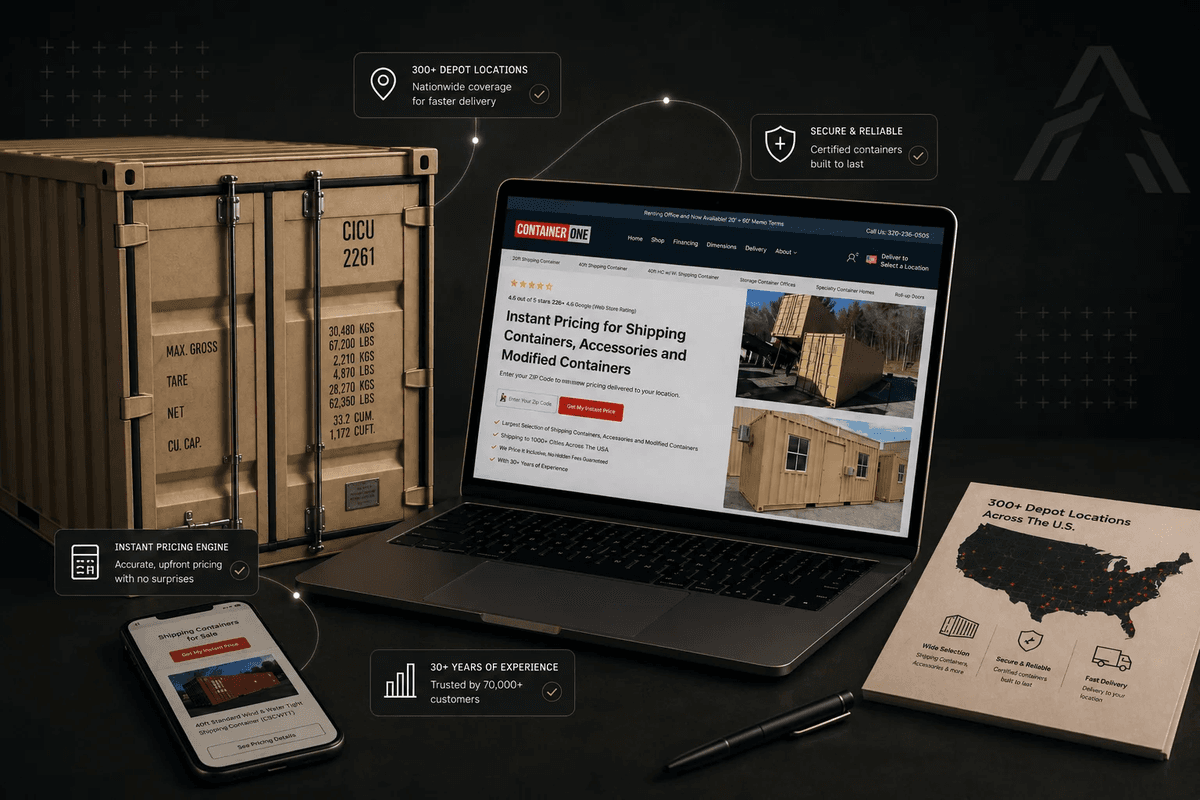
Container One sells shipping containers across 300 depot locations to 70,000+ customers. The Shopify store ran on a custom PHP stack that had been working for years, with pricing for the whole network living in a Google Sheet and shipping costs being calculated by legacy logic that quietly lost the business a few hundred dollars on every order.

We started with Memox, our AI sales assistant. Then we patched the pricing leak, closed the critical security gaps, and got version control in place. Now we are building Container One Hub, the central system that replaces the whole custom stack underneath the store.

70K+
Customers served
300
Depot locations
30+ Years
In business
Let's Talk About Your Stack
The Challenge

Container One has been selling shipping containers for more than thirty years. They serve over 70,000 customers and ship out of 300 depot locations across the US. Most of what they sell is priced by where the customer is. Different ZIP code, different depot, different price.

That logic was being handled by a custom PHP application running alongside the Shopify store. The app worked. It had been working for years. It handled location-based pricing, custom checkout, order processing, and the sync to the CRM. The team running it had built something real.

The cracks showed up once we looked closely. Pricing for all 300 depots lived in a single Google Sheet. The sync from the sheet to Shopify ran manually, which meant prices on the site were often stale. The shipping cost logic inside the PHP app was overestimating costs in a way the team had not caught, and Container One was losing a few hundred dollars on every order to bad math. Customer ZIP codes were getting looked up against Google Maps from scratch on every visit, with no caching, which was costing four thousand dollars a month for work that should have cost a small fraction of that.

The engagement started because Container One wanted an AI sales assistant. We built and shipped Memox. The moment we started integrating it properly, the architectural fragility underneath surfaced. The story stopped being about a chatbot and started being about the foundation everything sat on.

Container One needed more than an AI feature. They needed a central system that everything else could plug into reliably.

Pricing Lived in a Spreadsheet

Prices for 300 depot locations were managed in a single Google Sheet. A bad edit could affect the whole network. The sync to Shopify ran manually, so prices on the site were often stale.

Shipping Costs Were Being Miscalculated

The legacy PHP logic was overestimating shipping costs on every order. The team had not caught it because the math was buried in old code. Every shipment was leaving money on the table.

Four Thousand a Month in API Waste

Every customer who entered a ZIP code triggered a fresh Google Maps lookup against hundreds of nearby ZIPs. Nothing was cached. The same lookup ran from scratch on every visit, on every device, across every session.

A Foundation That Would Not Hold AI on Top

The team wanted to build AI features on top of the store. Voice agents, automated pricing, intelligent depot routing. None of that runs reliably on a stack of disconnected tools and a Google Sheet. The vision was right. The platform underneath was not ready.

The Build

Engineering Container One Hub

The work runs in two tracks. Some things needed to ship the moment we found them. The bigger build, Container One Hub, is the central system that replaces the custom PHP stack with a clean foundation everything else can sit on.

Memox AI Sales Assistant

Shipped. The original scope. A custom AI sales agent integrated into the Container One storefront. Handles repetitive inquiries, qualifies leads, and routes the complex conversations to the sales team. Live and running.

MemoxAI Sales AgentShopify Plus

Shipping Cost Logic Patched

Shipped. The legacy pricing logic was overestimating shipping costs on every order. We found it, fixed it, and pushed the patch live. Container One stopped losing a few hundred dollars per shipment to bad math.

PHP PatchPricing LogicLive Fix

Critical Security Exposures Closed

Shipped. The first weeks of the engagement closed several critical security issues that needed to come down immediately. The codebase was also moved into version control so every change from that point forward is reviewable and reversible.

Security HardeningVersion ControlGitHub

Container One Hub: The Central System

In progress. A central platform that replaces the custom PHP stack. Pricing, checkout, order processing, and the sync layer all run from one place. Built to be testable, observable, and ready to carry AI features on top.

Container One HubDjangoPostgresSQLCI/CD

Google Maps Cost Reduction

In progress. The ZIP-code-to-depot lookups are being rebuilt with caching and smarter query patterns. The goal is a 60% reduction in monthly Google Maps spend, which translates to a few thousand dollars back every month.

API OptimizationCachingCost Reduction

Method CRM Decommissioning

Planned. Container One has already moved to HubSpot. The Method CRM integration that the old PHP stack relied on is dead weight. The migration removes it cleanly, with no manual cleanup required after.

Method CRM RetirementSystem DecommissioningHubSpot
The Results

Not a project. A partnership.

LIVE
Memox + Pricing Fix Shipped
CLOSED
Critical Security Exposures
IN-PROGRESS
Container One Hub
60% Target
Google Maps Cost Reduction

Revenue Stopped Leaking

The shipping cost patch went live early in the engagement. Container One stopped losing a few hundred dollars on every order to legacy pricing logic. The website now reflects pricing the business actually wants to charge.

The Foundation is Being Rebuilt

Security exposures are closed. The codebase is in version control. Container One Hub is in active development. The store stays live the whole time, and every phase ships independently to staging before touching production.

The Path to AI Features is Clear

With the foundation stabilizing, the team can move on the AI roadmap Glenn has been talking about. Voice agents, automated pricing, intelligent depot routing. Built on a system that will not break when somebody edits a spreadsheet.

CO-casestudy
Adding new products is hell with the current setup. We want to eventually move pricing management out of Google Sheets entirely.
GT
Glenn Taylor
Owner, Container One
Frequently Asked

Questions About This Engagement

What does Shopify Plus development for B2B look like in practice?

Shopify Plus development for a B2B operator like Container One means building around the way the business actually prices and sells. For a shipping container retailer with 300 depot locations, that means location-based pricing logic, a custom checkout that respects delivery-adjusted prices, an AI sales assistant for inbound inquiries, and a central system underneath that ties pricing, orders, and CRM together reliably.

What is Container One Hub?

Container One Hub is the central system Autonomous is building for Container One. It replaces a custom PHP stack with a clean platform that handles pricing, checkout logic, order processing, and the sync layer between Shopify and the CRM. The hub is the foundation Glenn's team can build AI features on top of without the whole thing breaking.

Why migrate off a custom PHP stack?

The PHP application that ran Container One's pricing and checkout was built before modern frameworks became standard. It worked, but it had no test coverage, no staging environment, no rollback, and no separation of concerns. Replacing it with Container One Hub gives the team a maintainable codebase, automated background jobs, and a clean foundation for AI features.

How can a Shopify store cut Google Maps API costs?

By caching results and writing smarter queries. If your store uses Google Maps to find the nearest depot or warehouse based on a customer's ZIP code, those results rarely change. Storing them and reusing them, instead of recalculating from Google on every visit, can cut the API bill by 60% or more. For Container One, that means several thousand dollars back every month.

Can Memox integrate with an existing Shopify Plus storefront?

Memox is Autonomous's AI sales assistant, built to work as a widget on Shopify storefronts and integrate with backend CRMs and customer data sources. For Container One, Memox sits on the storefront, handles inbound questions, qualifies leads, and routes complex conversations to the sales team without adding headcount.

Is the Container One engagement complete?

No. The engagement is ongoing. Memox is live, the shipping cost bug is patched, and the critical security exposures are closed. Container One Hub, the central system that replaces the legacy stack, is in active development. The store stays live throughout.

Let's talk about your stack.

If you're running operations on spreadsheets and disconnected systems, we've seen this before. And we know how to fix it. Not as a vendor. As your long-term business engineering partner.

Let's Talk About Your Stack ← See all case studies
Built For
Shipping Containers · Industrial B2B EcommerceOperations-Heavy Businesses
Tech Used
Shopify PlusContainer One HubDjango REST FrameworkGitHub Version ControlRedis CachingPostgreSQLHubspotMemox AI Sales Assistant
Partnership Length
Ongoing Partnership
Not a project. A partnership.