You ask what a goda rebuild needs, in the words a Karachi workshop uses. Goda is Urdu slang for the steering knuckle. A useful reply names the parts and shows where each came from: a manual page, a forum thread or a video minute. LC80 Brain gives that reply. It is our own product, not public. Autonomous Technologies, a Shopify systems agency, built it for the Toyota Land Cruiser 80. Rizwan Qaiser, our founder, uses it on his own truck. It answers only from sources it can cite. Otherwise it says it does not know. Its launch test with outside users has not run yet.
| Measure | Result | When measured |
|---|---|---|
| Internal test questions with a matching passage in the top five results | 20 of 20, target 18 | Rerun 23 September 2026 |
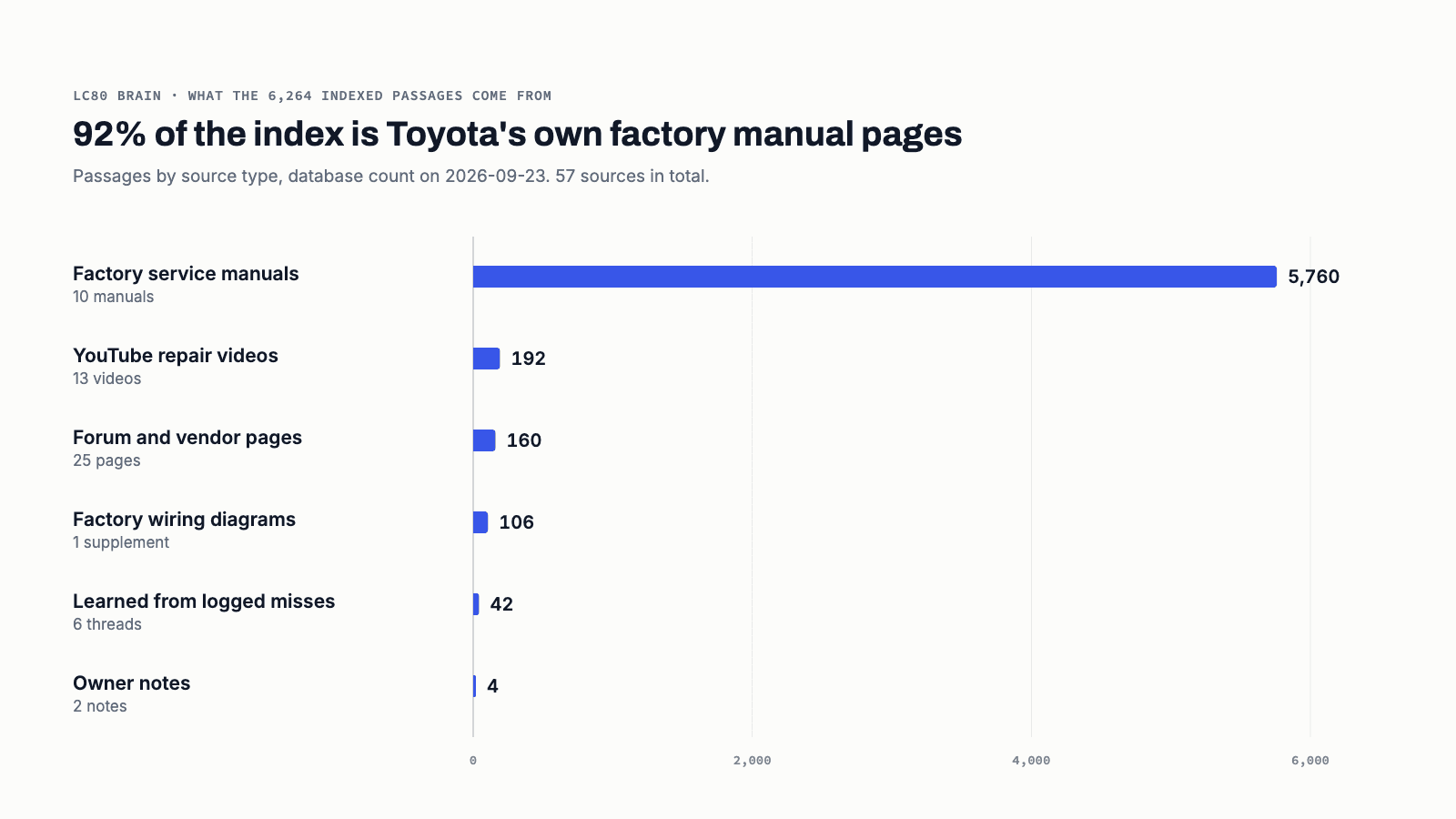
| Passages in the index | 6,264 from 57 sources | Database count, 23 September 2026 |
| Automated tests passing | 56 of 56 | Test run, 23 September 2026 |
| Questions from strangers, of the 100 the launch gate needs | 0 | As of 23 September 2026 |
A confident answer without a page is a risk in a workshop
If you work on these trucks, your questions are short: what torque, which part, how much oil. The answers are not. The right torque figure sits inside a manual of more than 1,000 pages. The forum thread that explains a failure can run for pages. A quick answer with no source leaves you guessing.
A wrong figure costs you a stripped thread, a wrong part ordered, or a job done twice. So the answer you want is one you can check against its source in seconds.
The same problem shows up in any business that answers customers from manuals. The reply is fast, but nobody can say where it came from.
Names got in the way too. The same truck is Burbuja in Venezuela, Sahara in Australia and LX450 in the US. Mechanics name parts in their own language. A search that only knows the manual’s words misses both. The fix is an alias: an extra word the search treats as the same thing.
Answers must cite a source, or the system says it does not know
A cite-or-refuse knowledge base answers only when it can point to its source. Otherwise it says the question is not covered.
Rizwan designed the system. He hunted down the manuals and, as a native speaker, added the Urdu slang himself. The index is the searchable copy of every source. It holds 10 factory repair manuals and one wiring diagram supplement. It also holds 13 repair videos with timestamps, plus chosen forum and vendor pages.
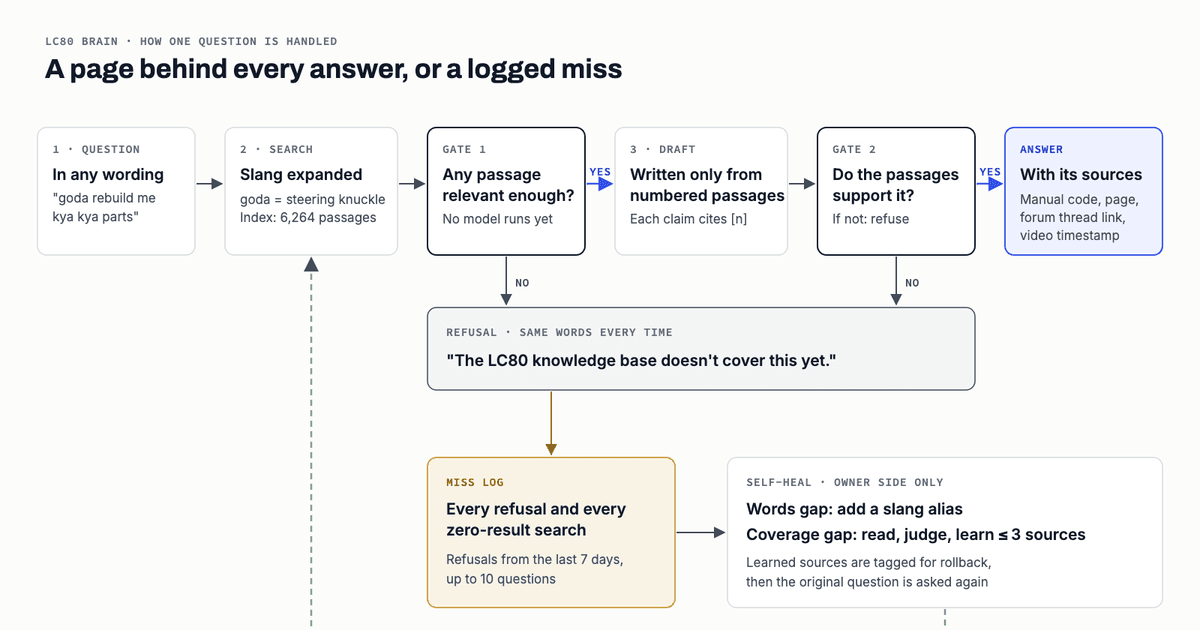
A question passes two gates before you see an answer:
- Relevance floor. Your words are expanded first, so goda also searches for steering knuckle. If no passage scores above a fixed floor, the system refuses. Nothing gets written.
- Support check. A language model writes the reply only from the numbered passages it is handed. If they do not support an answer, it must say so. You get the refusal instead.
A passing answer carries its sources: the manual code and page, a forum link, or a video at the exact minute. Manual pages are never served as files. The answer uses plain words and cites the page.
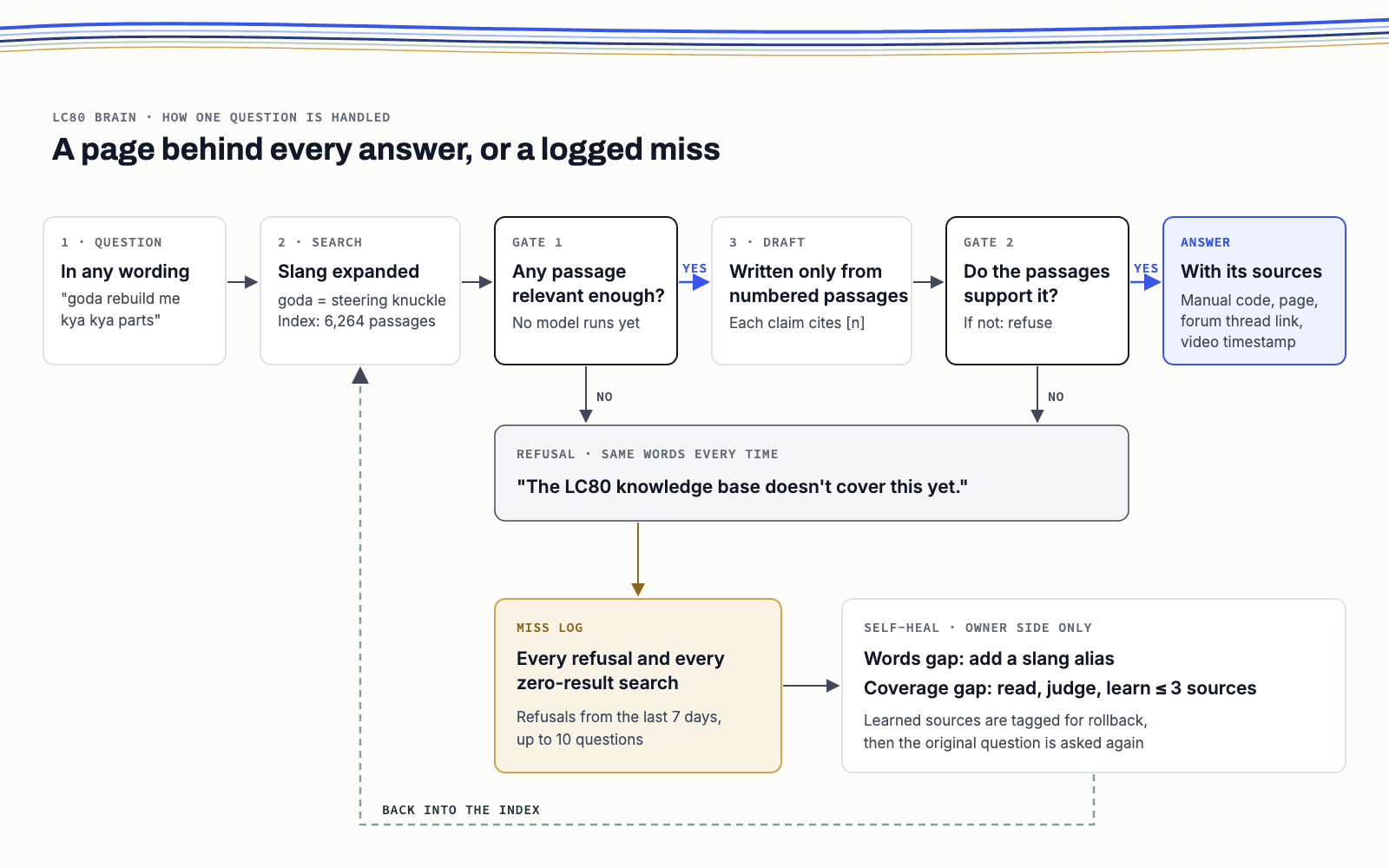
The rule is no source, no answer. A refusal costs you a minute and gets logged. An invented torque figure costs you a part, and nobody finds out why.
One logged refusal became a cited answer four minutes later
Refusing is only useful if the gaps close. So every refusal and every search with zero results is written to a miss log.
On 27 August 2026, a question about a 1HD-FTE swap dropping into limp mode was refused three times. The 1HD-FTE is a Toyota diesel engine. Limp mode is when the engine cuts power to protect itself. The manual calls it fail-safe mode. We added that alias and changed how the answer step decides to refuse. Five minutes after the first refusal, the question returned a cited answer.
On 1 September 2026, a question about engine-bay foam insulation was refused twice. The words were wrong and the sources were thin. “Bonnet” and “foam insulation” did not match the index’s terms, “hood” and “hood insulator”. Three aliases fixed the words. Forum threads on hood insulation, read and judged first, were also added to the index. Four minutes after the first refusal, the question was answered.
That same morning, the fix became a script. It collects up to ten misses from the last seven days. For each one it adds an alias, or learns at most three sources it judges trustworthy. Then it asks the question again. Learned sources carry a tag, so any of them can be rolled back.
| Question or measure | Before | After | Measurement window |
|---|---|---|---|
| Limp mode on a 1HD-FTE swap | Refused 3 times | Answered; search now ranks the engine repair manual first | 27 August 2026, 08:44 to 08:49 UTC |
| Engine-bay foam insulation | Refused 2 times | Answered; learned forum threads now rank first | 1 September 2026, 04:07 to 04:11 UTC |
| Internal test set, 20 questions | Target 18 of 20 | 20 of 20 | 26 August 2026, rerun 23 September 2026 |
| Stranger questions answered with a citation | Gate: 80 of 100 | Not measured, none asked yet | As of 23 September 2026 |
Healing stays with the owner. On a public service, a stranger’s miss would queue for review. It would never add a source to the index by itself.
It is not public, and the gate that would prove it has not run
LC80 Brain runs on the founder’s own machine. A web chat and an invite-only WhatsApp pilot are built. Neither is hosted, and the pilot still needs its own phone number. The weekly schedule for the heal script is not switched on yet.
The launch gate is 100 real questions from strangers, with at least 80 answered and cited. That gate has not run. The internal test checks that the right passage is in the top five results. It does not grade the written answer.
What we would do differently, and who this is for
We would recruit the first ten outside mechanics before building the web chat. Their misses are what this system learns from. We would also grade written answers, not only search results.
If a wrong answer costs you a return or a callback, this fits you. It suits a parts counter, a service team or an equipment dealer whose staff answer from long technical documents.
It is not for you if you want a chatbot that always answers. It is also not for you if the answers are not written down yet. Thin documents mean frequent refusals, by design.
Questions and answers
Who built LC80 Brain?
Autonomous Technologies built LC80 Brain as its own product. Rizwan Qaiser, the founder, designed it for his own Land Cruiser and added the Urdu slang himself.
Is LC80 Brain available to the public?
No. LC80 Brain is not public: its web chat and WhatsApp pilot are built but not hosted.
How accurate is LC80 Brain?
LC80 Brain found a matching source passage for 20 of 20 internal test questions on 23 September 2026. There is no public accuracy figure, because the 100-question stranger test has not run.
Does LC80 Brain copy the factory manual?
No. LC80 Brain answers in plain words and cites the manual code and page, quoting only torque figures, part numbers and capacities exactly.
What happens when LC80 Brain does not know?
LC80 Brain says so in one fixed sentence and logs the question. Autonomous Technologies then adds a missing slang term or up to three trusted sources, and asks the question again.