A hosted vendor billed Memox $0.09 for every minute its agent spent on a call. Callers heard a second of dead air before the agent spoke. The only fixes on offer were three vendor switches and a dearer plan. On 19 January 2026 an engineer moved the speed setting to turbo, then back to base ninety minutes later. Nothing in that tool knew which state a number sat in. A customer could dial a list with no proof the call was lawful.
So Memox stopped renting. Three engineers spent five months moving the call path and the calling rules into code it owns.
| What was measured | Figure | Period |
|---|---|---|
| Continuous work on the phone path | 5 months | 28 March to 27 August 2026 |
| Changes, and how many were theirs | 122 of 122 | same period |
| State calling rules in the dialling code | 0 before, 18 plus a federal default after | before and after April 2026 |
Renting the call left the expensive parts out of reach
What Memox got back: a dialler that waits when a number is outside its lawful window and drops suppressed numbers before a dial, and a per-minute rate that is no longer a vendor’s list price. That is the outcome for sale here: the vendor bill you stop paying. Autonomous Technologies is the engineering firm that built it. We build and run the systems behind online stores and software products for the people who own them after launch. Memox is our own product, not a client brief. A business feeds it documents, puts it on its website, and it answers customer questions. Two paying customers, roughly $50k a year as of September 2026, none of it from the phone channel.
The rented tool went in on 11 September 2025 and kept taking repair work into February 2026. It broke twice in four days that December. The next vendor on the list cost $0.05 a minute, with the same limits.
If your product lets a customer upload numbers and dial them, you ship an outbound calling machine. A suppression list is the set of numbers you must never call. A calling window is the hours local law lets you call them. Before April 2026 the code had neither.
Three engineers took five months to own the whole call path
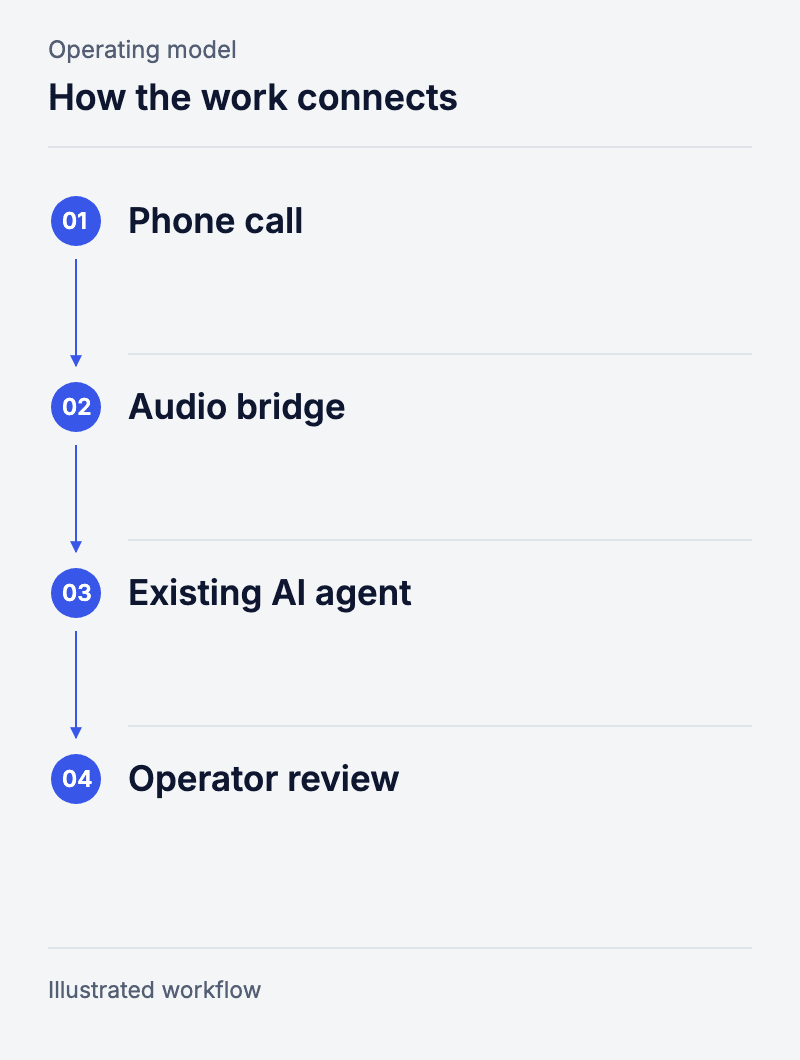
Most of AI voice agent development is not the model. It is the call path: the phone line, the sound bridge that carries audio between the line and the model, and the rules. A lead backend engineer wrote 83 of the 122 changes. The founder wrote 27 and kept the hardest sound problems. Abdullah, a founding engineer, wrote 12.
The phone company choice removed work. Telnyx is the carrier that connects the calls. It sends sound in the shape the model expects, so the converting step is one line. A second choice bought back the worst second of any call. The model connects and the greeting is ready while the phone still rings.
The rule this build runs on: if a sound library is missing, the audio still goes through. If a consent record is missing, the campaign stops.
The dialer will not place a call it is not allowed to place
Between picking a contact and dialling it, two checks run: the suppression list, then the calling window. Neither can be skipped.
The window rules are code, not a policy document. Eighteen state rules are stricter than the federal default. Twenty-seven automated tests hold the values. Maine is weekdays only. Rhode Island bans Sunday calls.
The system works out which state a number sits in. It maps 316 area codes to states, and 51 states and districts to timezones. A number outside its window waits for the next lawful moment.
No campaign starts until someone records that consent was obtained. Outbound calling stays locked until a business verifies itself. The launch screen makes the operator read who carries the legal risk.
When a list is uploaded, the import step checks each number’s format. It scrubs the list against the suppression list and removes duplicates before a single dial. Two dialling processes on the same campaign cannot dial one contact twice. A contact is locked the moment one of them picks it up. The rented dialler gave us no way to prove any of that. Source: Memox voice-app import and campaign code, read 20 September 2026.
What renting gave you, against what owning gave you
| What was measured | Renting, Sept 2025 to Feb 2026 | Owning, Mar to Aug 2026 |
|---|---|---|
| Rate per minute | $0.09, the vendor's list price | $0.030 modelled pre-build, never billed |
| Suppression check before a dial | none | internal list live, two layers still placeholders |
| State calling rules enforced | none | 18 plus the federal default, 27 tests |
| Tests guarding the call path | 0 | 1,012 plus 15 browser tests |
| Calls placed, answer rate, cost per minute | not measured | not measured |
The noise filter shipped switched off, deliberately
The echo and noise filter is real work, and it is switched off. A sample is one slice of sound. The filter hands sound back in blocks of 256 samples, but a phone line feeds it blocks of 160. Wired together directly, most of the sound comes back empty and the call goes silent.
A holding step now evens the two sizes out, at about 16 milliseconds of delay. That closed one of four activation gates. An activation gate is a named test a feature must pass before it is switched on. Three stay open: measured echo, a speed ceiling, and a tested rollback.
One outage is on the record. The phone company’s software dropped the helper that checked incoming call events were genuine. Inbound calls stopped. Abdullah wrote the check himself and merged it at 14:30 on 15 June 2026. Nobody recorded how long it was down.

One gate of four is closed, so the feature ships switched off.
What we would do differently, and who should not build this
Put a source, an owner and a review date on every state rule. Today nothing says who sourced each rule.
Wire the opt-out, a caller asking never to be called again, straight to the suppression list. Today it travels through the job that syncs to the customer database, which stops early when no such database is connected.
Record a cost and delay baseline on the first real call. The $0.030 a minute is a model nobody has held against a bill.
Build this if you place calls into a regulated market and carry the liability. Build it if your vendor cannot show where the check runs. What you buy back is the unlawful call you never place and the rate you stop paying: work worth owning rather than renting. Related: the embedded team on this platform.
Do not build this if you need a line answering next week, or place a few hundred calls a month. Rent one.
Questions and answers
What does AI voice agent development involve beyond the model?
A phone company, a sound path that matches the model, and handling for when a caller interrupts. The model is a small part of the bill.
Does this build make you compliant with US calling law?
No, and nothing here says it does. The software turns an operator’s own rules into checks the code runs. The launch screen says the operator accepts legal responsibility. No record shows a lawyer reviewed it.
Did the phone product go live with a paying customer?
Not that any record shows. The launch checklist has ten unticked boxes. No call volume, answer rate or cost exists to quote.