A support agent follows the assistant and refunds an order that should have been exchanged. The procedure it quoted was withdrawn in March. Nobody removed it from the index, the searchable store of your documents, so it is still the closest match. The assistant broke none of its own rules, and that is the problem.
The short answer. A RAG pipeline finds approved source material for a question and supplies it to a language model so the answer is grounded in that material. Three things decide whether it holds up in production: the architecture, meaning the indexing and answer paths; the evaluation set somebody keeps; and the production controls, meaning access filtering, citations and a set way to act when evidence is weak. An embedding model and a chat box are not a pipeline.
RAG stands for retrieval-augmented generation. Retrieval means finding the records that fit. Grounded means the answer is held to what was found. The language model is the software that writes the answer. The original RAG paper framed it as a model’s own knowledge plus fetched outside memory. In a company the question is blunter. Can the user see which approved record backs the answer? Can the system say it does not know?
One wrong answer costs a refund, a reopened ticket and an hour of a manager’s day. Autonomous Technologies is an engineering firm that builds and runs the data and AI systems behind Shopify stores and commerce businesses. Our clients are founders and operators who answer for what a customer is told. Our engineering work on assistants starts with the source boundary. Most bad answers we are asked to explain trace back to a document that should not have been in the index.
This is for whoever answers for the wrong answer
Read this if you are building or buying a knowledge assistant, support copilot or internal search over company content. It is for whoever has to explain a wrong answer to a customer. It assumes the content exists and somebody publishes it.
Skip this if the procedures are not written down, or nobody owns them. Retrieval will surface that mess at speed. Fix the source of truth first.
What is a RAG pipeline?
A RAG pipeline has two paths. The indexing path turns approved source material into records you can retrieve. The answer path takes a question and fetches only the records that user may see. It then picks the usable evidence and asks the model for an answer limited to that evidence.
The promise is traceability, not omniscience. If a policy changed, the pipeline should surface the current approved version and name its source.
- Stage
- Source intake
- Responsibility
- Accept approved content. Record owner, version, access policy.
- Evidence to retain
- Source id, change time, owner, permissions.
- Stage
- Prep and indexing
- Responsibility
- Parse, cut up, enrich, index. Keep provenance.
- Evidence to retain
- Parser version, chunk map, index version.
- Stage
- Retrieval
- Responsibility
- Find candidate evidence for this user and question.
- Evidence to retain
- Query, source ids, filters, scores.
- Stage
- Response
- Responsibility
- Bound the answer by the evidence and the policy.
- Evidence to retain
- Model and instruction version, citations, state.
- Stage
- Evaluation and operations
- Responsibility
- Test behavior. Catch regressions. Improve under change control.
- Evidence to retain
- Test run, incident record, owner, release call.
| Stage | Responsibility | Evidence to retain |
|---|---|---|
| Source intake | Accept approved content. Record owner, version, access policy. | Source id, change time, owner, permissions. |
| Prep and indexing | Parse, cut up, enrich, index. Keep provenance. | Parser version, chunk map, index version. |
| Retrieval | Find candidate evidence for this user and question. | Query, source ids, filters, scores. |
| Response | Bound the answer by the evidence and the policy. | Model and instruction version, citations, state. |
| Evaluation and operations | Test behavior. Catch regressions. Improve under change control. | Test run, incident record, owner, release call. |
Start with a source and user boundary
The first decision is what the assistant may know. Start with one narrow collection that has an owner and a change process. Published support articles will do. Do not index every shared drive. Broad intake mixes stale, private and clashing material before you can see how retrieval behaves.
Permissions travel with the content. A user who cannot open a document at source must not get it from the assistant. That is a retrieval rule, not a filter bolted on after the answer.
The Google Cloud RAG Engine overview sets out a managed flow, one a vendor runs for you, in five steps: ingest, clean and chunk (cut into retrievable pieces), index, retrieve, generate. A managed service still does not replace your source ownership.
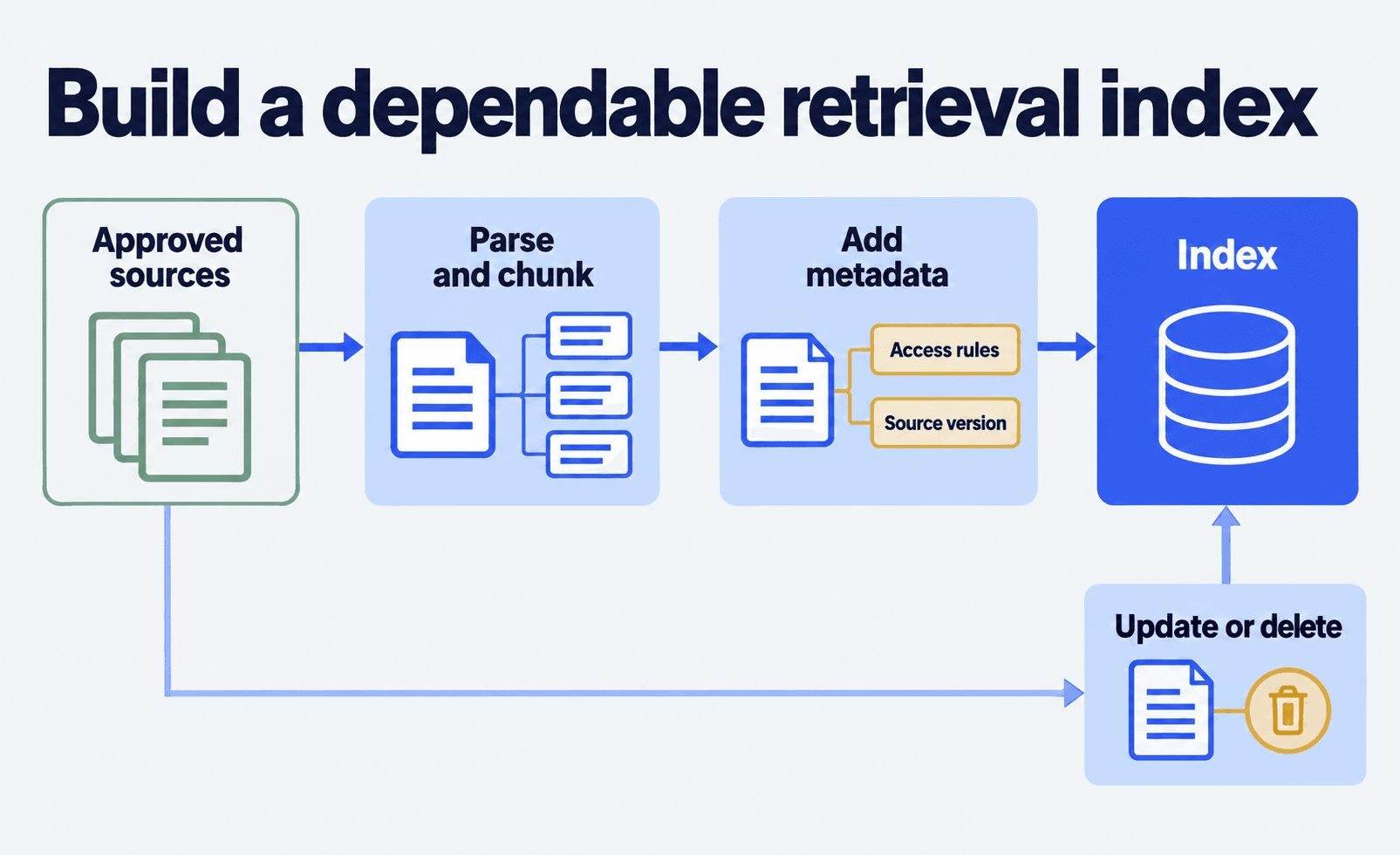
Build the indexing path for evidence, not just similarity
Preparation shapes what the system can later cite. Keep the title, source link, section heading, version, owner, access labels and a stable pointer to the original. Cut material at real boundaries where you can: headings, steps or product sections. A chunk is one retrievable piece of a document. Cutting chunks at a fixed length can split a rule from the condition that makes it safe.
Metadata is the set of labels on each chunk, such as owner, version and market. Metadata makes filters possible. A policy assistant may filter by country, unit, product version and published state. A support assistant may filter by plan and language. Store only the filters an owner can fill in and keep true. Half-filled metadata creates false confidence, because it drops the right source in silence.
Freshness needs a defined behavior. Decide how the system learns that a source changed and how often it re-indexes. Decide what users see for content not yet indexed. If a source is withdrawn, the pipeline must stop retrieving it.
Make the answer path selective and explainable
The answer path is a run of decisions. Read the question. Apply the permission and scope filters. Fetch candidates. Rerank them, which means re-ordering the candidates with a closer read. Judge whether the evidence is enough. Then answer with citations, or fall back to a safe reply.
Illustrative retrieval path
Indexing preserves evidence; the query path decides whether that evidence is usable for this person and question.
Indexing lane
Query retrieval reads this index →
Query lane
Do not refuse every answer whose similarity score is low. That score is a number for how close a record is to the question. Score ranges differ by model, index and corpus, which is your whole body of documents. Test real question types instead. Then define what the product does in each failure state: no source, clashing sources, stale source, blocked source, and a vague question.
Make the evidence legible. Name the source so the user can judge it. A citation is not proof the answer is right. It gives the user a way to check.
Grounded means the answer is constrained by retrieved evidence. It does not mean the source is current, complete or right for every user.
Evaluate RAG as a system, not a chat demo
Judge the whole pipeline, from source record to the answer a user reads. Check four things on each example. Did the right source come back? Does the citation point at the text? Does the answer stay inside the evidence? Did the fallback fire when it should? An answer can sound fluent and cite the wrong document. It can cite the right one and add a step that is not in it. It can find the right text and show it to the wrong person. Each of those needs a different fix.
- Question type
- Clear answer in one approved source.
- Of a first 30
- 8
- A pass looks like
- right answer, citation on the section.
- Question type
- Answer needs a version or market filter.
- Of a first 30
- 6
- A pass looks like
- the filter runs before retrieval.
- Question type
- Two approved sources disagree.
- Of a first 30
- 4
- A pass looks like
- it names the clash, it does not merge it.
- Question type
- Source is withdrawn or stale.
- Of a first 30
- 4
- A pass looks like
- the record is gone, or the version is shown.
- Question type
- User may not see the source.
- Of a first 30
- 4
- A pass looks like
- nothing comes back, nothing is summed up.
- Question type
- Hostile text inside a fetched document.
- Of a first 30
- 4
- A pass looks like
- it is ignored, and the attempt is logged.
| Question type | Of a first 30 | A pass looks like |
|---|---|---|
| Clear answer in one approved source. | 8 | right answer, citation on the section. |
| Answer needs a version or market filter. | 6 | the filter runs before retrieval. |
| Two approved sources disagree. | 4 | it names the clash, it does not merge it. |
| Source is withdrawn or stale. | 4 | the record is gone, or the version is shown. |
| User may not see the source. | 4 | nothing comes back, nothing is summed up. |
| Hostile text inside a fetched document. | 4 | it is ignored, and the attempt is logged. |
- Signal
- Correct source retrieved
- What it shows
- Whether indexing and retrieval suit the question.
- Likely owner
- Data or search engineering.
- Signal
- Citation points at the text.
- What it shows
- Whether a user can check the claim.
- Likely owner
- Product and content owner.
- Signal
- Answer stays in evidence.
- What it shows
- Whether the response controls work.
- Likely owner
- AI engineering
- Signal
- Access boundary holds
- What it shows
- Whether permissions survive retrieval.
- Likely owner
- Security and platform owner.
- Signal
- Safe fallback fires
- What it shows
- Whether users are covered when evidence is thin.
- Likely owner
- Product owner and operations.
| Signal | What it shows | Likely owner |
|---|---|---|
| Correct source retrieved | Whether indexing and retrieval suit the question. | Data or search engineering. |
| Citation points at the text. | Whether a user can check the claim. | Product and content owner. |
| Answer stays in evidence. | Whether the response controls work. | AI engineering |
| Access boundary holds | Whether permissions survive retrieval. | Security and platform owner. |
| Safe fallback fires | Whether users are covered when evidence is thin. | Product owner and operations. |
Keep every change to the test examples recorded and open to review. Feedback from production is useful. It must not become ground truth, the answer key you grade against, on its own. A correction may reveal a missing source, an access problem, or a reader who misread. Review it before it changes a test set, an index rule or an instruction.
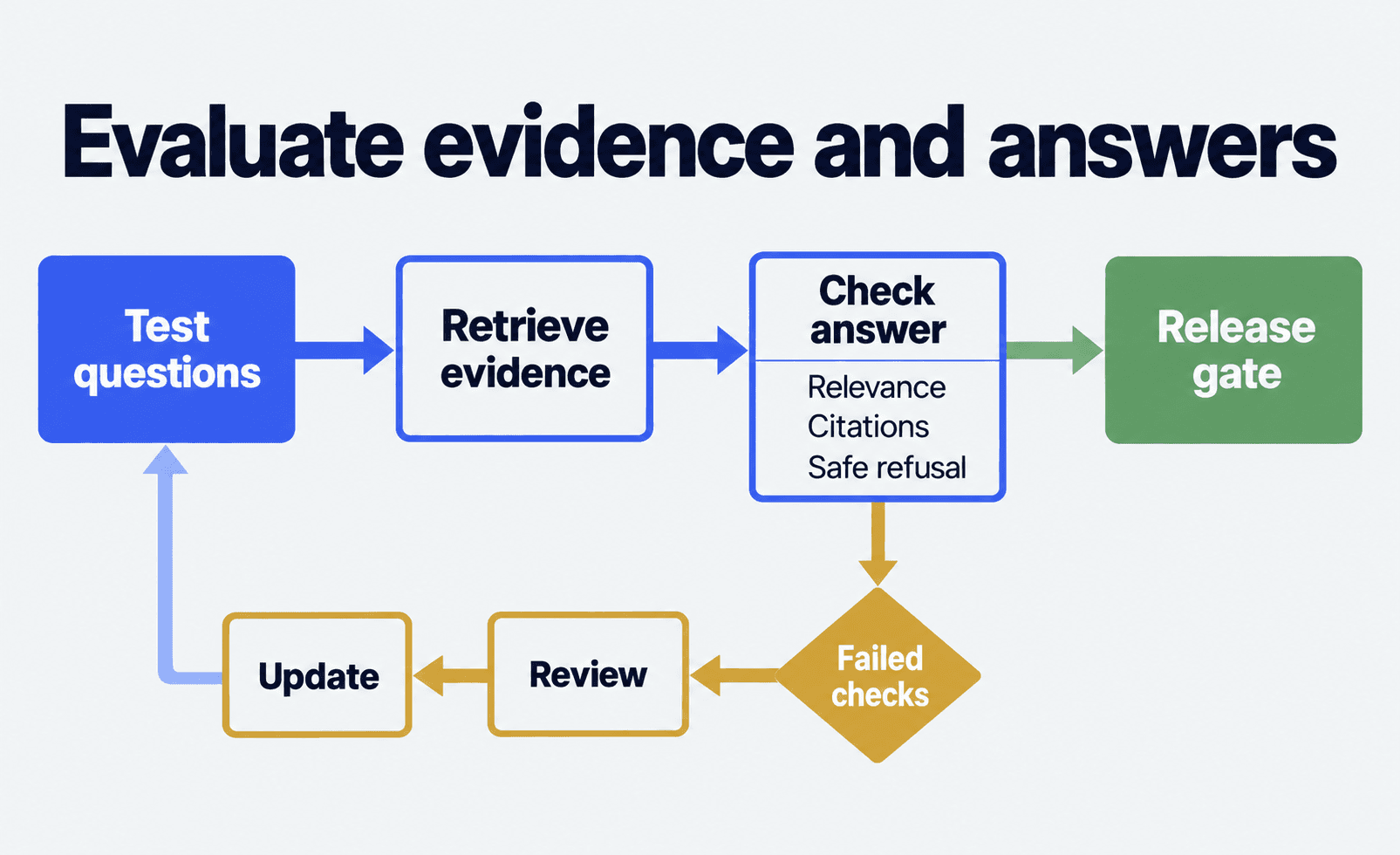
Security risks belong in the design
Retrieved content is untrusted input, even from an internal system. A tampered document can carry hidden instructions aimed at the model. That is prompt injection. OWASP, a security nonprofit, lists it first in its 2025 top ten for generative AI. It says plainly that retrieval and fine-tuning, which means retraining a model on your own examples, do not fully remove it. Read the OWASP prompt injection guidance beside your own list of what could go wrong.
These controls help. Limit sources to approved collections. Keep retrieved text separate from the instructions you give the model. Limit which tools the model may use. Require approval for costly actions. Keep logs detailed enough to investigate. These cut risk. They do not make any content safe. Test hostile content and blocked-access attempts in the review set.
- Buyer risk
- Sensitive source leak
- Question to resolve
- Does retrieval enforce the source permission model?
- Design response
- Carry access fields into the index. Test with real roles.
- Buyer risk
- Stale policy answer
- Question to resolve
- How does a withdrawn source leave the index?
- Design response
- Define deletion, the source owner, and a visible freshness state.
- Buyer risk
- Unsupported answer
- Question to resolve
- What happens when evidence is missing?
- Design response
- Cite only when evidence is enough. Else clarify, defer or route.
- Buyer risk
- Prompt injection via content
- Question to resolve
- Can retrieved text trigger tools?
- Design response
- Treat content as data. Constrain tools. Test indirect injection.
| Buyer risk | Question to resolve | Design response |
|---|---|---|
| Sensitive source leak | Does retrieval enforce the source permission model? | Carry access fields into the index. Test with real roles. |
| Stale policy answer | How does a withdrawn source leave the index? | Define deletion, the source owner, and a visible freshness state. |
| Unsupported answer | What happens when evidence is missing? | Cite only when evidence is enough. Else clarify, defer or route. |
| Prompt injection via content | Can retrieved text trigger tools? | Treat content as data. Constrain tools. Test indirect injection. |
What we saw on a real project
We run a retrieval system of our own. It answers repair questions about one vehicle model from factory manuals, forum threads and video transcripts. Every answer must cite a page or a link, or refuse. The rule in the code is one line: if no retrieved chunk supports the answer, reply “not covered”.
- What was measured
- Records in the index
- Figure
- 6,264
- Period or check
- 11 manuals, 33 web pages, 13 video transcripts, checked 22 Sep 2026
- What was measured
- Test questions answered with a citation
- Figure
- 20 of 20
- Period or check
- golden set, run 22 Sep 2026, target was 18
- What was measured
- Slang and market-name aliases that expand a query
- Figure
- 23
- Period or check
- added as real queries missed, 25 Aug to 1 Sep 2026
- What was measured
- Queries logged that returned nothing
- Figure
- 0 of 178
- Period or check
- 26 Aug to 22 Sep 2026
| What was measured | Figure | Period or check |
|---|---|---|
| Records in the index | 6,264 | 11 manuals, 33 web pages, 13 video transcripts, checked 22 Sep 2026 |
| Test questions answered with a citation | 20 of 20 | golden set, run 22 Sep 2026, target was 18 |
| Slang and market-name aliases that expand a query | 23 | added as real queries missed, 25 Aug to 1 Sep 2026 |
| Queries logged that returned nothing | 0 of 178 | 26 Aug to 22 Sep 2026 |
Two decisions carried it. The first was to skip an embedding model, which turns text into a list of numbers so similar meanings sit close together. The manuals are keyword-friendly, so plain full-text search with a ranking score passed the test set. Embeddings wait until the log of searches shows misses that keywords cannot catch. The second was to write the 20 test questions before the search code. The test runner, the script that asks each question, prints a pass or fail per question, so a change that breaks retrieval is caught the same day.
What it does not prove: one corpus, one owner, no permission model. A company assistant needs the access boundary this one never had. We built that boundary for Memox, a product that serves many separate customers from one system.
What breaks, and who owns it when it does
The pipeline is rarely what fails. The content under it is, and no retrieval design fixes that.
Three gaps do most of the damage. The first is a source with no owner. Nobody withdraws the March procedure, so it stays retrievable forever. The second is a permission model that lives only in the source system. Retrieval then runs as the app, not as the person. A customer finds the leak before a test does. The third is a test set one engineer wrote once and nobody has opened since. Quality drifts with no alarm on it.
Each gap needs a name against it. The content owner decides what is published and what is withdrawn. The index follows inside a stated window. The platform owner proves the permission model survives retrieval, with role tests rather than assurances. The product owner keeps the review set and decides what the assistant does when evidence is thin.
If you cannot fill in those three names today, that is the work.
What to buy, build or postpone
A managed service can speed up intake, indexing and operations. It does not set your source boundaries or your test standard. Build your own when you need unusual connectors to your systems, your own permission model, or control over where and how it runs. Fix the content first when the real problem is that nobody wrote it down.
Before you sign, ask for a working trial on real, approved documents and roles. Test source updates, document removal, role differences, vague questions, citations, and a source carrying hidden instructions planted for the model. Record the limits, not the demo.
Your next step is one collection and thirty questions
Pick the one collection that already has a named owner. Write the thirty questions from the table above against it, including the ones the assistant must refuse. Run them before you write retrieval code, as we did with our 20. Keep the answers where the next person will find them. That set, not the platform, tells you when the assistant stops being trustworthy.
RAG pipelines · Project enquiry
Make your RAG system answer reliably
Tell us what the system should retrieve, cite, or protect. We will follow up to discuss whether Autonomous can help.
Common questions
Does RAG stop fabricated answers?
No. Retrieval can give a model relevant evidence, but the model can still misunderstand, omit or add unsupported content. Evaluate answer support, show citations and design a safe path for weak evidence.
How much content should we index first?
One collection that is current, owned and useful for a named task. A narrow corpus makes access, freshness and test failures visible.
Who is accountable when the assistant quotes a withdrawn document?
The content owner, for pulling it at source inside a stated window. The platform owner, for the index following. If neither name exists, it will keep quoting it.