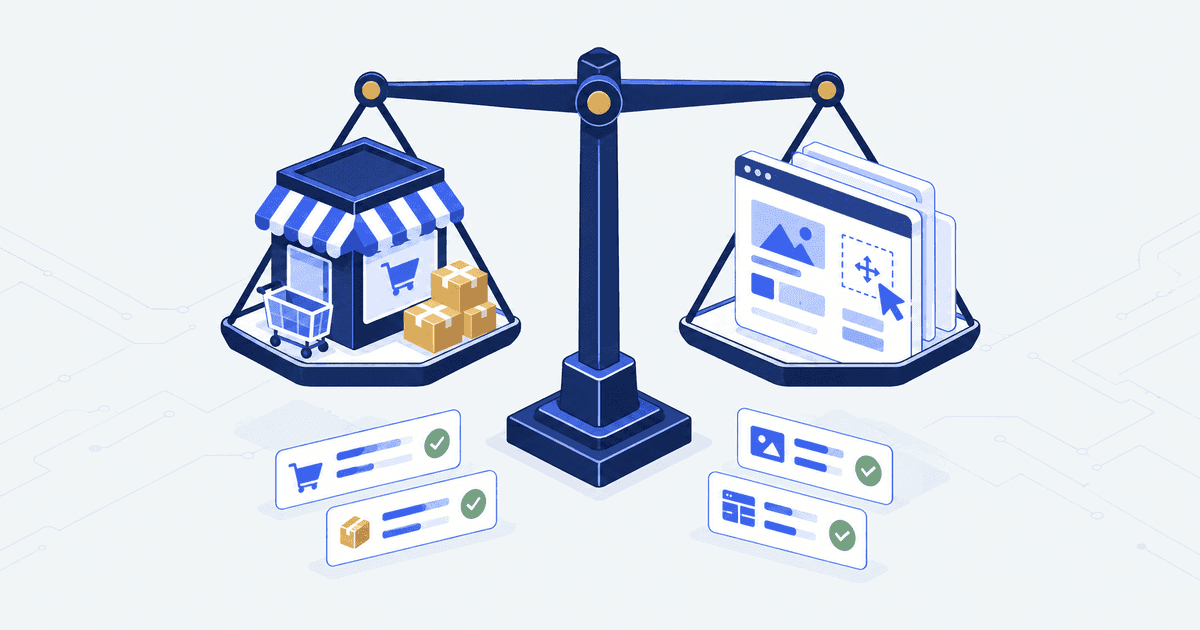

Shopify Plus is Shopify’s top plan, built for larger stores. Shopify lists it at $2,300 USD a month on a three year term, or $2,500 on a one year term. At the best listed rate that is $27,600 a year.
Advanced, a lower plan, is $399 a month, or $4,788 a year. The question is whether your store uses $22,812 a year of difference.
BigCommerce and Adobe Commerce both pitch deeper B2B tooling than Shopify. B2B means selling to other businesses. Adobe Commerce is the current name for Magento. They are not wrong to pitch it.
This review checks what Plus still sells that lower Shopify plans do not. If you already know you want Plus, see what a Shopify Plus agency does.
The short answer. Plus costs at least $27,600 a year, which is 1.4% of $2M in sales. Pay it only if you use a Plus-only feature. These are unlimited B2B catalogs, company catalogs, deposits on B2B orders, nine expansion stores and a 1,000 points per second API. B2B alone no longer justifies it.
Who this is for, and who it is not for. This is for you if you sell at the $2M to $20M a year level. Someone has quoted you the Plus fee. Or you pay it and have never used a Plus-only feature. You feel it as a $2,300 line on the bill that no one can explain.
It is not for you if you want a platform bake-off with scores out of ten. We did not run BigCommerce or Adobe Commerce side by side. Those columns are vendor claims.
| Criterion | Basic, Grow or Advanced | Shopify Plus | BigCommerce B2B Edition | Adobe Commerce (Magento) |
|---|---|---|---|---|
| Listed monthly fee | $25, $65 or $399 | $2,300 to $2,500 | Not measured here | Not measured here |
| Active B2B catalogs (price lists shown to different buyers) | Up to 3 | Unlimited | Not measured here | Not verified here |
| Catalog tied to one company | No | Yes | Lists account pricing per buyer | Not verified here |
| Deposits and part payments on B2B orders | No | Yes | Lists company credit management | Not verified here |
| Quoting | Draft orders | Draft orders | Lists a quoting engine (CPQ) | Not verified here |
| Admin API rate (how fast software may call Shopify; GraphQL is its query language) | 100 or 200 points a second | 1,000 points a second | Not measured here | Not measured here |
| Who runs the code | Shopify | Shopify | BigCommerce | You or Adobe's cloud service |
What the Plus fee still buys
Most of the old Plus sales story now sits on every plan. A price list, which Shopify calls a catalog, is the set of products and prices one buyer sees. Net payment terms let a buyer pay some days after the invoice.
Draft orders are orders staff build by hand for a buyer. Companies, net terms and draft orders run on all four plans (B2B features by plan).
Here is what is still Plus only.
| What you get | Basic, Grow or Advanced | Plus |
|---|---|---|
| Active B2B catalogs | Up to 3 across all B2B markets | Unlimited |
| Catalog assigned to a company or location | Not available | Available |
| Deposits, part payments, payment requests per fulfillment | Not available | Available |
| Expansion stores (extra stores for other regions or locations) inside the fee | 0 | 9, then $300 a month each |
| Admin GraphQL API rate | 100 points a second, 200 on Advanced | 1,000 points a second |
Deposits and part payments let a buyer pay in stages. The plan figures come from Shopify’s pricing page and the Plus pricing page. The nine stores are on the Plus plan page, and the API figures are on Shopify’s rate limit page.
B2B is no longer the reason to buy Plus
B2B used to be the headline Plus feature. It is not any more. Lower plans cap you at 3 active catalogs across all B2B markets.
Plus lifts that cap and adds company-level catalogs and deposits. That is the whole difference Shopify documents.
So count your price lists first. Two or three price lists and a handful of trade accounts do not need Plus. Forty accounts, each on its own terms, probably do. That threshold is our judgement, not a Shopify rule.
Shopify Scripts stopped running on 30 June 2026
Checkout work on Plus used to mean checkout.liquid and Shopify Scripts. checkout.liquid was the old checkout template.
It was written in Shopify’s Liquid language. Scripts were small Ruby programs that changed prices at checkout. Shopify states: “As of June 30, 2026, Shopify Scripts has been deprecated. Any Scripts that were still published on your store have been deactivated and no longer work” (Scripts migration page).
The replacement is Shopify Functions. These are small programs Shopify runs inside checkout and ships inside an app. They run under hard limits. One is 11 million instructions per run for a cart of up to 200 lines (Function limits).
If nobody rebuilt your Scripts, a discount may be quietly not applying today. The scope of that rebuild is in our Scripts sunset post. Where a rule needs code, that is custom app development for Shopify Plus, not a setting.
Where BigCommerce or Magento is better
If your business is mostly trade sales, the other two platforms deserve a real look. BigCommerce lists several B2B tools under its B2B Edition (BigCommerce B2B). One is an open-source buyer portal, meaning a customer login area whose code you can change.
Others are company account credit management and multi-company hierarchy with role-based access. It also lists a quoting engine, often called CPQ, for configure, price, quote.
Shopify documents draft orders and net terms on all plans, and deposits and company catalogs on Plus. It does not document a hierarchy of company roles or a quoting engine in the pages we read. Whether yours is deep enough is a question for a demo, not for us.
Adobe Commerce markets itself for “multichannel, global commerce for B2B and B2C”. B2C means selling to consumers. It also now sells a cloud service (Adobe Commerce). Its page did not list B2B features in the text we read, so we do not rate them.
| Your situation | Where we would look first |
|---|---|
| Retail first, with a small B2B side | Shopify, on the plan your catalog count needs |
| Over half of sales are trade, with quotes, credit terms and role-based buyers | BigCommerce B2B Edition, then a demo against your workflows |
| You need to own and change the commerce code itself | Adobe Commerce, and budget a team to run it |
| On Plus and using none of the Plus-only features | A lower Shopify plan |
We have not measured launch times, cost or support on these platforms. We make no speed claim.
Four things to settle before you sign or renew
- The variable fee. This is a charge that grows with your sales. Shopify says “there might be a variable platform fee based on your revenue and business model, which differs for B2B and D2C companies”. No rate or threshold is published. Ask for both in writing. Then run them against your last 12 months of sales.
- The term. One year lists at $2,500 a month and three years at $2,300. That is a difference of $2,400 a year. Take the longer term only if you can name what you will use it for.
- Extra stores. Nine are inside the fee. Each one after that is $300 a month. Count the stores you will really run.
- Support. The Plus plan page promises “Round-the-clock access to priority phone and chat support”. It does not promise a named manager, so do not price the deal as if it does.
Where this rule breaks
The strongest objection to our rule is a small store with heavy B2B needs. Picture a $2M store with five catalogs, one per trade tier. Our rule says skip Plus at that size.
Shopify caps lower plans at 3 active catalogs. That store needs Plus whatever its sales.
The boundary is the cap. Count your active catalogs first. At 3 or fewer, the rule holds. At 4 or more, price Plus against the workaround.
Plus fee against Advanced, in your numbers
Do the subtraction on your own store. Advanced is $399 a month and Plus starts at $2,300 a month on the three year term. That gap is $1,901 a month, or $22,812 a year.
Ask what you would stop doing on Advanced. If the list is empty, the fee buys support only. Some stores keep Plus for that. That is a fair call once it is a call.
We have not measured how many stores could move down, and we publish no share. Plan engineering time to unpick Plus-only code before any switch. How much depends on how much of it you wrote.
What breaks, and who owns it
The usual objection is “we will use the rest of Plus next year”. Next year arrives and the fee has been paid twelve more times. Plus does not come with a person who configures it.
Nobody owns the price lists, the customer tags, the app list or the discount logic unless you name someone.
We build the Shopify Plus platform for SENE Studio. There, 37 changes reached the order systems between 14 July and 8 September 2026. A named person accepted every one. That gate is what ownership looks like in practice.
Before you pay the fee
Decide with three facts: the Plus-only features you use, your active catalog count and last year’s sales. Those three settle the plan. Everything else is preference.
Our bias. We are paid to build and fix Shopify Plus stores, so we gain when you choose it. Weigh our view with that in mind. Your next step is to list the Plus-only features you use today, then check each one against the table above.
Common questions
Is Shopify Plus worth it at $2M in sales?
Usually not, because Plus costs at least $27,600 a year, about 1.4% of $2M in sales. That figure is the three year term, $2,300 times 12. Many stores at that size may use none of the Plus-only features, so check yours against the table above. That is our judgement, not a measured share. Revisit it when trade accounts pass three price lists.
Do I need Shopify Plus to sell B2B?
No, because companies, net terms and draft orders run on Basic, Grow and Advanced. Those plans allow up to 3 active catalogs across all B2B markets. You need Plus past that cap. You also need it for a catalog tied to one company, deposits or part payments.
How much does Shopify Plus cost?
Shopify lists Plus at $2,300 a month on a three year term and $2,500 on a one year term. A variable platform fee may apply on top. Shopify publishes no rate or threshold for it, so ask for both in writing. Nine expansion stores are included, then $300 a month each.
What happened to Shopify Scripts?
They stopped running on 30 June 2026, and Shopify deactivated any Script still published. The replacement is Shopify Functions. These ship inside an app and run under a limit of 11 million instructions per run. A Script nobody rebuilt is silently not applying now.
Is Shopify Plus better than BigCommerce?
Not always, because it depends on your B2B depth. BigCommerce lists a quoting engine, company credit management and multi-company hierarchy. Shopify documents company catalogs and deposits on Plus. If most of your sales are trade with complex buyer roles, demo BigCommerce first. If you are retail first, Shopify usually fits.
Facts checked October 2026. We read the Shopify pricing, Plus, B2B, rate limit, Function limits and Scripts pages on 5 October 2026. We read the BigCommerce and Adobe Commerce pages the same day. Re-check prices by 5 November 2026, before you sign. Sources: Shopify pricing, Shopify Plus pricing, Shopify Plus plan, B2B features by plan, Admin API rate limits, Function limits, Scripts migration, BigCommerce B2B, Adobe Commerce.