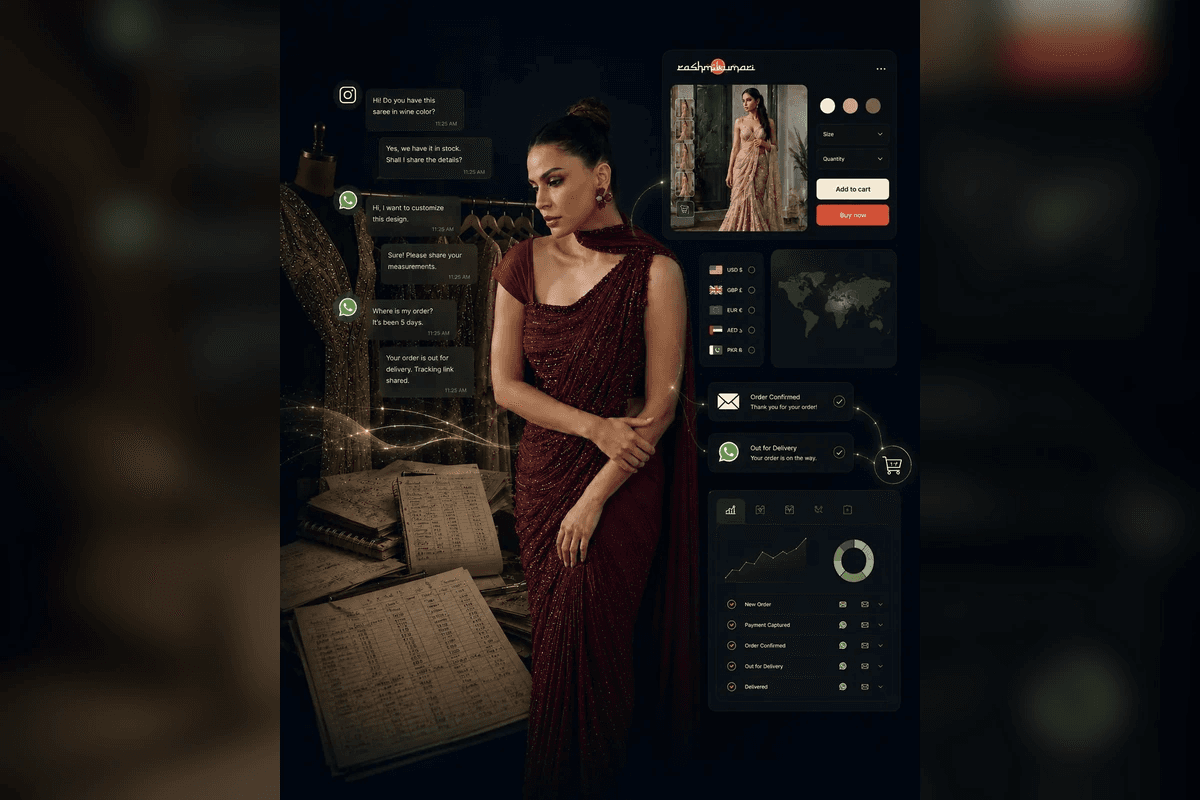
What was in the way
Pieces here are made to order on a four to six week make time, and the atelier has no shop floor. The fitting conversation happens on WhatsApp.
Before May 2025 there was no Shopify store at all. The store record was created on 21 May 2025.
A pixel is the snippet of code that tells an ad platform what a shopper did. This theme carried two. One belonged to an unknown business and had been collecting the store's traffic for nine months. The other was the real one, throttled by a consent setting that quietly suppressed add-to-cart and purchase events.
Presentment currency is the currency a shopper sees on the page. Shopify's multi-currency feature needs Shopify Payments, which in the UAE needs the Plus plan, and this store is on Basic with a third-party gateway. So every shopper in every country sees US dollars, on the product and at the checkout, until the plan changes.
More from this build
The storefront went live in 2025 on a theme we bought, not one we wrote
Pieces here are made to order on a four to six week make time, and the atelier has no shop floor: the fitting conversation happens on WhatsApp. Before May 2025 there was no Shopify store at all. The store record was created on 21 May 2025.
We built the storefront on Taiga, a commercial Shopify theme from Woolman. A theme is the template deciding how a Shopify store looks and behaves. Buying one and reshaping it was right at that size.
What we added is dated and checkable: a celebrity slider on 10 July 2025, a size guide on 12 July, a contact page with a WhatsApp button on 23 July, the atelier page on 25 July, a press archive on 8 September. Ninety-eight commits sit behind them.
For nine months the store reported its shoppers to an account nobody owned
A pixel is the snippet of code that tells an ad platform what a shopper did. This theme carried two. One belonged to an unknown business and had been collecting the store's traffic for nine months. The other was the real one, throttled by a consent setting that quietly suppressed add-to-cart and purchase events.
Both were fixed on 19 May 2026, and six of six checks passed after. We then fired a controlled add-to-cart on a live product page. The browser event and its server-side copy arrived as one deduplicated pair, with Google Analytics carrying the same event id.
You cannot audit a store whose measurement is lying to you. Every conclusion drawn from this account before 19 May 2026 came from a feed with a nine-month leak in it. Fix the instrument first.
The checkout can only show US dollars, and on this plan it always will
On 17 August 2026 we tried to turn on local pricing and could not.
Presentment currency is the currency a shopper sees on the page. Shopify's multi-currency feature needs Shopify Payments, which in the UAE needs the Plus plan, and this store is on Basic with a third-party gateway. So every shopper in every country sees US dollars, on the product and at the checkout, until the plan changes. The India shipping zone was also misconfigured as domestic and rendering as free.
Put that next to the opening table. A shopper in India was being sent to a US dollar card wall for a garment that takes six weeks to make. Those 94 abandoned checkouts are not a conversion problem. They are people who cannot pay, behaving correctly.
An asterisk is not a source. An earlier version of this page claimed geolocation-aware checkout in five or more currencies, and end-to-end order automation over email and WhatsApp. Neither is true here. Both were removed rather than footnoted.
What the honest numbers said to stop
The same 30 days bought 976,000 impressions and 689 add-to-carts for zero purchases. That is not a broken campaign. The ad set was optimised for add-to-cart, so the platform bought people who add things to carts.
All Meta advertising was paused on 16 and 17 September 2026. We confirmed it through the API, not the dashboard: zero delivering objects across three ad accounts, 20 campaigns, 23 ad sets and 49 ads. The same measurement discipline runs the sister store in the Boop Body build.
The demand that does exist is small, slow and organic
Fifty-one city pages went live on 17 August 2026. By 17 September, 50 were indexed, meaning listed in Google's index. Between them they had produced about 130 impressions and two clicks.
Indexed is not ranked. An Ahrefs pull on 1 September returned a domain rating of 0.0, 342 referring domains that are all link sellers, and 12 organic keywords. Pages cannot outrank anyone from there. The same page-by-page pattern is in the SafaiKaro local search engine.
Two things do work. Editorial pages outrank collection pages here, so a long kaftan guide went live on 17 September. And the WhatsApp button in the theme took 398 taps from 341 visitors in the 28 days to 1 September, against four customise-form submissions. The close still happens in chat, and now you can count it.
Three rows say not measured and they stay in, because no order-volume, revenue or operator-hours baseline was ever taken on this account.
| Before | Last check | |
|---|---|---|
| Shopify storefront | none before 21 May 2025 | live, 92 products |
| Pixels reporting this store | 2, one of them to an unknown account | 1, verified browser and server |
| Purchase events visible to the brand | suppressed by a consent setting | firing and deduplicated |
| Pages in Google's index | not measured | 50 of 51 city pages, 17 Sep 2026 |
| Money going into paid traffic | a campaign buying add-to-carts | 0 delivering ad objects, 17 Sep 2026 |
| Orders per month | not measured | not measured |
| Operator hours on the store | not measured | not measured |
Check the payment rail before you buy a single click. Whether a shopper in a given country can complete your checkout is a five-minute test. Run it before the media plan, not after 17,722 sessions.
What we would do differently, and who this is not for
Three things. We would have run a checkout probe as a shopper in the target country before any traffic was bought. We would have taken a non-brand search baseline on day one, not a year in. And we would have checked what the ad set was optimising for before reading its results as a funnel.
This is for you if you sell a considered, made-to-order product, if your reporting and your bank statement disagree, and if you want the market question settled before the creative question. It is not for you if you want a traffic number to go up, or a rebuild quoted before anyone has checked that your checkout works where your ads run.
Test the checkout before you fund the traffic
The money here is the spend you stop, not the spend you optimise. Open your own store from the country your ads run in and try to buy something. If you hit a currency you do not use or a payment method you do not have, every click into that country is already spent. That check costs five minutes. Finding out the way this account did costs a quarter. Our wider approach is on the ecommerce page.
Questions and answers
Can a Shopify store show local currency in every country?
Only on a plan and payment setup that support it. This store runs Shopify Basic with a third-party gateway, so multi-currency was unavailable and US dollars show everywhere. We confirmed that on 17 August 2026 rather than assuming it.
How do you tell a tracking problem from a market problem?
Fix the tracking first, then look again. Here the pixel was repaired on 19 May 2026 and the clean data still showed 94 checkouts and zero orders over 30 days. That leaves the market.
Did this work increase the brand's revenue?
No revenue or order-volume figure is verified for this account, so none is printed. The last completed orders were on 11 June 2026. What is proven is a repaired measurement layer and paid spend stopped.
Why publish a case study with no sales in it?
Because the diagnosis is the useful part. Knowing which traffic can never finish a checkout beats a chart that goes up, and you can check every number here against the store.