Prospect research often creates the same bottleneck: a team can find many public signals, but the account owner still needs one relevant reason to contact a company. If the handoff is loose, researchers pass a long list of observations to sales, writers turn weak clues into confident claims and the most useful opportunities disappear in the noise.
TypeSafe AI Jev can make that handoff more usable. Autonomous Technologies uses it in an internal prospect-research component that selects from approved options before a writer drafts the message. A conversation angle is one specific, evidence-backed reason to open a relevant discussion with an account. Jev can choose from a short list of those angles or hold the case for a reviewer. It does not write the email, decide that a prospect wants the service or send anything.
The decision that belongs between research and outreach
Cold email is not one decision. Research checks whether an observation is supported. The account owner decides whether it matters for this account and recipient. A writer turns an approved observation into a message. The person responsible for sending checks whether, when and how the message may be sent.
The Jev decision belongs after research and before copy. Its question is practical: given a few approved options, which one is the most relevant evidence-backed reason for this account to be contacted, or should the workflow hold the case for review?
- Stage
- Research
- Decision
- Is the observation supported by a dated source?
- Owner
- Researcher or reviewer
- Stage
- Jev selection
- Decision
- Which approved conversation angle is most relevant, or should the case go to review?
- Owner
- Workflow, with a named reviewer for exceptions
- Stage
- Account review
- Decision
- Is this worth pursuing for this account and role?
- Owner
- Sales owner
- Stage
- Copy and delivery
- Decision
- Does the message use the approved evidence and meet sending rules?
- Owner
- Writer and sender
| Stage | Decision | Owner |
|---|---|---|
| Research | Is the observation supported by a dated source? | Researcher or reviewer |
| Jev selection | Which approved conversation angle is most relevant, or should the case go to review? | Workflow, with a named reviewer for exceptions |
| Account review | Is this worth pursuing for this account and role? | Sales owner |
| Copy and delivery | Does the message use the approved evidence and meet sending rules? | Writer and sender |
This separation avoids the common failure where a model-generated sentence appears more certain than the evidence behind it. It can also give sales one reason to investigate, linked to the supporting observation, instead of an unranked research dump.
What our Jev component does
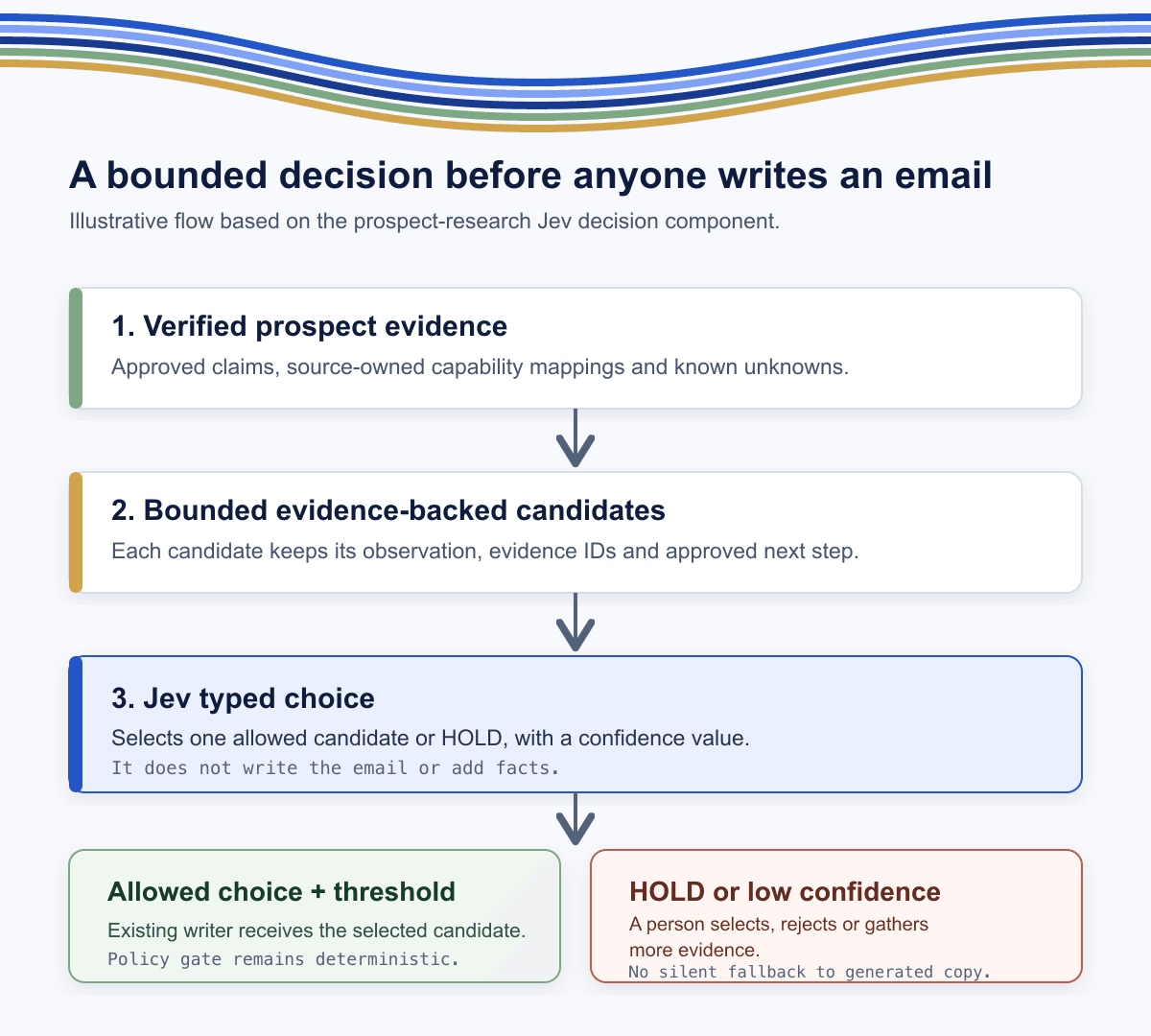
Autonomous has a prospect-research component for this decision. It reads a research record with dated observations, open questions and the roles the team may contact. Before an observation becomes an option, the component checks that it has a verified source and connects to a service the team actually provides.
It then asks Jev to choose among those options or HOLD. Jev can choose only from the options the workflow supplied. If Jev is not sure enough, or returns an answer the application cannot use, the application holds the case for review. It records the selected angle and its supporting evidence so someone can trace why the account reached the queue. Missing evidence or a service error also becomes a human-review case.
That is a concrete implementation pattern, not a claim that Jev can verify research on its own. It means the workflow can show an account owner the observation behind the selected angle and preserve uncertainty when the evidence or fit is not good enough.
A worked example
Imagine a research file contains a dated product announcement, a public hiring signal and a generic company description. The announcement has a source and maps to a service your team actually provides. The hiring signal is old. The company description says nothing specific about the account’s current needs.
The research step retains only the supported observation. Jev can select the corresponding conversation angle or send the record to review. The sales owner then decides whether that angle matters to the recipient and whether a message is appropriate. A writer may use the approved evidence in a draft, but cannot turn the observation into a claim about the prospect’s priorities or budget.
The intended commercial benefit is a cleaner research-to-sales handoff. The workflow makes it easier to see why an account reached the queue, what fact supports the suggested conversation and where a person must still exercise judgement. A Jev SEO workflow applies the same select-or-hold pattern to draft content before an editor reads it.
What to build around the model call
The model is one step in a useful outbound workflow. A first integration should include:
- A defined research record. Store the source, date, quotation or page reference, account match and unresolved questions with each observation.
- A small list of approved conversation angles. Each angle should connect a real observation to a service conversation your team can honestly have.
- A review route. Missing, stale or irrelevant evidence should create a review task, not a more imaginative message.
- A clear account-owner handoff. Show the selected angle, evidence link and reason for review where the salesperson already works.
- Copy and sending checks. Keep approved claims, sender identity, recipient opt-outs, permission and applicable legal obligations outside the selection step.
For U.S. commercial email, the FTC’s CAN-SPAM guide is a starting point. The rules that apply also depend on your recipients, locations, platforms and internal policy. A relevant research angle does not create permission to send.
When not to use this pattern
Use a simple rule when the route is genuinely predictable. Use a person when the account list is small or relationship context matters more than speed. Do not add an AI layer to make thin research look personalised. This pattern earns its place only when it gives the account owner a clearer, better-supported decision than the current manual handoff.
Outbound research workflow · Project enquiry
Build an outbound research-to-message process
Tell us where research, message review, or delivery rules break down. We will follow up to discuss whether Jev fits the workflow and what it would need to connect to.
Frequently asked questions
Does Jev write or send the cold email?
No. It selects from supported conversation angles or routes the case to review. People retain responsibility for copy, approval, recipient opt-outs and sending.
What happens when prospect evidence is missing or stale?
The workflow should hold or route the record to a person. It should not turn a weak signal into a confident claim about the prospect.
What does the selected angle represent?
It is one evidence-backed reason to consider a conversation. The account owner still decides whether it is relevant and appropriate for the recipient.
Review your outbound workflow
If sales receives research but still has to work out why an account is worth contacting, tell us where that handoff breaks. We will discuss whether Jev fits that step and what a first outbound integration would need.