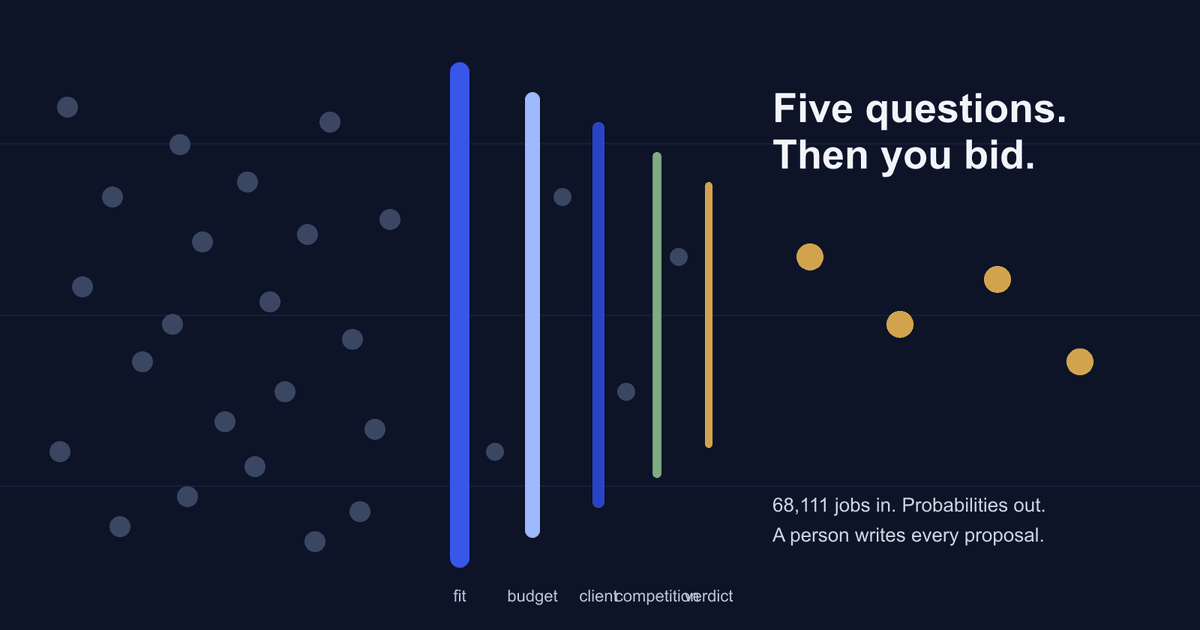
Jev SEO is how we stop the same 4 defects reaching your editor twice. They are an opening that never answers the title, an undefined term, an unsourced claim, and an ending with competing asks. A script asks TypeSafe AI Jev 36 fixed questions about every draft. Code counts the rest. The editor decides.
Who this is for, and who it is not for. This is for the editor or content lead who sends drafts back for the same reasons every week and wants a repeatable first pass. It is not for a team looking for a tool that predicts rankings or writes the article. Jev does neither.
What is Jev SEO?
Jev SEO is our name for using TypeSafe AI Jev, a decision model, to review SEO drafts before they are published. The script sends Jev the title, the meta description (the summary shown under a search result), the target keyword, headings, opening, body and a list of the page’s visual elements. Jev answers 36 fixed questions, such as whether the opening answers the title and whether claims name a source. It returns a probability, a score or a choice for each one.
Jev is not a chat model and it does not write. TypeSafe describes it as a System One model that picks a defined answer from supplied evidence. That is what a review question needs. The model itself is covered in What is Jev AI. This article covers the SEO use only.
SEO is search engine optimisation, the work of helping people find a page in search. AEO and GEO, answer engine and generative engine optimisation, ask whether an answer tool can quote the page. All three need the same things from your draft: an early answer, defined terms, sourced claims and one next step. Our SEO and AI search service holds client content to that standard. The review script holds ours to it.
Code counts, Jev judges, the editor decides
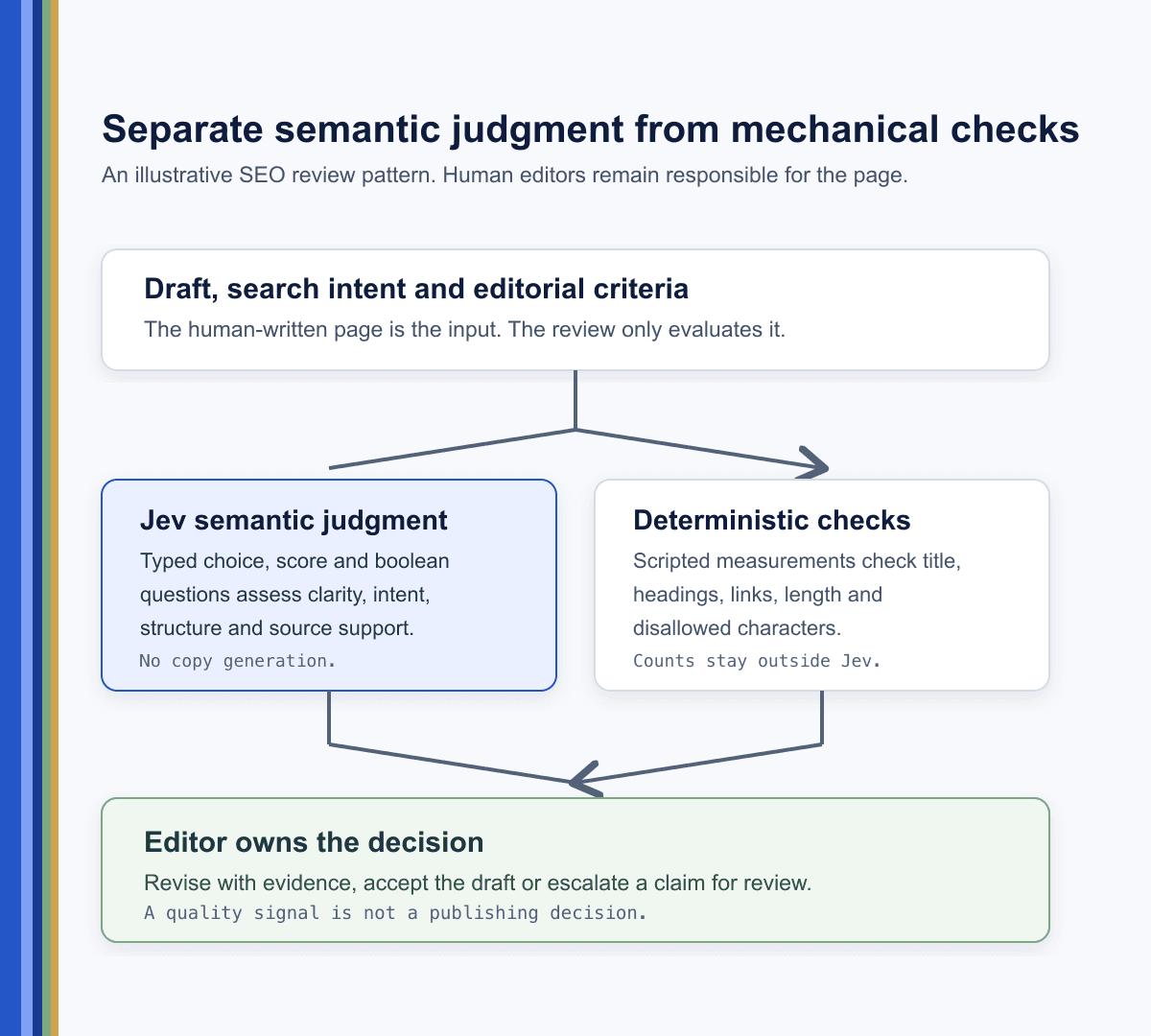
The review runs in two layers, because a language model cannot count reliably. The first layer is plain code. It measures lengths, counts headings and tables, finds banned characters and computes a reading score. The reading score is Flesch reading ease, a 0 to 100 scale where higher is easier to read. Every check is a fixed threshold, run before any model is called.
- Check
- Title length
- Threshold
- 30 to 60 characters
- On a miss
- Hard fail
- Check
- Meta description length
- Threshold
- 70 to 155 characters
- On a miss
- Hard fail
- Check
- Opening paragraph
- Threshold
- 40 to 55 words, with a number or a decision word
- On a miss
- Hard fail
- Check
- FAQ block
- Threshold
- 3 to 6 pairs, answers 40 to 80 words, answer first
- On a miss
- Hard fail
- Check
- Em dashes and tracking codes
- Threshold
- 0 of either
- On a miss
- Hard fail
- Check
- Tables and images
- Threshold
- Every one captioned
- On a miss
- Hard fail
- Check
- Hero image alt text
- Threshold
- Set, and not a copy of the title
- On a miss
- Hard fail
- Check
- Sentences over 30 words
- Threshold
- Flagged above 15 percent of sentences
- On a miss
- Reported
- Check
- Words per H2 section
- Threshold
- Flagged above 400
- On a miss
- Reported
- Check
- Flesch reading ease
- Threshold
- Flagged below 45
- On a miss
- Reported
| Check | Threshold | On a miss |
|---|---|---|
| Title length | 30 to 60 characters | Hard fail |
| Meta description length | 70 to 155 characters | Hard fail |
| Opening paragraph | 40 to 55 words, with a number or a decision word | Hard fail |
| FAQ block | 3 to 6 pairs, answers 40 to 80 words, answer first | Hard fail |
| Em dashes and tracking codes | 0 of either | Hard fail |
| Tables and images | Every one captioned | Hard fail |
| Hero image alt text | Set, and not a copy of the title | Hard fail |
| Sentences over 30 words | Flagged above 15 percent of sentences | Reported |
| Words per H2 section | Flagged above 400 | Reported |
| Flesch reading ease | Flagged below 45 | Reported |
The second layer is Jev. It takes the questions code cannot answer. Does the opening name a problem you already have? Do the headings tell the story on their own? Is the next step the right size for you? Scores and choices carry a confidence value, and the script turns the answers into six lens scores.
The one rule that keeps this useful: Jev flags, the editor decides. A flag means open the passage and look. It never means rewrite, and it never means publish.
The six lenses Jev SEO scores
Every question belongs to one lens, except one that only classifies search intent. A lens score is the average of its answers, from 0 to 100. The gate compares each score with a floor for the article type. The draft fails if the overall score is under its floor, or if more than three lenses miss theirs.
- Lens
- SEO, AEO and GEO
- Questions
- 12
- What it scores
- One clear topic, keyword in title and opening, quotable answers, named sources, defined terms
- Floor
- 78
- Who acts
- Writer and editor
- Lens
- Readability
- Questions
- 4
- What it scores
- Reading difficulty, buzzword filler, unexplained jargon, plain voice
- Floor
- 65
- Who acts
- Writer
- Lens
- Structure
- Questions
- 4
- What it scores
- Headings that tell the story, logical order, one call to action, an actionable ending
- Floor
- 90
- Who acts
- Editor
- Lens
- Visual
- Questions
- 6
- What it scores
- Captions that state a finding, claims backed by a table, callouts at key moments, a concrete opening
- Floor
- 75
- Who acts
- Editor and designer
- Lens
- Conversion
- Questions
- 6
- What it scores
- Problem in the reader's words, proof before any ask, a proportionate next step, the objection answered
- Floor
- 78
- Who acts
- Editor and owner
- Lens
- Brand
- Questions
- 3
- What it scores
- No AI as the pitch, no price tiers, no promise a cautious CFO would challenge
- Floor
- 70
- Who acts
- Owner
| Lens | Questions | What it scores | Floor | Who acts |
|---|---|---|---|---|
| SEO, AEO and GEO | 12 | One clear topic, keyword in title and opening, quotable answers, named sources, defined terms | 78 | Writer and editor |
| Readability | 4 | Reading difficulty, buzzword filler, unexplained jargon, plain voice | 65 | Writer |
| Structure | 4 | Headings that tell the story, logical order, one call to action, an actionable ending | 90 | Editor |
| Visual | 6 | Captions that state a finding, claims backed by a table, callouts at key moments, a concrete opening | 75 | Editor and designer |
| Conversion | 6 | Problem in the reader's words, proof before any ask, a proportionate next step, the objection answered | 78 | Editor and owner |
| Brand | 3 | No AI as the pitch, no price tiers, no promise a cautious CFO would challenge | 70 | Owner |
The readability floor is a target, not a block. Most of our guides have scored between 50 and 60 on it since the gate was introduced, and none has reached 65. The miss is reported, not hidden.
What Jev SEO catches, and what it misses
Jev catches on the first read what your editor finds on the third. In our drafts the common flags are an opening that defines the topic instead of answering the title, a term used before it is explained, and a claim with no source beside it. It also catches a quieter one: a pitch that leads with the technology instead of what you save.
Jev misses anything it cannot see. It does not crawl the live site, read Search Console (Google’s free report of search traffic) or know how Google will treat the page. It reviews the draft text and the list of visuals the script gives it, nothing more. It does not verify that a linked source says what you claim, so the editor still opens the link. It cannot count, which is why code does the counting.
Jev can also be wrong. A question about voice or proof is a judgement, and a confidence of 0.6 is a weak one. When a flag looks wrong to you, read the passage, decide, and move on.
The review workflow we run, step by step
Autonomous Technologies is a Vancouver-founded Shopify agency that publishes operator guides for ecommerce teams. Every guide goes through this loop before the founder sees it in the CMS, the publishing system. You can run it with your own questions.
- Brief first. Name the reader, the question the title must answer, the evidence on hand and the one next step. Jev scores the draft against the title, so a vague title gives you vague flags.
- Run the gate on the Markdown source. One command runs the mechanical checks, then the Jev call, and prints pass or fail with every miss listed. A run takes a minute or two; we have not timed it formally.
- Fix hard fails before reading the lenses. A missing caption or a 62-character title is a two-minute fix. Clear those first.
- Read each flag in context. The editor opens the passage, decides whether the flag is right, and changes the draft or leaves it. Keep a short note per run saying what changed and why.
- Re-run, up to five times. Each run is logged with its scores. If the draft still fails after five, the problem is the brief, not the wording. Go back to step 1.
- Render the page before publishing. A source file cannot show whether the tables, image and call to action render. Open the page at desktop and 390 pixels wide and check that the structured data, the machine-readable summary of the page, matches what a reader sees. Google’s structured data policies require that match, read 9 October 2026.
Publishing stays a separate decision. The script writes a log row. A person presses publish.
A worked example: this article’s first gate run
On 9 October 2026 the previous version of this article went through the gate as an operator guide. It failed. These are the real scores from that run.
- Lens
- SEO, AEO and GEO
- Score on 9 October 2026
- 67
- Floor
- 78
- Result
- Miss
- Lens
- Readability
- Score on 9 October 2026
- 57
- Floor
- 65
- Result
- Miss, target only
- Lens
- Structure
- Score on 9 October 2026
- 82
- Floor
- 90
- Result
- Miss
- Lens
- Visual
- Score on 9 October 2026
- 47
- Floor
- 75
- Result
- Miss
- Lens
- Conversion
- Score on 9 October 2026
- 84
- Floor
- 78
- Result
- Pass
- Lens
- Brand
- Score on 9 October 2026
- 81
- Floor
- 70
- Result
- Pass
- Lens
- Overall
- Score on 9 October 2026
- 69
- Floor
- 80
- Result
- Miss
| Lens | Score on 9 October 2026 | Floor | Result |
|---|---|---|---|
| SEO, AEO and GEO | 67 | 78 | Miss |
| Readability | 57 | 65 | Miss, target only |
| Structure | 82 | 90 | Miss |
| Visual | 47 | 75 | Miss |
| Conversion | 84 | 78 | Pass |
| Brand | 81 | 70 | Pass |
| Overall | 69 | 80 | Miss |
Visual was the biggest gap. The old body had one table, one image and no callout, so the emphasis blocks counted as absent and the captions as labels. Structure missed because the headings named topics rather than making points. SEO missed because the opening defined the subject instead of answering the title.
The fix is the article you are reading: captioned tables, two callouts, headings that state a point, and an opening that answers within 55 words. Its own score is not quoted here, because quoting it changes the text being scored. Whether it changes search traffic is not measured yet. Search Console gets re-pulled after 20 October 2026.
Where Jev SEO breaks
The main hesitation you will have is cost and effort: another tool, another step before publishing. The step costs a minute or two per run, and the API call, the request the script sends to Jev, is metered per request. The effort is in the first week, writing the questions down. After that they do not change.
It breaks when the questions are vague. “Is this good?” produces noise. “Does the opening answer the title within its first hundred words?” produces a flag you can act on. Every question in our script names one passage and one criterion.
It breaks when you treat a score as a verdict. A draft can clear every floor and still be wrong about a fact, because Jev does not check facts against sources. Google’s people-first content guidance, read 9 October 2026, puts first-hand expertise at the centre of helpful content. No review script supplies that. It only makes your standard easier to apply the same way every time.
And it breaks on a thin brief. A draft with no evidence to cite fails the sourcing question every run. Go back and get the evidence.
Content review workflow · Project enquiry
Give your team a consistent content review workflow
Tell us which content checks depend on manual review and where drafts stall. We will follow up to discuss whether Jev fits the workflow and what it would need to connect to.
Jev SEO questions
Does Jev SEO predict rankings or AI citations?
No. Jev reviews the draft text and the editorial questions it is given, nothing more. It does not crawl the live site, read Search Console or model how a search engine or answer tool will treat the page. The editor still checks the evidence and the rendered page. The result after publication is measured separately in Search Console.
What does code check before Jev reviews a draft?
Code checks what can be counted: title and meta length, the opening’s word count, FAQ answer lengths, heading order, captions and alt text. It also counts em dashes, tracking codes, long sentences and reading ease. Those checks run first and cost nothing. Jev then takes the 36 questions that need judgement, such as whether a claim has a source beside it.
Who decides whether a flagged draft is ready?
The editor decides. A Jev flag is a prompt to open one passage, not a verdict on the article. The editor reads the passage in context, then revises it, adds a source, or leaves it and notes why. Publication stays a separate step owned by a person. The script writes a log row and nothing more.
Can a team use Jev SEO without our script?
Yes, if you write your own questions. The method is the questions, not the tool. Give each one passage, one criterion and one defined answer, and use plain code for everything that can be counted. TypeSafe publishes the Jev API, and a short Python script with no extra libraries is enough to call it. Expect your first week to go on the questions, not the code.
Thresholds and gate scores above were read from our own scripts and logs on 9 October 2026. Re-check by 9 April 2027, or sooner if TypeSafe changes the Jev API.