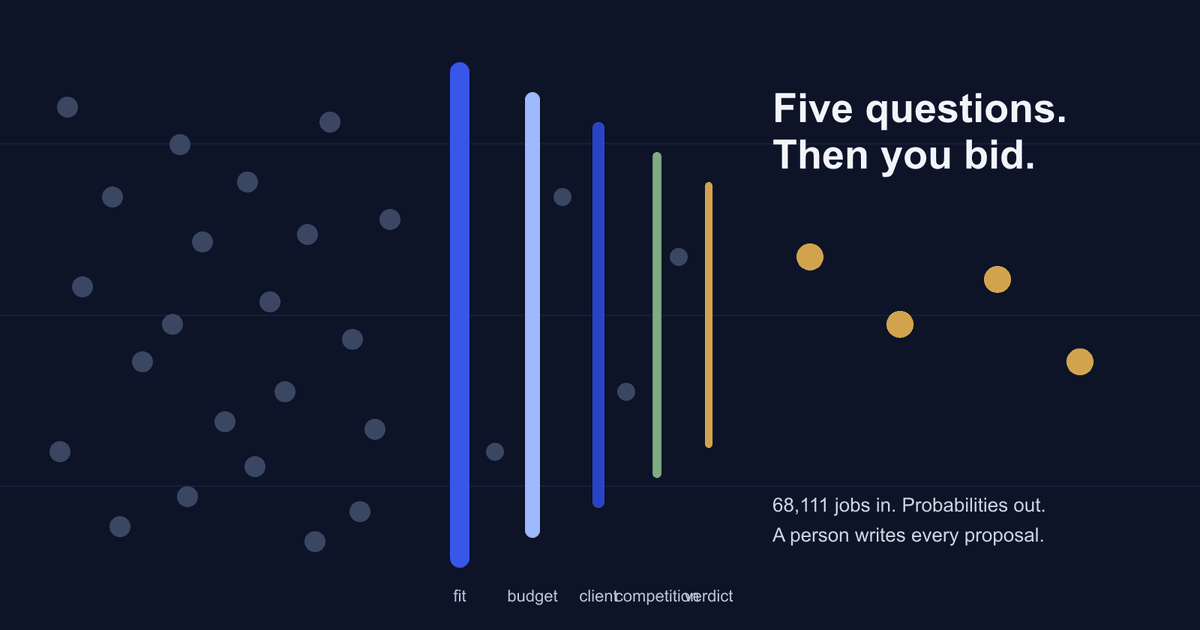
When a support ticket, sales signal or content draft enters a queue, someone has to decide what happens next. A fixed rule may be too simple. An open-ended AI answer may be hard to route or review. TypeSafe AI Jev is built for the middle ground: give it the evidence for one decision and the allowed choices, then use its selection inside a workflow your team controls.
Jev is useful when the next step matters more than generated text. A support lead may need to route a case to urgent, specialist or human review. A sales team may need to decide whether a researched account has one relevant, evidence-backed reason to investigate. Autonomous Technologies builds data and workflow integrations for teams that need these handoffs to work across the systems they already use. The goal is a decision people can inspect, with the commitment still owned by the responsible person.
Jev in plain English
TypeSafe describes Jev as a System One model for returning typed, probabilistic decisions. In plain language, the application supplies the facts, lists the permitted answers and asks Jev to select one. The workflow may also use a score or confidence estimate. A typed decision is simply an answer in the format the workflow accepts, such as urgent, standard or human review, rather than an open-ended chat response.
Another large language model can also return a structured classification. Jev is built around this decision interface. The surrounding workflow still decides which sources are allowed, what the choices mean, what happens after a selection and when a person takes over. That boundary matters when a choice can affect a customer, a commercial commitment or a team’s priorities.
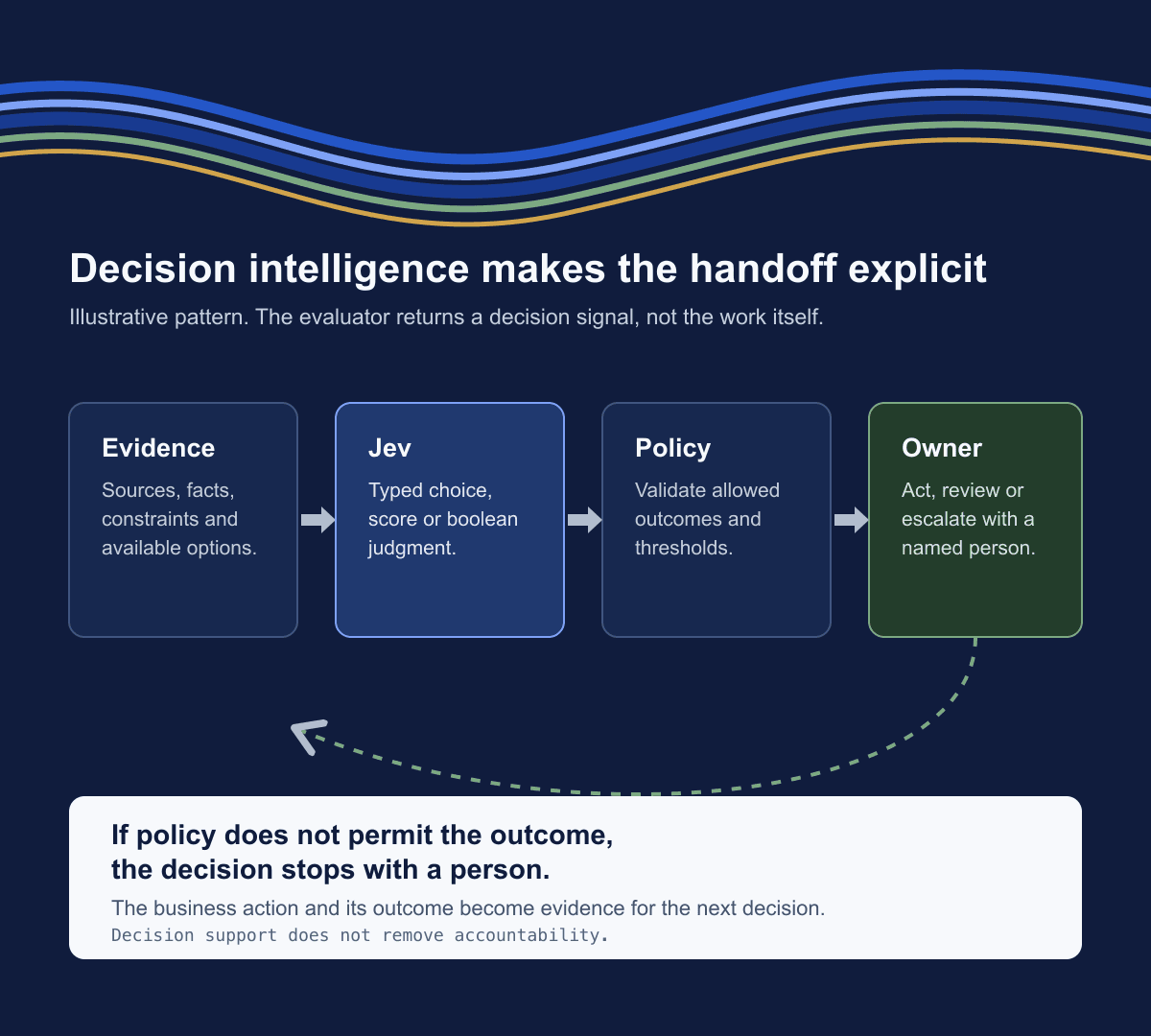
Decision intelligence is the practice of combining evidence, allowed choices, business rules and human responsibility so a team can make a recurring decision consistently. It is not a model feature by itself. The model, application policy and accountable owner all have to work together.
- Mechanism
- Fixed rule
- Use it when
- The condition and action are stable
- Example
- Route a ticket with a confirmed outage code to the incident queue
- Mechanism
- Text model
- Use it when
- The work is drafting, summarising or extracting information
- Example
- Summarise a support thread and list the products mentioned
- Mechanism
- Jev decision
- Use it when
- Several relevant signals must produce one permitted next step
- Example
- Choose an evidence-backed outreach angle or send the case to review
| Mechanism | Use it when | Example |
|---|---|---|
| Fixed rule | The condition and action are stable | Route a ticket with a confirmed outage code to the incident queue |
| Text model | The work is drafting, summarising or extracting information | Summarise a support thread and list the products mentioned |
| Jev decision | Several relevant signals must produce one permitted next step | Choose an evidence-backed outreach angle or send the case to review |
The recurring business problem
Teams often keep recurring judgment work in one person’s head. A manager reads signals from several tools, rebuilds the context and decides which queue should act. The cost is more than reading time. Two people may use different evidence or interpret the same situation differently, so the handoff changes from one case to the next.
A useful Jev integration starts with one decision that has an owner and a safe next action. It specifies the evidence the decision can use, a small set of outcomes, an escalation route and a way to review whether the choice was useful. The NIST AI Risk Management Framework is a helpful reference for this discipline: it is voluntary guidance for considering trustworthiness through the design, use and evaluation of AI systems.
Ten decisions worth considering
These are examples, not promises that every decision should be automated. A sensible starting point is repeatable, has a clear owner, has a manageable downside and leaves enough evidence to review the result.
- Decision
- Support triage
- Evidence considered
- Issue type, account context and service-impact evidence
- First action and owner
- Support lead reviews urgent and uncertain cases
- Status
- Illustrative
- Decision
- Shared-inbox routing
- Evidence considered
- Sender, message, account match and existing labels
- First action and owner
- Inbox owner routes sales, support, billing or sensitive mail
- Status
- Illustrative
- Decision
- Lead monitoring
- Evidence considered
- Dated account signals and account-match quality
- First action and owner
- Sales owner decides whether the signal merits investigation
- Status
- Illustrative
- Decision
- Outbound angle selection
- Evidence considered
- Verified observation, relevant capability and recipient role
- First action and owner
- Research and sales owner review one relevant reason to contact or send the case to review
- Status
- Autonomous component
- Decision
- Renewal review
- Evidence considered
- Usage, open issues, renewal date and account notes
- First action and owner
- Customer-success owner decides who needs attention
- Status
- Illustrative
- Decision
- Deal-desk preparation
- Evidence considered
- Scope gaps, security questions and integration dependencies
- First action and owner
- Deal owner resolves approved questions before a proposal moves forward
- Status
- Illustrative
- Decision
- Content review
- Evidence considered
- Draft topic, opening, sources and next step
- First action and owner
- Editor sends the draft to revise, source review or final editing
- Status
- Autonomous review script
- Decision
- Product-feedback triage
- Evidence considered
- Original report, product version and reproduction evidence
- First action and owner
- Product owner decides defect, request or investigation
- Status
- Illustrative
- Decision
- Vendor exception intake
- Evidence considered
- Request, contract context and security requirements
- First action and owner
- Procurement or security routes the request to the right review
- Status
- Illustrative
- Decision
- Incident intake
- Evidence considered
- Alert source, service impact and known incident context
- First action and owner
- On-call owner confirms whether to investigate or escalate
- Status
- Illustrative
| Decision | Evidence considered | First action and owner | Status |
|---|---|---|---|
| Support triage | Issue type, account context and service-impact evidence | Support lead reviews urgent and uncertain cases | Illustrative |
| Shared-inbox routing | Sender, message, account match and existing labels | Inbox owner routes sales, support, billing or sensitive mail | Illustrative |
| Lead monitoring | Dated account signals and account-match quality | Sales owner decides whether the signal merits investigation | Illustrative |
| Outbound angle selection | Verified observation, relevant capability and recipient role | Research and sales owner review one relevant reason to contact or send the case to review | Autonomous component |
| Renewal review | Usage, open issues, renewal date and account notes | Customer-success owner decides who needs attention | Illustrative |
| Deal-desk preparation | Scope gaps, security questions and integration dependencies | Deal owner resolves approved questions before a proposal moves forward | Illustrative |
| Content review | Draft topic, opening, sources and next step | Editor sends the draft to revise, source review or final editing | Autonomous review script |
| Product-feedback triage | Original report, product version and reproduction evidence | Product owner decides defect, request or investigation | Illustrative |
| Vendor exception intake | Request, contract context and security requirements | Procurement or security routes the request to the right review | Illustrative |
| Incident intake | Alert source, service impact and known incident context | On-call owner confirms whether to investigate or escalate | Illustrative |
Three practical starting points
Support triage. A useful system sees the facts that change the route: affected product area, account context, confirmed impact and known incident status. Customer tone alone should never become a diagnosis. Define which conditions always reach a specialist and which uncertain cases stay with the support lead.
Research to sales handoff. A research process can collect far more observations than a salesperson can use. The decision is not whether a prospect will buy. It is whether one dated, verified observation gives the account owner a relevant reason to investigate or contact that account. Our Jev cold-email workflow shows this pattern in an actual component that selects from approved candidates and holds uncertain cases for someone to review.
Editorial review. A content team can use Jev to flag whether a draft needs an answer-first opening, better source support, revision or an editor’s judgment. Code can count headings and links; it cannot decide whether an article makes sense to its intended reader. Our Jev SEO workflow keeps those jobs separate so editorial time goes to the issue that needs judgment.
What a first integration needs
The model call is the small part. A working integration needs clear business rules around it:
- A narrow decision and accountable owner. State the question in the owner’s language. Name the person who can accept, override or improve the result.
- Evidence and permitted choices. Connect only the source fields that matter. Define every route, including human review.
- Policy outside the model. Let application code route the result, protect sensitive cases and block actions that need approval.
- Evaluation cases and monitoring. Test strong, weak, stale and ambiguous examples before relying on the workflow. Review outcomes with the owner after it is in use.
This gives a business buyer something concrete to assess: which data and systems are involved, which handoff changes, who owns exceptions and how the team will judge whether the integration helps. It also clarifies when a simple rule or a person is the better choice.
When a rule or person is better
Do not add a model where a stable rule already handles the job, or where there is no clear owner for the result. Jev also cannot establish that an incomplete source is true, make a commercial commitment safely or replace consent, privacy and delivery controls. Its output is a decision input, not evidence or permission to act.
Jev decision intelligence · Project enquiry
Put Jev to work on a real business decision
Tell us which task your team repeatedly sorts, checks, or reviews and where the current handoff slows down. We will follow up to discuss whether Jev fits the work and what it would need to connect to.
Frequently asked questions
Does Jev write emails or make business commitments?
Not by itself. Jev selects from the decision options the application supplies. A separate, controlled process must own any writing, approval, sending or customer commitment.
What happens when the evidence is weak?
The workflow should provide a human-review route. That preserves uncertainty instead of forcing a confident-looking decision from missing or stale information.
How do you know whether an integration is working?
Compare selections with the responsible team’s review of representative real cases. Look for incorrect routes, recurring exceptions, missing evidence and decision states that need to be redesigned. Do not use a single model score as proof of business value.
Discuss a decision workflow with Autonomous
If a queue keeps depending on one person to reconstruct context and choose the next step, tell us where it breaks down. We will discuss whether Jev fits that decision and what a first integration would need.