What was in the way
If you sell made to order on Shopify, the gap between your shop and your production is your business. It is not a feature you bolt on.
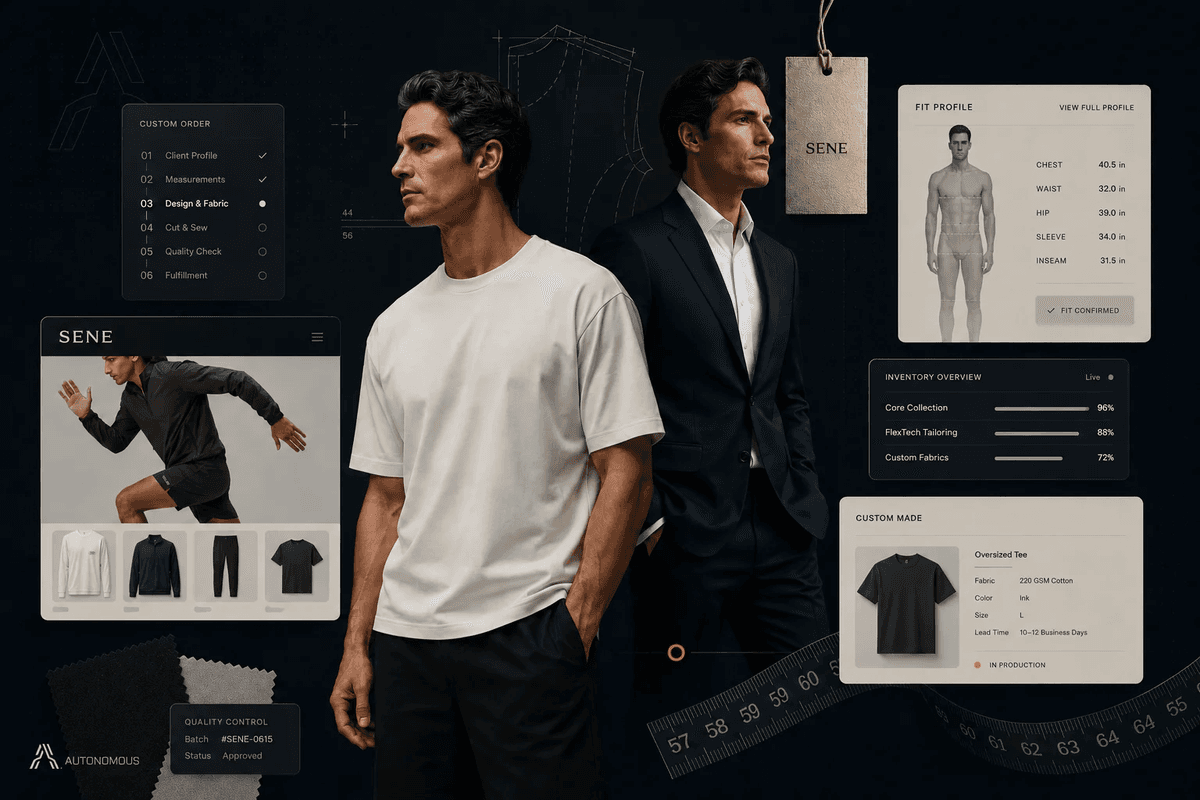
SENE Studio makes clothes cut to the customer, not to a size chart. A shopper answers a fit quiz: a short set of questions about their body and how they like clothes to sit. The brand turns those answers into that person's measurements. The order reaches a garment factory as a finished set of numbers for one person. Nothing is cut until somebody buys.
Shopify runs the shop, the customer record and the payment. It has no idea what a body is. It does not know that each factory shapes a garment differently, or what a remake is: the replacement you make when the first garment does not fit. SENE works with four factories and no two agree on anything. One takes orders line by line. One takes a spreadsheet. One wants millimetres, another inches.
Some plumbing was already there, and the code says so. The client's older codebase, started in January 2021, held scripts that pulled orders, worked out measurements and talked to a factory. The real problem was two sets of code running side by side for years. One was PHP, one was Python. Nobody owned the join. An outside agency held the PHP half, and not one of its 44 changes was checked by a second person.
More from this build
Made to order on Shopify: the shop is the easy half
The money in a made to order business leaks between checkout and the factory floor. It goes on the hours a person spends moving an order between two screens, and on the garment cut from a wrong number. Autonomous Technologies builds the order layer that closes that gap for Shopify brands. SENE Studio has been one of them since April 2022.
Every figure on this page is a count from the platform's own code history, taken on 20 September 2026. No revenue, order-volume or remake-rate figure has been released for this account, so none appears here.
A thin pipeline is harder to replace than no pipeline. Nobody can stop the shop while you rebuild. The old PHP code was retired one piece at a time, between February and April 2026, with both halves serving customers throughout.
What we built, and which part the client kept
The order platform is a Django application. Django is the Python toolkit their own engineers already used. It holds the quiz answers, the measurements, the fit-update process, the remake rules and the factory routing. Four factory routes sit behind one shared connection, added one at a time. The first went in August 2023, the fourth in March 2025. Source: the four routing modules in the platform code, checked 20 September 2026.
Next to it sits the operations console. That is the screen where SENE's staff work fit updates, track fabric stock and clear the queue of orders waiting to ship. Our work on it runs from 4 April 2024 to September 2026: 654 changes across 30 of 31 months, 215 of them reviewed and accepted. Source: the console's commit history and merged pull-request search, counted 20 September 2026.
The client's own engineers never left the room. Both SENE founders wrote code alongside our team, on the same tickets and reviews. In August 2026 one of them took the storefront over outright, a cost decision helped by AI tools making a small team more self-sufficient. The work changed shape rather than ended, which beats a vendor nobody can remove. The longer arc is in the four-year platform partnership.
An order that cannot be routed wakes a person up
Honest automation does not mean nothing needs a human. It means the exceptions find one fast.
When an order cannot reach a factory, a catcher picks it up and posts an alert into the team's Slack. It does not fail quietly. The catcher shipped in September 2025 and covered batch orders within three weeks.
An asterisk is not a source. The earlier version of this page claimed 6x revenue growth, $10M+ in revenue processed and 100 percent of manual entry eliminated. No export, repository or client document supports any of the three, so all three are gone rather than footnoted.
Four rows moved and three say not measured, because no remake rate, order volume or operator-hours figure was ever released.
| Before, Apr 2022 | Last check, Sep 2026 | |
|---|---|---|
| Where factory routing lived | scripts plus an outside vendor's PHP code | one platform, four routes |
| Second pair of eyes on that code | none, 0 of 44 changes reviewed | 1,203 reviewed changes |
| Automated tests on it | not measured | 2,664 tests across 172 files |
| Releases you can point at | none for the first 29 months | 98, Sep 2024 to Sep 2026 |
| Orders reaching a factory untouched | not measured | not measured |
| Remake rate | not measured | not measured |
| Operator hours per week on orders | not measured | not measured |
What changed on the code, and what nobody measured
Time is the saving here, and it is the one nobody counted. Adding a garment type, a factory or a market used to take an engineering project. Now it is a settings change. The hours that used to go into moving an order between two screens came back, but no before picture exists to size them.
Sources for the table. 1,203 merged changes: a merged pull-request search on the platform repository, 9 September 2026. 2,664 tests across 172 files: a count at the repository tip of 8 September 2026. 98 releases: the tagged versions, first 25 September 2024, last 1 September 2026. 0 of 44 reviewed changes: the PHP service's own commit history, June 2021 to July 2024.
A blank row is a finding. Three rows above say not measured, and they stay in. A table showing only what moved is a sales sheet.
What we would do differently, and who this is not for
Three things. We would have asked for the remake rate in year one, while a baseline was still cheap. A baseline is the before picture you take so you can prove a change later. Here nobody took one. We would have built the catcher before the fourth factory, not after the third. And we would have timed the fit-update queue once before the console shipped.
This is for you if your shop is the easy half of your business, if a person still moves order data between two screens by hand, and if your engineers want to stay in the code. It is not for you if you want a theme refresh, or a lift promised before anyone has measured your before picture. On keeping review in human hands, see agent-authored features behind a human gate.
Get back the hours a person spends carrying orders between two screens
The return on this work is time you stop paying for: the hours somebody spends moving an order from the shop to the factory, and the remakes that start with a number typed wrong. Neither shows up in a theme refresh.
Take one order from checkout to the factory floor and mark each point where a person opens a second screen. That short list is where your hours go. Reading it costs an afternoon. Rebuilding on a guess costs a quarter. Send us the list and you get a written map of where the hours go, before anyone touches your code. The wider approach is on the ecommerce operations page.
Questions and answers
Can Shopify handle made-to-order garments on its own?
Not the measurement and production half. The layer that turns a fit quiz into an order a factory can cut sits outside Shopify. That is what we built here across 54 months.
How long does it take to add a fourth factory?
For SENE the four routes went in one at a time between August 2023 and March 2025. Once the first exists, a new one is a settings change plus a small file-format converter.
What happens when an order cannot reach a factory?
A catcher picks it up and posts a Slack alert to the team instead of failing silently. It shipped in September 2025 and covers batch orders as well as single ones.
Did this increase SENE's revenue?
We cannot show that and we will not claim it. No revenue, order-volume or remake-rate figure has been released for this account. This page carries counts from the code and nothing else.