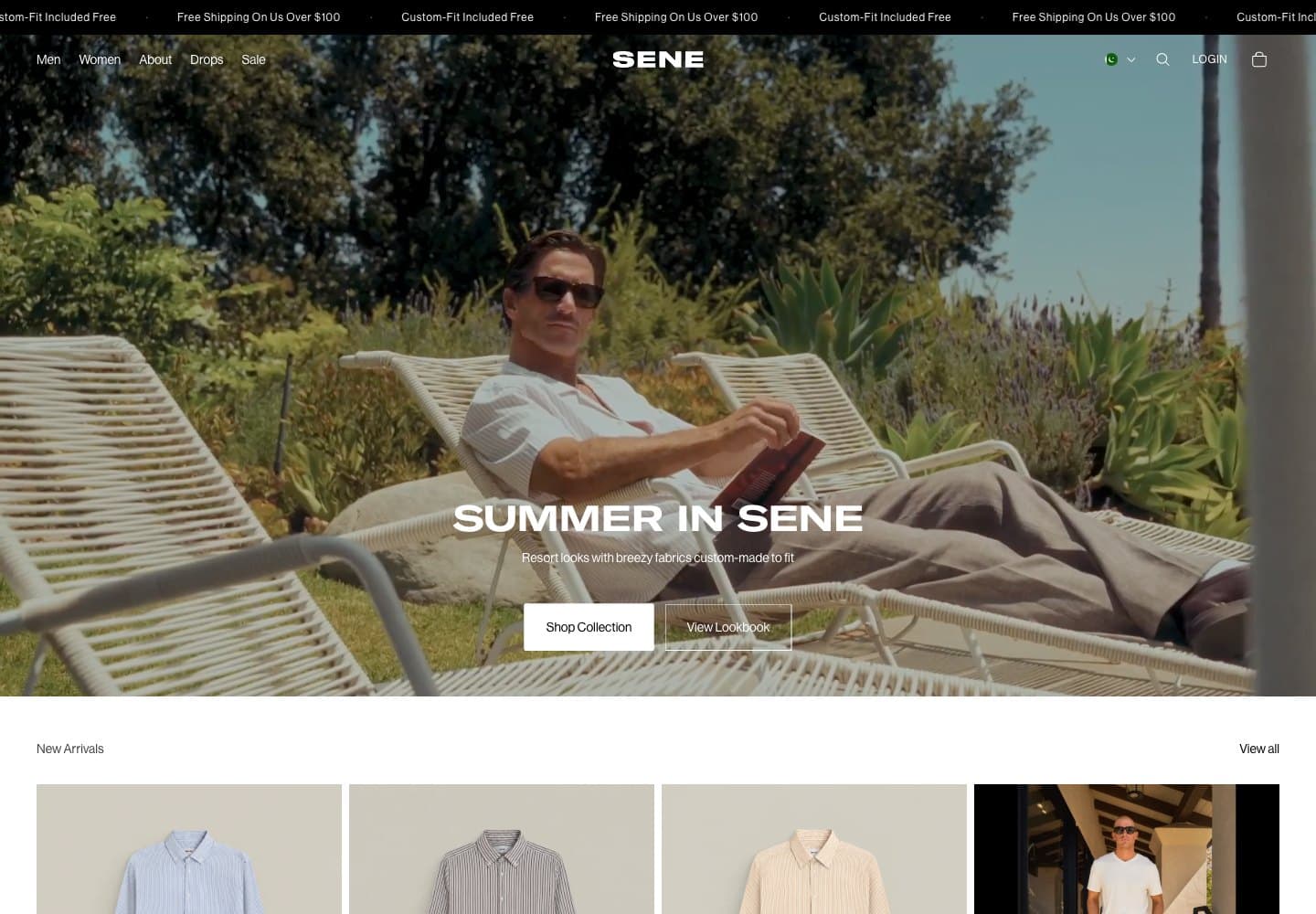
A shopper pays for a suit cut to their own body. There is no size to pick. The order must reach a factory that wants a different file and unit than the last one. Sene Studio sells that way every day. Autonomous Technologies builds the systems behind stores like theirs. We have run this one since April 2022. This is what four years of Shopify custom app development look like from inside the code history.
| What we counted | Figure | Period |
|---|---|---|
| Months with work on the platform, no gap | 54 | Apr 2022 to Sep 2026 |
| Reviewed changes merged, GitHub API count | 1,203 | Apr 2022 to Sep 2026 |
| Tagged production releases | 98, about four a month | Sep 2024 to Sep 2026 |
| Sene ticket numbers in our commits | 470, across 688 commits | May 2023 to Sep 2026 |
Shopify ends at the payment, and the garment starts there
Shopify holds your customers, your orders and your money. It has no idea what a person’s body is, or what a remake is: a second garment, cut again to corrected numbers, at your cost.
Sene had a pipeline before we arrived. It was thin, not missing. Scripts from January 2021 already moved data between shop and factory, but nobody owned the join.
The work started as freelance fixes through Upwork, then grew into ongoing engineering. The first saved change is dated 16 April 2022.
One place where a paid order becomes a production job
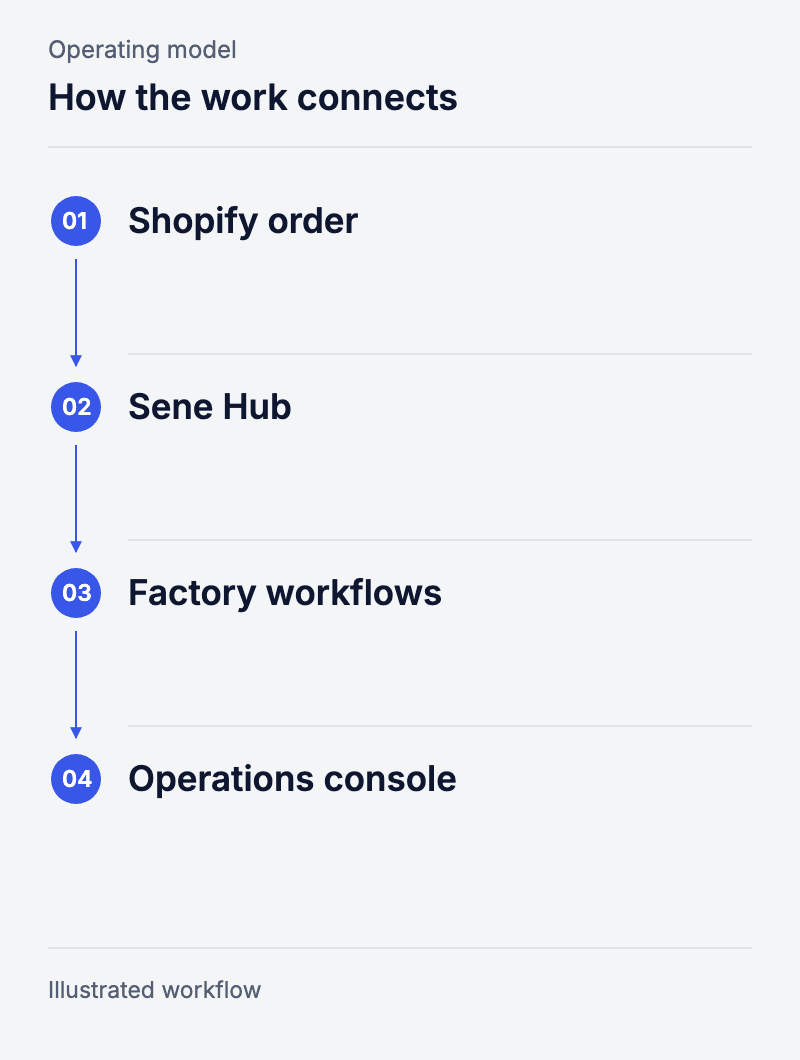
We built Sene Hub, a Django application that sits beside the shop. Shopify stays the shop. The Hub holds the quiz record, the order, the fit update, the remake, factory routing and the fulfilment check.
A fit update is the customer telling you the garment came back wrong. Before the Hub, someone worked that out by hand.
A shopper takes a fit quiz. The platform produces that person’s measurements. The order reaches a factory as finished measurements, the exact numbers it cuts to. Work that would leave a shopper waiting runs in the background.
Four factories that agree on nothing
One factory takes orders one line at a time. Another takes a whole order as a spreadsheet. Each reports fabric stock its own way.
We did not write four pipelines. We wrote one order workflow and a small plug per factory. The fourth went live in March 2025, switched on per product from a settings screen rather than by a developer.
Operations staff got buttons, not database rows
Routing is half the job. The console is the other half, set up by the prior agency in March 2024. Our work on it runs from 4 April 2024 to September 2026.
Staff work fit updates there. They read the measurement history of one garment. They hold a garment on an order and release it later. They push a change back to Shopify and sign a review with a real name.
Those are the moves automation cannot make for you.
Sene’s founders hold merge rights, the power to approve a change into the live code. They review our work and press the button. A change of engineer reaches their queue before it reaches an invoice, so a handover here cannot pass unseen. Ask for that on your own build.
The founders never left their own codebase
None of it ran without the client. Mark Zheng and Ray Li founded Sene, and they are in the code too. Mark has saved changes to the platform since January 2023 and was still doing it in September 2026. Ray rebuilt the fit quiz himself.
Two lead engineers changed on our side over four years. Both times the outgoing engineer was still shipping when the incoming one started. Abdullah, our co-founder, stopped leading the platform in December 2025 and stayed as a reviewer.
In August 2026 the storefront moved to Ray. That was a cost decision, not friction: money is tight everywhere, and a small founding team can now do more on its own.
We tagged no releases for the first 29 months. The first is dated 25 September 2024, and there are 98 in the 23 months since. The first two years have a real gap in the audit trail. We would rather write that here than let you find it.
The review gate caught a defect in agent written code
Between 7 August and 8 September 2026 the platform took in 22 reviewed changes written by a software agent, the console 15. Sene’s founders extend the platform that way now, in code they own.
The gate earned its keep. In August 2026 a review caught an export that could have run a formula on a staff machine. Abdullah flagged it before production. The full write up is in the agent authored features study.
Work written by an agent is fast, and does not review itself. Decide who signs it off and owns the defect if one ships, before the first branch opens.
What changed between 2022 and 2026
| What changed | Before | Now |
|---|---|---|
| Adding a garment factory | An engineering project | One plug, switched on per product, since Mar 2025 |
| Standard sizes sold abroad | Not offered | Live since 10 Mar 2025 |
| Custom fit in Canada | Not offered | Live 7 May 2025, narrowed by product type 19 May |
| An operator tool for fit updates | None before Mar 2024 | Our console work from 4 Apr 2024 |
| Tests on the platform | 1,758 in 121 files, 1 Jul 2026 | 2,664 in 171 files, 8 Sep 2026 |
| Revenue, orders, remake rate, staff hours saved | Not measured | Not measured |
Read that last row first. Sene has not released a business figure, so we printed none.
Thirty three of the 2,275 saved changes are labelled hotfix, an urgent repair after release. Small, not zero.
What we would do differently, and who this is not for
We would tag releases from month one, not month 30. We would also have put the fit update and remake numbers in front of the client monthly. Then this page could show you money saved, not code history.
This is for you if the custom layer is your business: a fit quiz, a made to order flow, a configurator, a gap between what your shop knows and what your factory needs. Every order your team re-keys by hand is a remake waiting to happen, and a remake costs you the fabric, the factory slot and the customer. Taking those hours and that cost out of your week is what our Shopify platform engineering work is for.
It is not for you if an app from the store does the job, or if nobody on your side will hold merge rights. Without that, a change of engineer costs you months of rediscovery. The opposite case, a system nobody owned, is in the Container One study.

Questions and answers
When does a Shopify store need a custom app instead of an app from the store?
When your core workflow crosses systems no app can express. At Sene that was custom orders, fit updates, remakes and four factories with four different contracts. If an app does the job, buy the app.
What does Shopify custom app development involve for a made to order store?
An application beside your shop that you own. It holds the quiz record, the order, fit updates, remakes, factory routing and the fulfilment check, plus a console your staff work in.
Can our own team maintain and extend it?
Yes, if you own the code and hold merge rights from day one. Sene’s founders do both, and extend the platform themselves.
How do we judge whether a partner will still be there in year three?
Ask for the handover record. Ask whether the outgoing engineer was still shipping when the incoming one started. Ask to see your ticket numbers in the history.