
Your ops team types product codes by hand. A customer changes their address after ordering. The old one is already cut into the factory order, so you pay for the remake. A fit update fails quietly, and nobody sees it until the order is downstream. At Sene Studio those were open tickets, waiting on hands the team did not have. The backlog cleared in eight weeks. A named person accepted every one of the thirty-seven changes.
| What we counted | Figure | Period |
|---|---|---|
| Changes merged into the two systems that run orders | 37 pull requests | 14 Jul to 8 Sep 2026 |
| Merged without a named person accepting them | 0 | same window |
| Sent back after review before they could ship | 5, four of them serious | 18 Aug to 4 Sep 2026 |
| Database queries for one 13-row admin page | 113 before, 17 after | measured against the previous code, merged 8 Sep 2026 |
Sene’s costly mistakes are the quiet ones, not the crashes
Sene Studio is a Los Angeles made-to-measure clothing brand. Nobody picks a size. We have built and run its Shopify operations platform since April 2022. That is the system holding orders and sending each one to an outside garment factory, plus the dashboard the ops team works in all day.
This is not a marketing site. A wrong size record becomes a real garment, cut wrong, shipped, and remade at Sene’s cost. A crash you can see. Bad data you cannot.
By mid-2026 the ticket queue had outrun the team. Dashboard changes fell to three in June, down from thirty-seven in January.
A machine wrote thirty-five of the changes, and a person still held every merge
Between 14 July and 8 September 2026, thirty-seven pull requests reached the shared branch across the two systems. A pull request is one bundle of change that somebody proposes and somebody else accepts. A merge is the moment that bundle enters the code your live orders run on.
A coding agent wrote thirty-five of them, each on a branch with a reserved name. So its work stays easy to tell apart from ours.
None of them let themselves in. Mark Zheng, Sene’s co-founder, merged thirty-four. Danial, an Autonomous engineer, merged three. There was no bot account and no auto-merge rule.
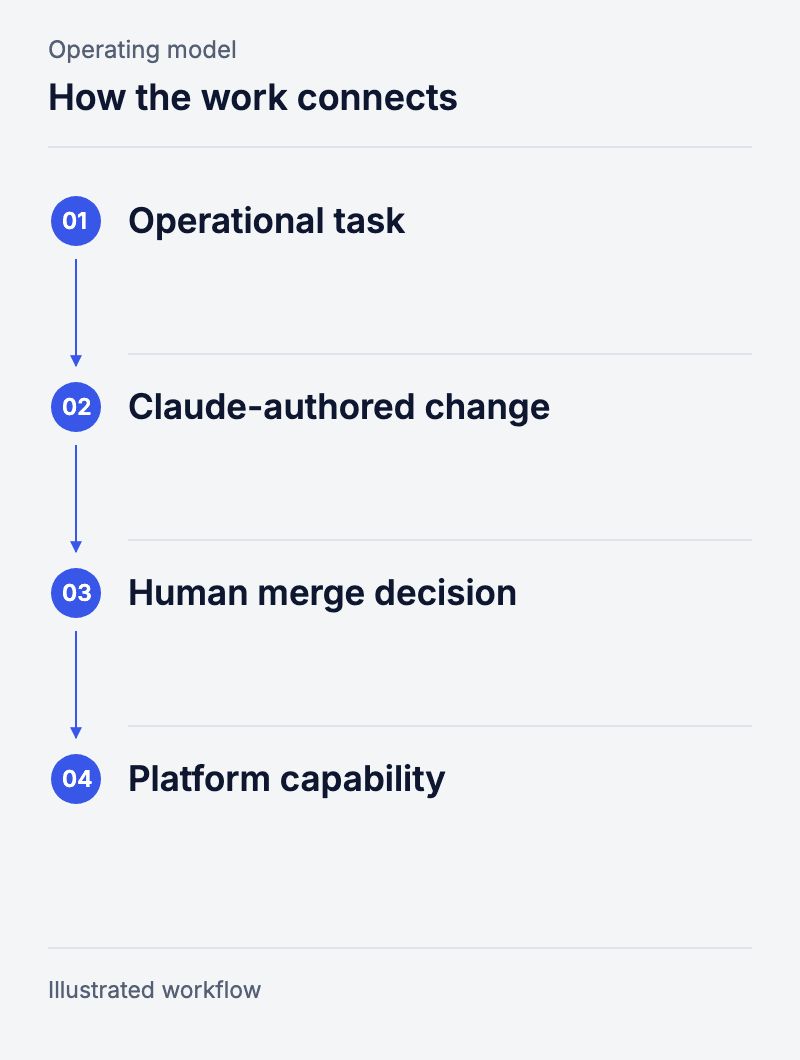
A branch is not a shipped feature until a named person merges it. Sixteen machine-written changes still sit on eight branches nobody accepted. They are pipeline, not delivery, and are not in the thirty-seven.
Review caught the same export bug twice, seventeen days apart
On 18 August the reviewer blocked a new export. An export here is the button that turns a dashboard table into a spreadsheet file. Spreadsheets run any cell that starts with an equals sign, even in quotes. Those cells held product names taken from the catalogue. The fix made that text safe, with a test to keep it safe.
Seventeen days later the same export moved to the server, and the same bug came back on the other side. The reviewer caught it again. In that pass he caught a second one. An export over its row limit reported success and returned a file that stopped early, which looks exactly like a complete file. Anyone checking that list against a factory would have checked a partial list without knowing.
A reviewer skimming code finds the first bug. Only a reviewer who knows the workflow finds the second. That is the case for keeping operations and fulfilment systems with someone who knows what the data is for.
Fixing a bug on one side of an interface does not fix it. Put the same guard on both sides and in your release checklist. The second one arrived weeks later under a different ticket.

What Sene’s ops team can do now, and what nobody measured
| The job | Before | After | When |
|---|---|---|---|
| Creating product codes | typed by hand | generated from the dashboard, with a searchable log | shipped 18 Aug 2026 |
| Address changed after ordering | the old address went to the factory | corrected first, and fulfilled orders held back | shipped 11 Aug 2026 |
| A failed fit update | found downstream | listed on the error queue, with the approver's name | shipped 24 to 30 Aug 2026 |
| One 13-row admin page | 113 database queries | 17 queries | measured against the previous code, merged 8 Sep 2026 |
| Ops hours saved, remakes avoided | not measured | not measured | no baseline was taken |
The last row is the honest one. Nobody counted hours, remakes or defects beforehand. There is no productivity multiple here and we have not invented one. The query figure is measured against the old code, not live traffic.
What a Shopify development agency still owns is the merge standard
If you are choosing a Shopify development agency this year, the question is no longer who writes the code. It is who accepts it, and what they know.
Five of the thirty-seven carry a commit answering review notes point by point. For the other thirty-two, the record shows who merged and nothing about what was read. We would rather say that than imply a process the record cannot show.
About half the merged output is test code. Tests check that code does what it was told. They never ask whether it should do that at all, which is the question that catches a colour name read as a size.
Treat any count of machine-written work as a floor, not a census. Thirty-one further changes this window carry a co-author line under a human name. Nobody can tell you which lines a model wrote.
Who this fits, and who it does not
This fits you if you have three things: a working platform, your own ticket queue, and someone who can say whether a change is right for the business. Sene had all three, plus four years with the same team on this platform and the storefront work in front of it.
It does not fit you if nobody owns the domain on either side. Without a reviewer who knows what a record means, the gate is just a signature, and the errors stay quiet until a customer finds them.
We would do one thing differently: measure first. A week of baseline on ops hours and remakes would have made this a business case.

Questions and answers
Who decides what enters the shared branch?
A named person, every time. Across thirty-seven merges between 14 July and 8 September 2026, Sene’s co-founder accepted thirty-four and an Autonomous engineer accepted three. No bot account, no auto-merge rule.
What does a Shopify development agency do once code gets cheaper to write?
It holds platform knowledge, integration judgement and the merge standard. Here that meant catching one spreadsheet bug on both sides of the interface, seventeen days apart, in work that had already passed its tests.
Can you prove every change was reviewed?
No. Five of the thirty-seven carry a commit answering review notes. For the other thirty-two the record shows who merged, not what anyone read. We say so rather than imply otherwise.
What kind of work suits this?
Work with a named ticket, a clear job to do, and a reviewer who knows the cost of getting it wrong. Product codes, factory filters and address handling all qualify. Anything near your pricing or sizing rules needs a higher bar.
Do tests remove the need for review?
No. Roughly half the output here was tests, and they still did not ask whether a colour name should count as a size. That question needs a person.