
The nightly job fails at 02:14. Somebody has to know which of three things broke. A driver that ran out of memory. A cluster that never came up. A library that moved a version. That question, not a feature list, is what splits Databricks from running Apache Spark yourself.
Apache Spark is an open-source distributed processing engine. Databricks is a managed platform that runs Spark and adds notebooks, cluster automation, and governance through Unity Catalog. The real question is not which is faster. It is how much of that surrounding platform your team wants to operate. Below roughly two full-time data engineers, managed usually wins.
That two-engineer line is our rule of thumb from platform work, not a benchmark. The rest of this page shows how to find your own number.
Pick wrong and you pay twice. Once for the platform, and once for the engineer hours it was meant to save. Most platform arguments turn out to be staffing arguments. So the first question in our engineering work is never the platform. It is who takes the 02:14 page.
This is for the team that will run it, not the team that will demo it
Read this if you have a data workload in production or close to it, a named team that will operate it, and a decision to make in the next quarter. It helps most when someone has already asked why the cloud bill moved.
Who is writing. Autonomous Technologies builds and runs the data systems behind online stores, so owners stop losing mornings to failed jobs and numbers that do not match.
Skip this if you are exploring Spark on a laptop or a single node. Neither platform choice matters yet. Come back when a second team depends on the output and a job failing overnight costs somebody their morning.
Databricks vs Spark at a glance
| Decision area | Databricks | Self-managed Apache Spark |
|---|---|---|
| Core | Spark plus managed services. | A Spark runtime you build a platform around. |
| Setup time | Create a compute resource and run. | Four assembly steps before the first production job. |
| Cluster lifecycle | The platform starts and runs the compute. | Your team starts, tunes, upgrades and retires it. |
| Developer workflow | Shared notebooks, jobs, SQL and workspace controls. | You pick the notebooks, repos and schedulers. |
| Scaling | Managed or serverless, where supported. | The cluster manager and the capacity are yours. |
| Governance | Unity Catalog can hold access, lineage and audit. | You wire up catalog, identity, policy and audit yourself. |
| Cost inputs | Platform use, cloud, storage, contract terms. | Cloud or metal, storage, network, software, and people. |
| Lock-in | Runtime features, habits built on Delta Lake, the open table format Databricks created, and contract terms. | Your own tooling, and the people who know it. |
| Best-fit team size | Fewer than two full-time data engineers on the platform. | Two or more, with on-call cover already in place. |
What is the difference between Databricks and Apache Spark?
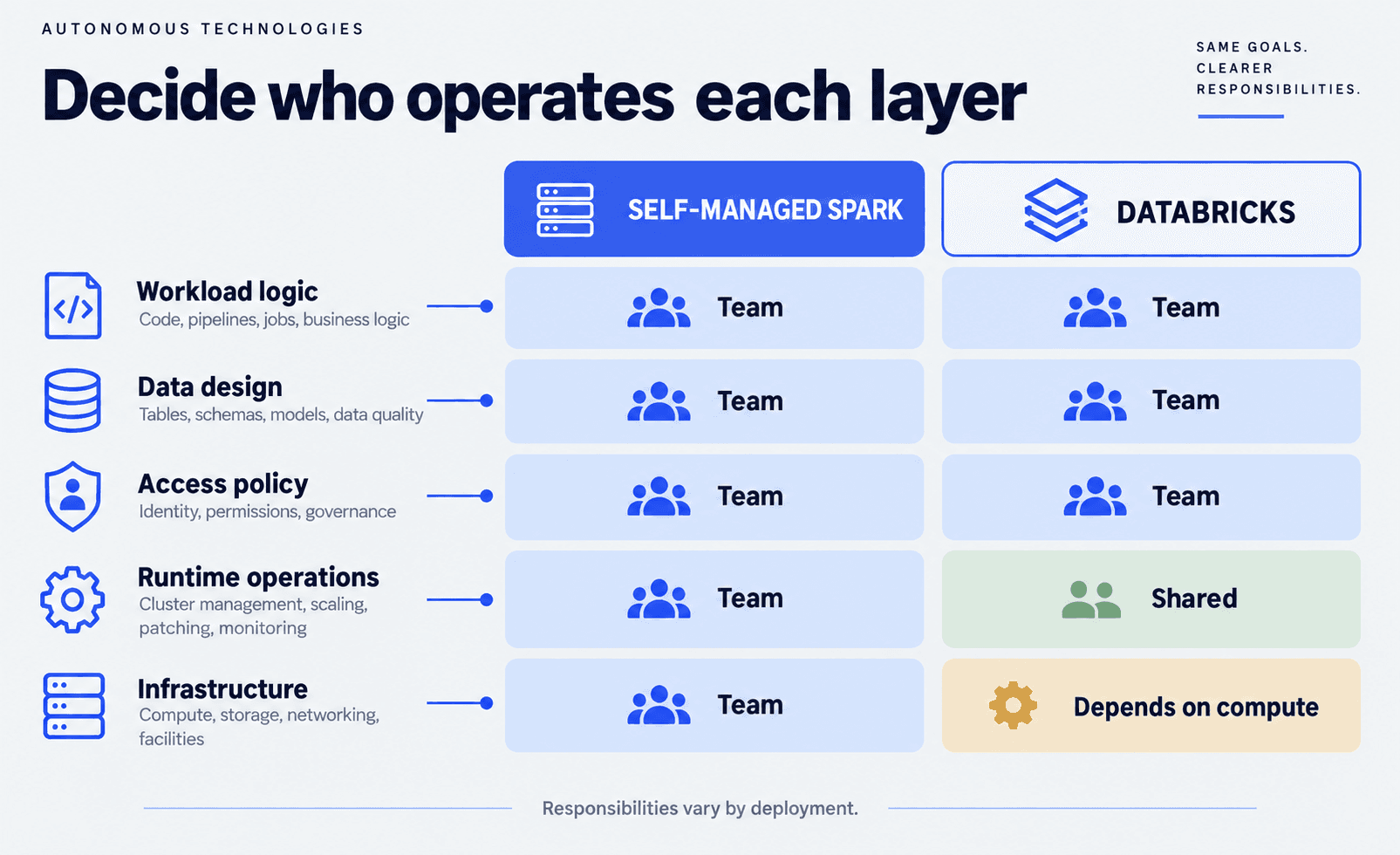
Apache Spark gives you APIs and a runtime for spreading data work across machines. It covers batch, SQL, streaming and machine learning. A Spark job runs as a driver, the process that directs the work, plus executors, the ones that do it. A cluster manager sits under that. It is the scheduler that decides which machine runs which part of the job. Spark’s own cluster overview names three: its standalone manager, Hadoop YARN, and Kubernetes.
Databricks uses Apache Spark at its core. Its runtime adds its own tuning. The service adds managed machines, notebooks, scheduled jobs and SQL warehouses. Databricks says Spark is set up and deployed for you when you create a cluster or a SQL warehouse. That moves the boundary. Your team still designs the data platform. It does less cluster assembly and less day-to-day plumbing.
The useful question is who owns each part: the machines, the upgrades, the access rules, the deploys and the bill.
What self-managed Apache Spark really means
Self-managed Spark appeals because the engine is free and you can shape it. Run it on Kubernetes, YARN or Spark standalone. You pick the machines, the file format, the network, the login system and the pace of upgrades.
That flexibility also creates systems to operate:
- Rent the machines and set up the disks, the network and the passwords.
- Pick a cluster manager and decide how jobs share the machines.
- Pin versions of Spark, Python or Scala, and every library, so they work together.
- Build the deploy steps, the schedule, the alerts, the access rules and the upgrade plan.
The Spark cluster overview covers the engine and nothing else. A shared production platform still needs an owner for failures, upgrades, capacity and access.
What Databricks buys you
Databricks wraps the Spark runtime in a wider surface. Its compute docs name three types: serverless, classic, and SQL warehouses. Serverless here means the platform starts the machines for you and you never size them. You also get notebooks, jobs and workspace rights.
For SQL-heavy work, a Databricks SQL warehouse is managed compute for queries. It starts and scales on its own. You still size the work, set the rights and cap the spend.
Governance is the other difference. Unity Catalog is one place to set who can read what. It also keeps lineage, audit logs and search. Lineage is the record of which job made which table from which source. If you want a governed set of metric names on top, that is a semantic layer and it is a separate build. Unity Catalog cuts the number of parts you assemble. You still design the catalogs, the policies and the access reviews.
Moving existing jobs is rarely free. Spark code often moves with small changes. Versions, libraries and file formats still need testing. Its Spark migration guide notes some gains rest on platform features such as Delta Lake. How you lay the tables out on top of that is its own decision, and our guide to medallion architecture covers it. If the workload feeds a model, our guide to AI data pipelines covers what sits beside the engine.
What Apache Spark costs to run, and where the breakeven sits
Apache Spark costs nothing to license. You pay for the machines, the storage and the people. AWS publishes a worked example on its Amazon EMR pricing page, read on 21 September 2026. EMR is Amazon’s managed Spark and Hadoop service. The example is one master and two core nodes, all c4.2xlarge, in US-East-1, running all 730 hours of a month.
| Line, three c4.2xlarge nodes, 730 hours | Hourly rate per node | Monthly total |
|---|---|---|
| EC2 servers, the part you pay if you install Spark yourself | $0.398 | $871.62 |
| Amazon EMR fee, added on top of the servers | $0.105 | $229.95 |
| Managed cluster total, AWS's published figure | $0.503 | $1,101.57 |
The fee for having someone else run the cluster was $229.95 a month. One day of a platform engineer’s time costs more than that in most markets. Databricks bills the same way in principle. You pay a platform charge on top of the cloud bill. It is metered in Databricks Units, the credit Databricks bills compute against. The rate depends on tier, compute type and contract.
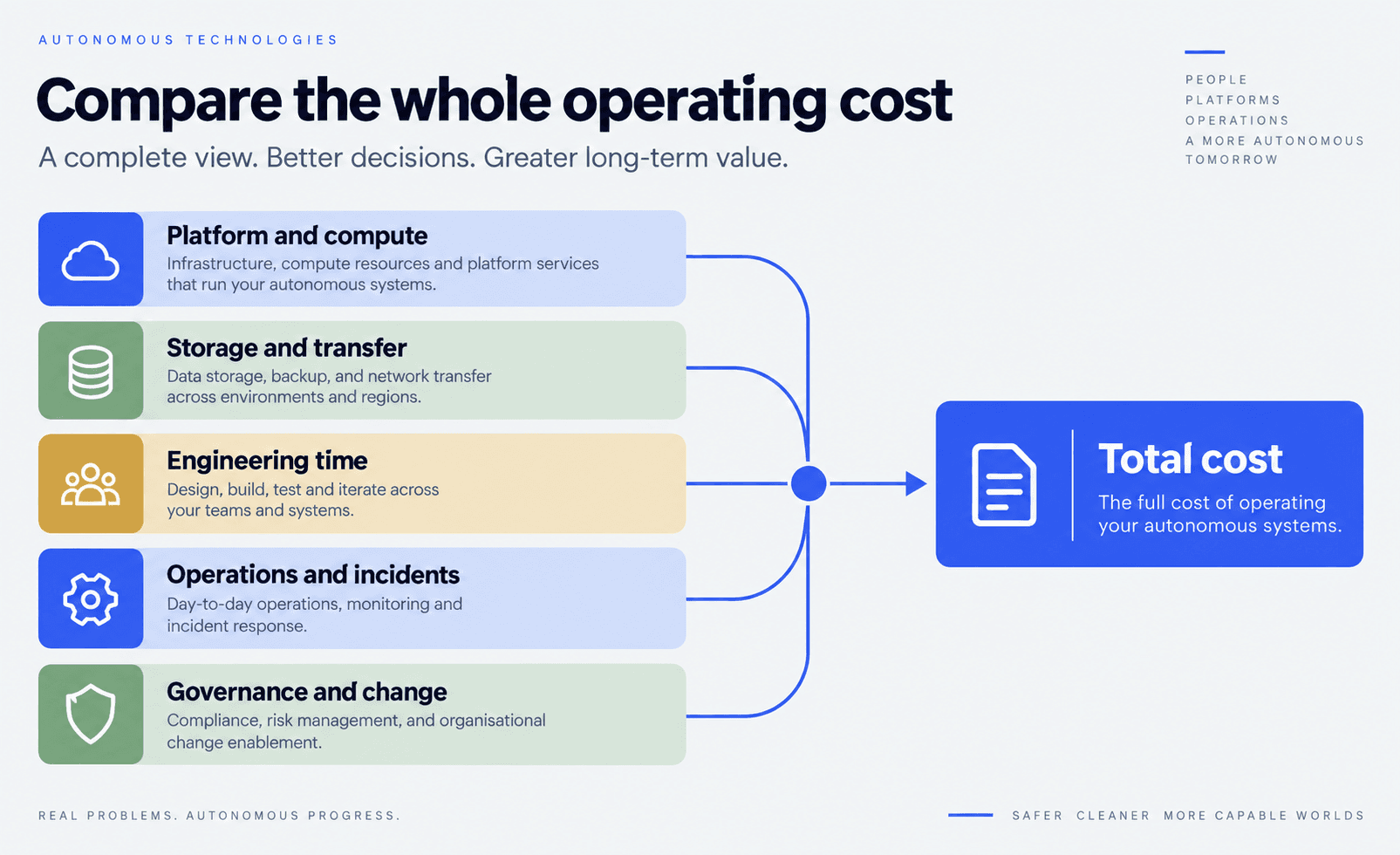
So the breakeven is a labour number, not a server number. Self-managed Spark gets cheaper only when the people who run it are already on payroll, already on call, and have hours to spare. Compare these categories:
| Cost category | Databricks | Self-managed Spark |
|---|---|---|
| Compute | Platform and cloud use, per your compute and contract. | Cloud or metal, idle hours and burst hours too. |
| Storage and network | Storage, reads, writes and data movement. | The same, plus the systems that manage them. |
| Platform labour | Less plumbing. Governance and cost are still yours. | Servers, runtime, deploys, monitoring, security, on-call. |
| Delivery risk | Defaults are faster, and they lock in choices. | A better fit, and more parts to prove. |
Databricks shows your own usage and effective price in its pricing system tables. Treat list prices as rough inputs. Contract terms and real workloads change the answer.
For a fair test, run one real workload for a set period. Write down the data read, the machine hours, the retries, the idle time and the hours your engineers spent. If the upgrade and support hours are missing, the sum is wrong.
When Databricks is the better fit
Databricks is often the better fit when several teams need the same setup soon. It helps when:
- engineers and analysts need one shared way to find data;
- work moves between batch jobs, live streams, SQL and notebooks;
- you want machines that start and stop on their own;
- access rules and audit logs must look the same for every team;
- you would rather spend time on the data than on the cluster.
The trade is platform lock-in. Your team must know the supported runtime, the compute modes, the access rules, the storage formats and the cost controls. A managed service cuts some work. It does not make the design calls for you.
When self-managed Spark is the better fit
Self-managed Spark can be the right choice when control comes first and you already run the platform around it well. Consider it when:
- Kubernetes or YARN is already your house standard;
- a job needs network or version control a managed service cannot give;
- the law fixes where your data may sit;
- your platform team can carry upgrades, alerts, security and on-call;
- staying clear of a vendor contract matters more than saving build time.
The risk is under-rating the platform around Spark. If the same engineers keep the cluster, answer pages, run upgrades and support users, any saving on servers is eaten by delay.
Where this breaks: the platform is not the thing that slows you down
Here is the objection worth taking seriously. Teams run this compare for a quarter, pick a side, and the first production workload still lands late. The platform was rarely the blocker.
Three things often are. The first is data contracts. If nobody has agreed what an order row means, which system is master, and what happens on a late correction, the engine cannot save you. The second is access: a workload that needs three approvals to read one table moves at the speed of the approvals, on either platform. The third is the on-call path. On either platform, one team stays awake for the workload, and it is yours.
Speed comes from a narrow, owned scope. On our white-label shipping work the partner had a working research platform in production 11 days after the first commit, 6 to 17 February 2026. We built and shipped it ourselves, so we know what the 11 days were made of. Nine of the commits in that window were fixes against the live server. None of them was a platform problem. It was a small surface, a named owner and one decision-maker.
So do the platform compare, but timebox it. Measure one real workload on one candidate, write down the data contract and the escalation path, and let the cost numbers settle the rest.
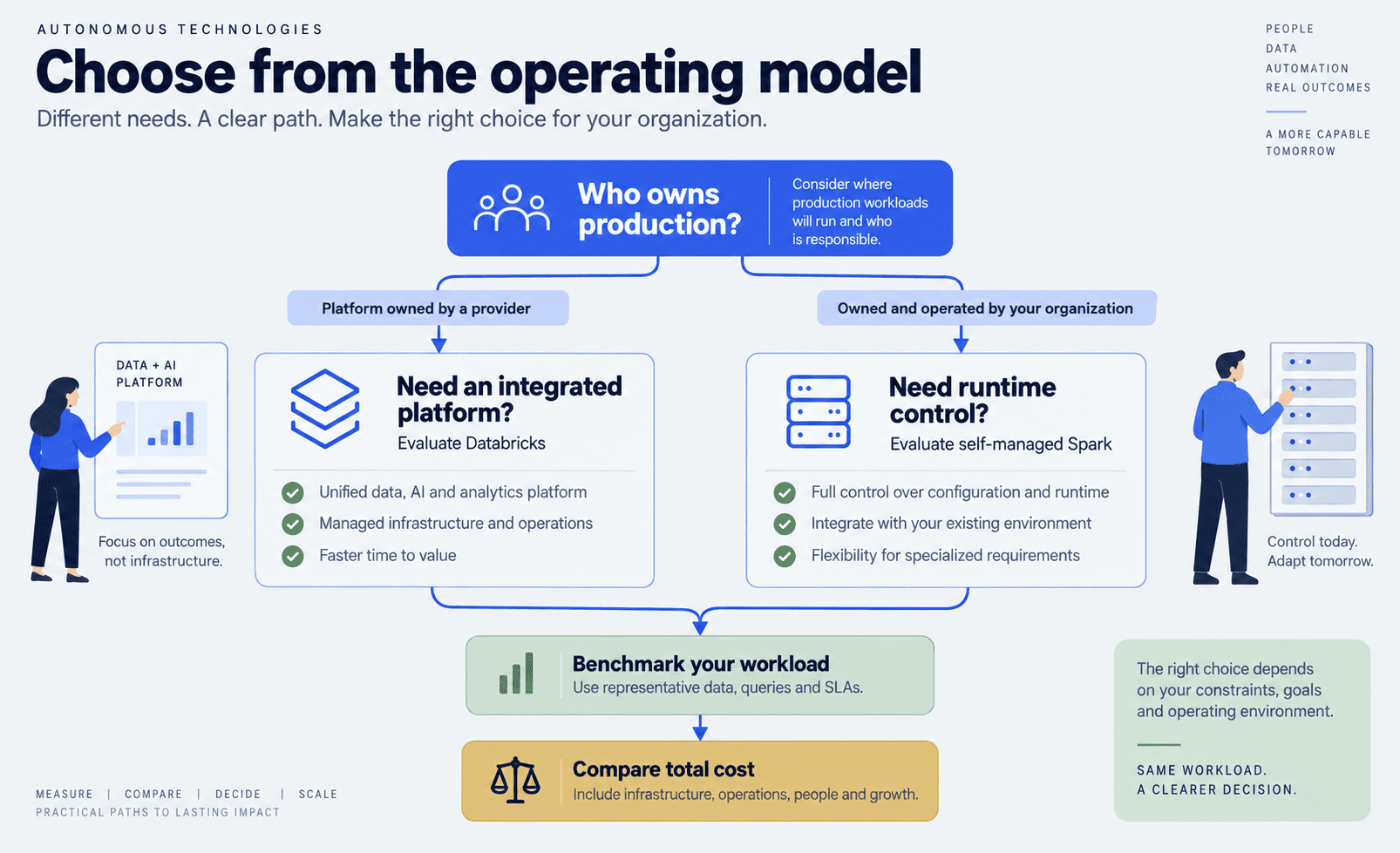
Five questions to answer before choosing
- Who owns a failed job at 2 a.m.? Name the team, the logs and the fix steps.
- Which languages and tools do you need? List Python, Scala, SQL, streaming and each library version.
- Where do the access rules live? Name who sets them, who checks them, and how long audit logs are kept.
- What does one real workload cost? Run it with the same inputs on each side, then add up machines, storage and staff hours.
- How will you leave? Write down the file formats and job packaging now, before they block a move.
Your next step is one workload, measured
Pick the workload that already hurts. Run it once on the candidate platform with the same inputs and the same acceptance checks, and record compute time, retries, storage, network and the hours your team spent. Then write one page naming the runtime, the governance owner and who answers the 02:14 page. That page decides this, not a feature checklist.
Questions about Apache Spark and Databricks
Is Databricks built on Apache Spark?
Yes. Databricks was founded in 2013 by the people who created Apache Spark, and Spark is still the processing engine at its core. On top of it Databricks adds managed compute, notebooks, jobs, SQL warehouses and governance through Unity Catalog. You are comparing the platform around Spark, not two engines.
How much does Apache Spark cost to run?
The software is free. The cost is compute, storage and engineer time. AWS’s own example of a three-node c4.2xlarge cluster running all month comes to $871.62 in servers, or $1,101.57 with the Amazon EMR fee, read on 21 September 2026. That assumes on-demand prices, no storage and no staff.
Are there managed Spark services cheaper than Databricks?
There are other managed options, and whether one is cheaper depends on your workload. Amazon EMR, Google Dataproc and Azure Synapse each run Spark for you. They charge a fee on top of the machines and give you less workspace and governance than Databricks. You trade platform features for a smaller bill and more assembly.
When is building Spark in-house cheaper than Databricks?
When the platform labour is already paid for. Our rule of thumb is two or more full-time data engineers, existing on-call cover, and a workload steady enough to run on reserved capacity. Below that, the fee is smaller than the hours. Test it with one real workload over one month before you commit.
What is Apache Spark used for?
Apache Spark is an open-source engine that splits one data job across many machines. Teams use it for batch processing, SQL queries, streaming and machine learning on data too large for one server. A job runs as a driver that directs the work and executors that carry it out.