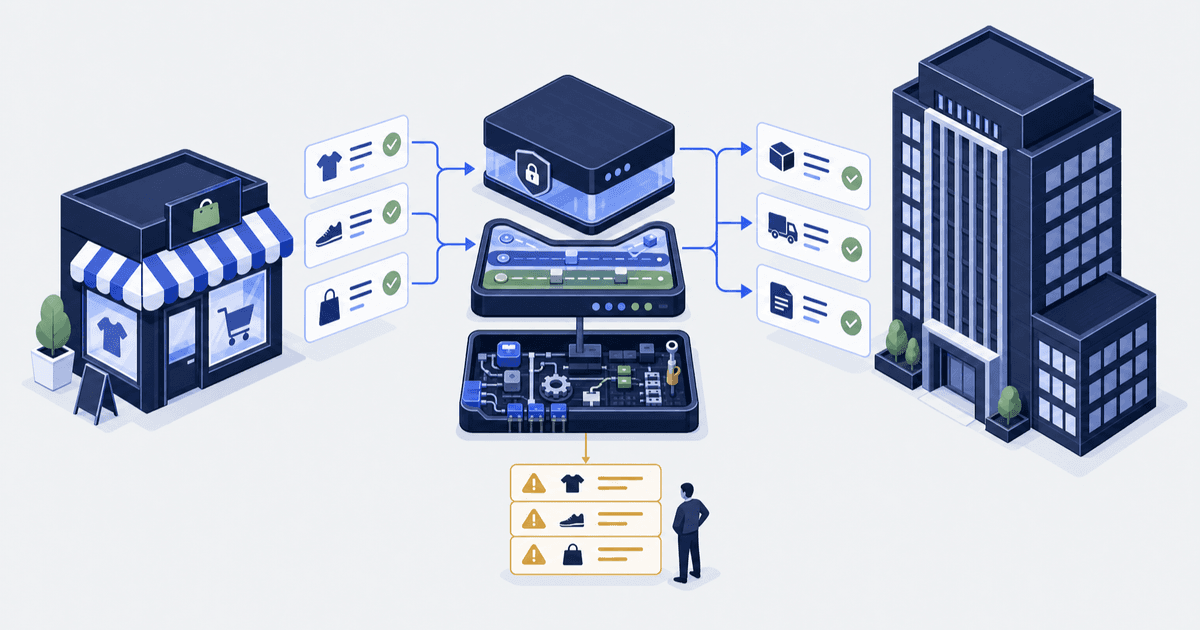
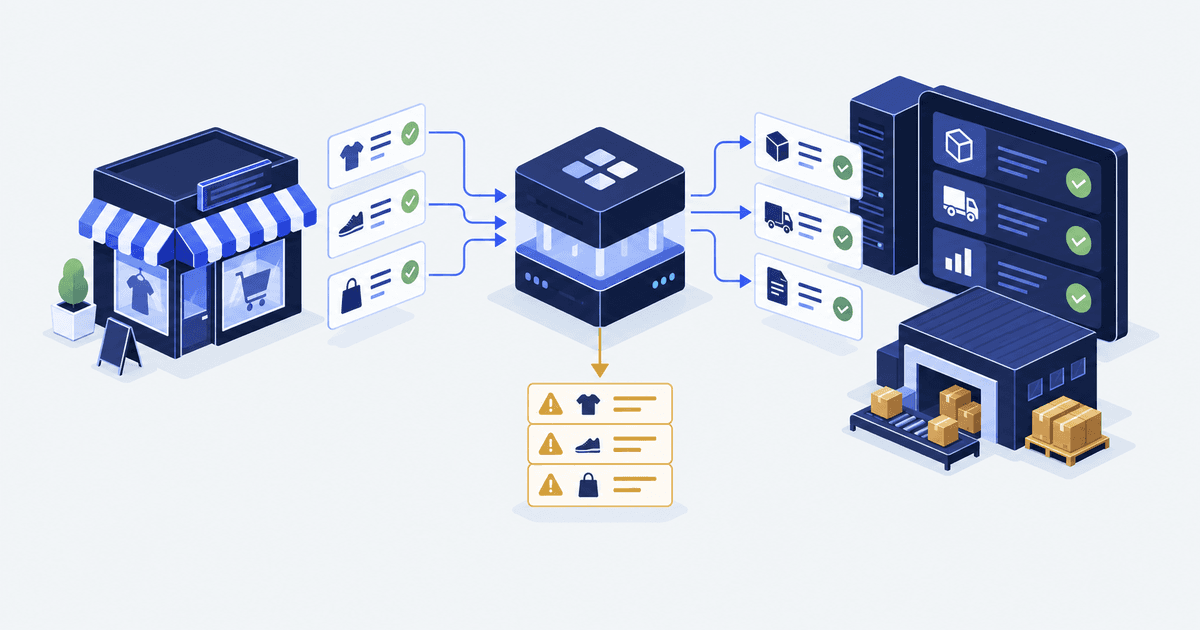
Stock is wrong in two systems, finance re-keys orders at month end, and someone has proposed an ERP to fix it. An ERP, or enterprise resource planning system, is one database that holds finance, stock, purchasing and fulfilment. A connector is the app that moves records between it and Shopify. The connector decides the outcome more than the licence does. And most stores under about $2 million a year do not need an ERP at all.
The short answer. Under about $2 million, keep accounting software and add an inventory tool. Between $2 million and $20 million, shortlist Cin7 Core, Katana, Brightpearl, Odoo, Acumatica and Business Central. Above $20 million, or with several entities, currencies or B2B price lists, it narrows to NetSuite, Business Central, Acumatica and SAP Business One.
Who this is for. Founders, operations leads and controllers at Shopify or Shopify Plus stores choosing an ERP, replacing one, or deciding whether they need one. Who this is not for. Anyone whose problem is a broken connection to an ERP they already own. That is a repair, and the Shopify ERP integration guide covers it.
We build and repair ERP, 3PL and accounting integrations for Shopify stores. We resell none of these systems, so read this as a practitioner’s list. Prices are in USD. Every figure links to the vendor page it came from, read on 15 September 2026.
| System | Revenue band and fit | Shopify connection | Published licence price |
|---|---|---|---|
| QuickBooks Online plus inventory tool | Under $2M, one entity | Intuit's own connector, plus A2X for payouts | Yes, $38 to $340 per month |
| Katana Cloud Inventory | $2M to $20M, light manufacturing | Vendor-built Shopify app | Yes, free tier then from $299 per month |
| Cin7 Core | $2M to $20M, multi-channel wholesale | Vendor-built Shopify app | Yes, $349 to $1,199 per month by tier |
| Finale Inventory | $2M to $20M, barcode warehouses | Vendor-built Shopify app | Yes, $499 and $799 per month |
| Odoo | $2M to $20M, in-house technical capacity | Paid third-party module only | Yes, per user, plus a module fee |
| Brightpearl by Sage | $2M to $20M, retail and wholesale | Vendor-built, onboarding-led | Vendor does not publish |
| Acumatica | $5M to $50M, many occasional users | Vendor-built native connector | Vendor does not publish |
| Dynamics 365 Business Central | $3M upward, documented sync behaviour | First-party Microsoft connector | Yes, $80 and $110 per user per month |
| Oracle NetSuite | $20M upward, multi-entity finance | Oracle connector app, or an iPaaS | Connector app yes, licence no |
| SAP Business One | $20M upward, existing SAP supply chain | Partner and iPaaS connectors only | Vendor does not publish |
Buy for the structure, not the revenue number
An ERP earns its place when one database must hold finance, stock, purchasing and fulfilment across more than one channel, entity or warehouse. Revenue is only a proxy. The real triggers are structural: a second sales channel, a second warehouse or 3PL, a second legal entity or currency, wholesale price lists, or manufactured goods. Two of those together is when the spreadsheet stops working.
Under about $2 million a year. If one person can still answer “how many of this are sellable, and where” without opening three tools, keep QuickBooks Online or Xero. Add an inventory system that owns stock.
About $2 million to $20 million. The decision is open. Cin7 Core and Katana fit if the constraint is stock and production. Brightpearl, Acumatica, Business Central and Odoo fit if finance, purchasing and multi-channel work need one database.
Above $20 million, or any multi-entity group. NetSuite, Business Central, Acumatica and SAP Business One. Consolidation, intercompany accounting and how many storefronts one licence covers decide it.
A $3 million store with three entities, two warehouses and wholesale pricing has a stronger ERP case than a $12 million single-entity store with none of them. Score the structure first and the revenue band second.
Six things that break in a Shopify ERP sync
The same six questions decide whether a connector fits, whichever system you pick. Ask them in writing. Do not just watch a new order appear in a demo.
- Inventory quantity definitions. Shopify splits stock into on hand, available, committed, unavailable and incoming. Incoming stock “isn’t available to sell until it has been received” (Shopify inventory states). Ask each vendor for the arithmetic that produces Shopify’s available figure.
- Order edits after export. Shopify states that orders created by an app “can’t then be edited in the Shopify admin or by other apps” (order editing considerations). Decide which edits are allowed before go-live.
- Partial fulfilments. A partial shipment closes the original fulfillment order and “opens two new fulfillment orders” (fulfillment solutions). A connector that assumes one shipment per order misreports the rest.
- Refunds and adjustments. Refunding less than the calculated amount creates an order adjustment in the store’s financial reports (Refund resource).
- Multi-currency. Shopify carries presentment and shop amounts at once (MoneyBag object). Ask which one posts.
- B2B price lists. If you sell wholesale through Shopify B2B, connector coverage of companies and catalogues is a screening question (B2B external integrations).
Some integrations in the Shopify App Store aren't fully compatible with Shopify B2B, specifically companies and catalogs.Shopify Help Center, B2B external integrations, read 15 September 2026
The connector scope you can read before signing is the scope you will get. Microsoft, Katana, Oracle and Finale publish theirs. Brightpearl, Acumatica and the SAP partners do not, so get it in writing.
The six systems for stores under $20 million
QuickBooks Online or Xero plus an inventory tool. Intuit publishes its own Shopify connector. It imports sales, refunds, fees and payouts. It is bookkeeping, not stock control, so the inventory tool must own quantity. If the connector does not cover your flows, the remaining work is a QuickBooks to Shopify integration built around it. QuickBooks lists $38 to $340 per month (Intuit pricing).
Katana Cloud Inventory. For light manufacturing and made-to-order brands. Katana documents its formula plainly: it pushes “In stock minus Committed” to Shopify’s available field (Katana integration overview). B2B price-list behaviour is not documented, so ask. Free up to 30 SKUs, then from $299 per month (Katana pricing).
Cin7 Core. For multi-channel wholesale and distribution. The plan limits are the buying constraint. Standard at $349 per month covers 6,000 sales orders a year. Pro at $599 covers 24,000. Advanced at $1,199 covers 120,000 (Cin7 pricing). Grow past a cap mid-year and you get a price change, not a warning.
Finale Inventory. For barcode-driven warehouses where picking accuracy is the problem. Finale documents a five-minute sync in both directions (Finale Shopify integration), which is thin for a flash sale. Essentials from $499 and Growth from $799 per month (Finale pricing).
Odoo. For teams that want one modular suite and have technical capacity. Odoo has no first-party Shopify connector. The common route is a paid third-party module such as Emipro’s Shopify Odoo Connector at $634.15. Ask who maintains it across Odoo upgrades. Standard is $7.25 per user per month billed yearly, a first-year rate (Odoo pricing).
Brightpearl by Sage. For retail and wholesale teams that want an implementation partner. Brightpearl describes native Shopify and Shopify Plus integrations and per-store currency pricing (Brightpearl Shopify integration). The on-hand versus available logic sits in a help centre we could not read, so get it in writing. The vendor does not publish a price (Brightpearl pricing).
The four systems for larger or multi-entity groups
Acumatica. Priced on transaction volume rather than seats, which suits many occasional users. Its native connector imports orders “using the Shopify default currency or the entity’s base currency in Acumatica” (Acumatica for Shopify). Your controller should make that choice. No published price (Acumatica on ERP cost).
Microsoft Dynamics 365 Business Central. The best documented connection of the ten, built by Microsoft itself (connector overview). It offers two inventory formulas and raises an error on an edit to a processed order. With presentment currency selected it posts “the currency and amounts that the customer saw and paid” (synchronise orders). It does not work with Dynamics 365 Finance or Supply Chain (connector FAQ). Essentials is $80 and Premium $110 per user per month (Business Central pricing).
Oracle NetSuite. For groups that buy for consolidation and intercompany accounting. Oracle’s NetSuite ERP Connector lists at $199.92 per month for B2C Standard and $916.58 for B2B. Oracle documents that it “does not support adding items to orders” and that “each connector can have only a single store connected” (NetSuite Connector FAQ). The licence has no published price. See our Shopify NetSuite integration guide.
SAP Business One. For businesses already inside an SAP supply chain. SAP publishes no connector. The App Store listing is by eShopSync, and Celigo documents a prebuilt flow (Celigo). Every capability claim belongs to a partner, so get the record list in writing. No published price.
Which we pick, and when, from the work
We often hear “the vendor says the connector handles all of this.” Sometimes it does. What decides it is never the feature list. It is the mapping, the exception queue and who clears it on a Tuesday morning. An exception queue is the list of records that failed to sync, with a reason and an owner.
Sene Studio is the clearest example. Every order carries custom measurements. Since 2022 we have built four factory integrations that route four order types down one shared path (Sene Studio). Orders reach the factories without re-keying, and the team has a place to fix the ones that fail. The licence was never the hard part. The quantity formula, the edit rules and the failed-record queue were. At Container One, we matched legacy custom pricing on all 41 products before moving a single endpoint.
| Engagement | What moved | Figure |
|---|---|---|
| Sene Studio, made-to-measure apparel | Shopify orders to garment factories | 4 factory integrations, 4 order types on one routing path, since 2022 |
| Container One, shipping containers | Legacy custom pricing into a new pricing hub | 41 of 41 products verified at price parity, 40 depots seeded |
When a client in the $2 million to $20 million band asks, we start with Business Central or Katana if the flows are standard. Their documented behaviour lets us test the awkward cases before anyone signs. We steer toward NetSuite only when a group structure forces it.
A published price is not the cost. Budget the licence plus the monthly work: clearing exceptions, reconciling stock and maintaining mappings. Price the people first.
Where this breaks: the connector does not cover your flows
If the standard connector misses a flow, the middle option is an integration platform, or iPaaS. It is a third-party service that moves and reshapes records between systems and holds the error queue. Patchworks and Pipe17 list on the Shopify App Store. None publishes a price on its own site. Pipe17 states its “pricing is based on order volume, connections, flows, and sub-accounts” (Pipe17 pricing). Its App Store listing shows $24,000 a year for Standard. Budget a subscription plus a named person who clears its error queue daily.
Five questions to put in writing before you sign:
- Which of our flows are in standard scope? Send your record types and directions and ask for written coverage.
- What is the inventory formula? Not the field name, the arithmetic.
- What happens to an order edited after export?
- How many storefronts does one licence cover? NetSuite documents one store per connector.
- Who clears the exception queue, and who owns the monthly tie-out?
What to do next
Shortlist two systems for your structure and run the same flow list past both. The one that answers the six sync questions in writing wins. Our Shopify ERP integration guide carries the ownership map and the acceptance tests. For stock gaps once live, read Shopify inventory sync problems.
Best ERP for Shopify: common questions
What is the best ERP for Shopify for a store doing $5 million a year?
Usually Cin7 Core, Brightpearl, Acumatica or Business Central, and structure decides which. Manufacturing or assembly pushes toward Katana or Cin7 Core. Several entities or currencies push toward Business Central or Acumatica. Wholesale price lists push toward whichever vendor will demonstrate Shopify B2B companies and catalogues.
Is the best ERP for Shopify Plus different?
The shortlist is the same, but Plus adds B2B companies and catalogues, multiple storefronts and markets. Ask about storefront counts, because at least one vendor connector supports a single store per connector.
Our ERP does not fit. Do we replace it or fix the integration?
Separate the two failures. If the ERP holds the right records and the numbers are still wrong, the fault is the mapping, the quantity formula or an unattended exception queue. A replacement reproduces it. If the ERP cannot represent something the business does, such as a second entity, no integration fixes that.
Facts checked October 2026, re-check by 5 April 2027. Vendor prices and connector scope were read on 15 September 2026.