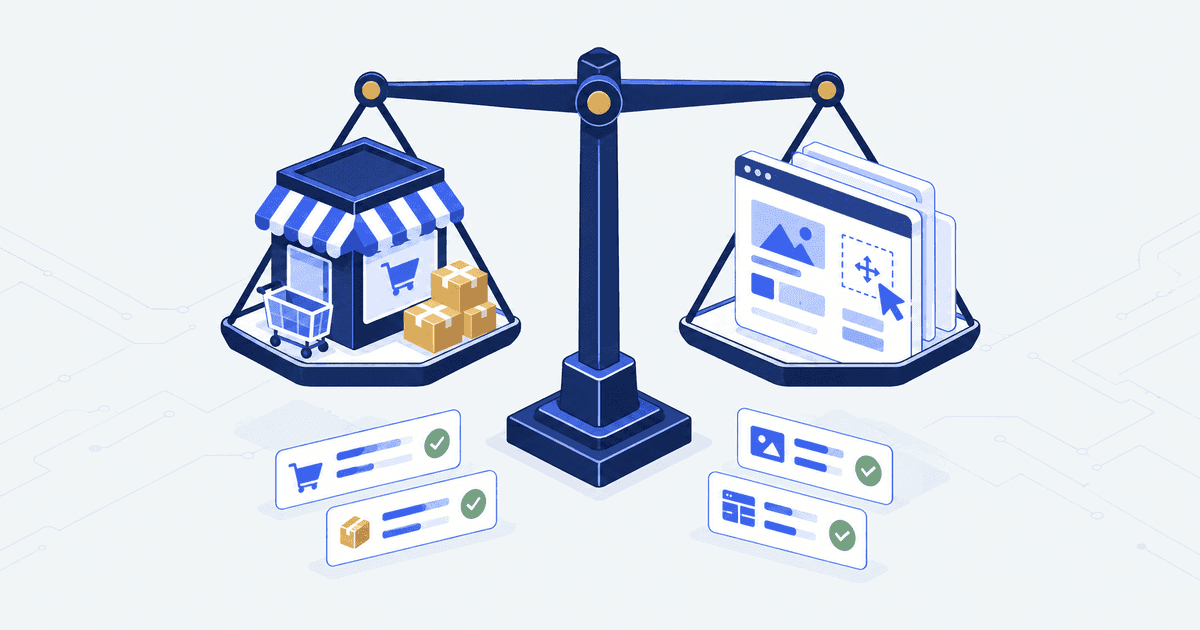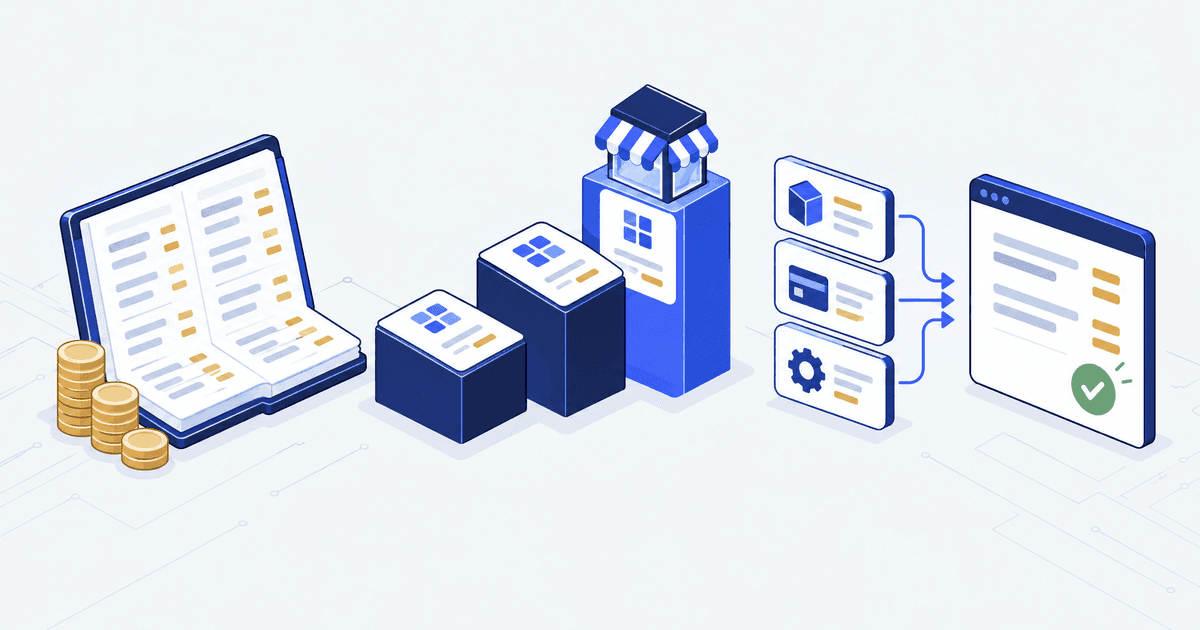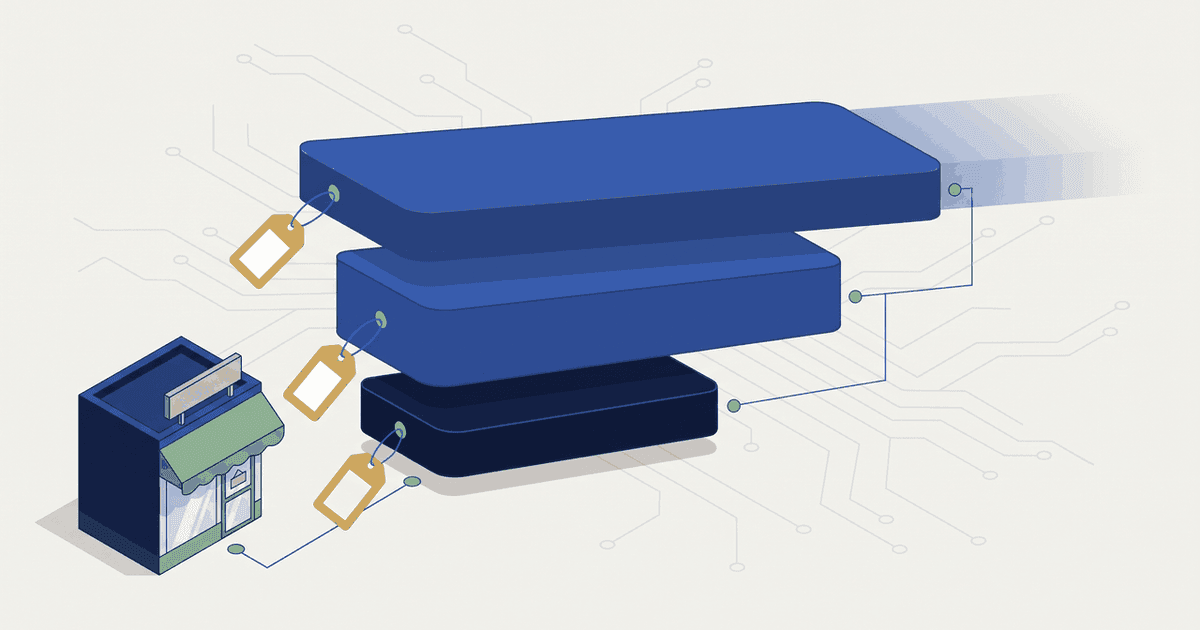

You asked three agencies what a Shopify store costs and got three numbers that are not close. Shopify cost has three layers: a plan at $25 to $399 a month, a one-time build from $3,000, and the apps and support that follow. Price each layer separately before you compare quotes.
The short answer. A Shopify store costs three separate things. The platform runs $25 to $399 a month, or from $2,300 on Shopify Plus. The one-time build runs $3,000 to $10,000 for a theme store, $10,000 to $60,000 for custom work, and $50,000 to $250,000 or more on Plus. Apps, email and support come on top.
| Stage | Shopify plan and monthly fee | Typical one-time build range | What decides the number |
|---|---|---|---|
| Testing an idea | Basic, $25 or $19 yearly | $0 to $3,000, mostly your own time (not measured) | Paid themes run $160 to $500 (read 21 September 2026) |
| First real store | Basic or Grow, $25 to $65 | $3,000 to $10,000 | Catalogue size, content, photography |
| Custom front end | Grow or Advanced, $65 to $399 | $10,000 to $35,000 | Page types, design system, apps |
| Replatforming | Advanced or Plus | $15,000 to $60,000 | Data model, redirects, old orders |
| Plus, one storefront | Plus, from $2,300 on a 3-year term | $50,000 to $250,000 and up | Checkout logic, ERP, B2B rules |
| Headless front end | Usually Plus | $40,000 to $150,000 | A second codebase to own |
Who this is for, and who it is not for. This is for the founder or operator budgeting a new Shopify store or a move onto Shopify. It is not for hobby sellers testing one product. They need a Basic plan and a free theme, which is a ready-made store design, and nothing else here. If you already run on Shopify and want to cut cost, start with the payment fee section below.
Where the build range comes from matters, so here it is. OuterBox, a US agency, puts theme work at “roughly $2,000 to $10,000+” and custom design at “often $5,000 to $20,000+”. It puts advanced or Plus work at “often $25,000 to $100,000+” (OuterBox Shopify website design pricing, re-read 5 October 2026).
The Shopify Agency Directory, re-read 5 October 2026, is the source for the custom, replatform, headless and enterprise bands. Headless means the shopper-facing site is built apart from Shopify.
Neither shows its method, so treat both as a market signal. A quote well outside both is a question to ask, not proof of a problem. Rows with no source in the table are labelled not measured. If you are weighing a Plus build, see our Shopify Plus agency work.
The three layers of Shopify store cost
Most budgets go wrong because someone prices one layer and assumes it covers the other two. Price three lines, on three billing rhythms.
Layer one is the platform fee. It is recurring, published, and usually the smallest number in the project. If you are still choosing a platform, our Shopify vs WooCommerce comparison prices the people as well as the licence. Layer two is the build. It is one-time and quoted per project, because the work is not fixed.
Layer three is ongoing: apps, which are add-ons that extend the store, plus email, support, fixes and the next round of changes. People leave it out of the first budget. It arrives every month anyway.
Budget the layers separately. A $2,300 monthly Plus fee and a $60,000 rebuild are not the same kind of number. Never add them into one “Shopify cost” figure.
Shopify cost per month, by plan
Shopify fees are the monthly plan price, a transaction fee of 2% to 0.2% if you use an outside gateway, and card processing set by country. There are no setup fees on any plan.
A payment gateway is the service that takes the card payment, such as Stripe or PayPal. Shopify Payments is Shopify’s own gateway. Use any other gateway and Shopify adds a transaction fee, a percentage of each sale. That fee is the one most people call “Shopify fees”, and it moves more than the plan price does.
| Plan | Billed monthly | Billed yearly | Fee on third-party payment providers | Additional staff accounts |
|---|---|---|---|---|
| Basic | $25 a month | $19 a month | 2% | None |
| Grow | $65 a month | $49 a month | 1% (not re-verified) | 5 |
| Advanced | $399 a month | $299 a month | 0.6% | 15 |
| Plus | From $2,300 a month | Not published | 0.2% | Unlimited |
Shopify’s pricing page lists these plan prices and staff accounts (Shopify pricing). It also says “Third-party transaction fees may apply when you use a third-party payment provider (instead of Shopify Payments)”. The rate depends on your plan, and Shopify’s own pages say rates vary by region. The Basic, Advanced and Plus rates above come from WooCommerce’s published comparison. The Grow 1% is not re-verified, read 21 September 2026.
There are no setup fees on any plan. Annual billing takes about 24% off the Basic and Grow monthly rate.
Shopify also runs a starter offer, “Try 3 days free, then $1/month for 3 months”. That is a trial price, not a budget number.
Over a year, the plan fees alone come to $228 to $300 on Basic and $588 to $780 on Grow. They come to $3,588 to $4,788 on Advanced and $27,600 on Plus on a 3-year term. That is 12 months of the published price, nothing more.
What the platform actually charges on Plus
Plus pricing turns on how long you sign for. Shopify’s Plus pricing page puts it at $2,300 a month on a 3-year term or $2,500 on a 1-year term (Shopify Plus pricing). The gap is worth $2,400 a year.
| Plus line item | Published figure | Cost over 12 months |
|---|---|---|
| 1-year term | $2,500 a month | $30,000 |
| 3-year term | $2,300 a month | $27,600 |
| Main store plus 9 expansion stores | Included in the fee | $0 extra |
| Each store past the tenth | $300 a month | $3,600 per store |
Above a certain size the flat fee stops being the deal. Shopify says “More complex, higher volume businesses switch to a variable platform fee based on their revenue and business model” (Shopify Plus pricing). It does not publish the percentage or the sales level where that starts, so that part is not measured here.
Get both in writing before you model anything. Our honest review of Shopify Plus covers what is negotiable.
Selling in several countries? Read the store allowance rather than assume it. “Your main store and 9 expansion stores are included as part of your monthly platform fee.
For additional stores, it costs an extra $300 USD per month per store, or a revenue share across all stores” (Shopify Plus pricing). Ten storefronts inside the fee is generous. The eleventh is a line item.
The five things that move a Shopify quote
Design is rarely the expensive part. These five are, in the order they tend to blow up budgets.
System links, and the ERP above all. An ERP, short for enterprise resource planning system, runs stock, orders and finance. Linking Shopify to one is a project in itself, priced as its own line item. Three jobs need a named owner after launch.
Who owns each record. Who clears the errors. Who checks the two systems agree. Our Shopify ERP integration guide has that map.
Trade selling. B2B means selling to shops, dealers and distributors rather than the public. It no longer forces a Plus upgrade.
Basic, Grow and Advanced now carry company accounts, net payment terms and purchase order numbers. They also carry saved cards, draft orders and ACH bank transfer in the United States.
Net terms let a buyer pay 30 days after delivery. ACH is a US bank-to-bank payment.
The cap on those plans is “up to 3 active catalogs across all your B2B markets”. A B2B catalogue is a price list for one buyer group. Plus adds unlimited catalogues and “Deposit requirements, partial payments, and payment requests per fulfillment” (Shopify B2B plan features).
The plan question changed. The build effort did not.
Moving from another platform. That adds data mapping, a redirect map (a list sending old web addresses to new ones), old orders and a rehearsed switch-over. None of it shows up in a design mock-up, and it is the biggest gap between a cheap quote and an accurate one. Our Shopify migration checklist lists the work.
Changing the checkout. Shopify calls this checkout extensibility, the ways you can customize checkout pages. Only half of it forces Plus.
Shopify keeps “Eligible apps that customize the information, shipping, and payments pages” and “Access to the Checkout Branding API” for Plus. The checkout editor and apps that restyle the thank you and order status pages work “on the Basic plan or higher” (Shopify checkout extensibility). Custom discount, delivery, payment or validation rules run on Shopify Functions, small pieces of code that run on Shopify’s servers.
“Stores on any plan can use public apps that are distributed through the Shopify App Store and contain functions”. But “Only stores on a Shopify Plus plan can use custom apps that contain Shopify Function APIs” (Shopify Functions documentation). An app off the shelf delivers the rule on Advanced. A rule written for you alone is priced at Plus.
Theme or custom front end. A theme is the ready-made design a store runs on. A paid one is a one-time $160 to $500 from the Shopify Theme Store, read 21 September 2026 and not re-read. Free themes exist.
A custom front end costs thousands and carries an upkeep bill. In our judgement, not a measured figure, most brands without a content-heavy catalogue do better with a well set-up theme. They can spend the difference on merchandising.
The recurring costs that are not on the pricing page
Four of these you can predict. One you cannot. Price all five before you sign.
Outside gateway fees. Skip Shopify Payments and Shopify adds the fee shown in the plan table on top of what your gateway charges. Shopify’s help page confirms that “If you use Shopify Payments alongside a third-party provider, then transaction fees apply” (Shopify Payments help). At $200,000 a month, the gap between 2% and 0.2% is $3,600 a month.
Card processing. Separate from the above, and set by plan and country. Read the rate for your own country on Shopify’s pricing page rather than copying a blog.
Apps. The one you cannot predict. The monthly total depends on your own list, so a general figure is not measured here.
List the apps you need, look up each price, and add the total. Do that before you compare platforms, including Shopify versus WooCommerce, where the hosting line sits on the other side.
Email and messaging. Priced by list size, not store size, so it grows as you succeed. Klaviyo’s free tier stops at “Up to 250 profiles” and “500 emails/month”. Budget the list size you expect in 18 months.
Support after launch. A retainer is a monthly fee for ongoing work. Published agency retainers run $1,500 to $10,000 a month (Shopify Agency Directory).
Whether you need one turns on how often your store changes. A fixed catalogue does not. A brand shipping launches does. Stores in that second group often keep a Shopify development agency on call for the ongoing work.
| Plan | Plan fee a month | Third-party fee on $200,000 of monthly sales | Combined |
|---|---|---|---|
| Basic | $25 | $4,000 | $4,025 |
| Grow | $65 | $2,000 | $2,065 |
| Advanced | $399 | $1,200 | $1,599 |
| Plus, 3-year term | $2,300 | $400 | $2,700 |
The gateway fee beats the plan fee. At $200,000 a month in sales, Advanced costs $374 more than Basic in plan fees. It saves $2,426 a month in total. Run that sum before you pick a plan.
How to avoid paying for the same build twice
In our judgement, the most expensive pattern is a store designed before anyone decided how its data works. The theme ships. Then the ERP link needs product fields nobody built.
The second build is not a change request. It is the first build again, with the design budget spent.
Settle these four before a theme is chosen:
- The data model. Products, variants, collections and metafields, the extra fields you add to a record. Include the codes that must carry through downstream.
- Record ownership. Which system writes each field after launch, written as a rule.
- The integration list. Every system that sends or receives data, with records and directions named.
- Trade selling, or several markets. In from the start, or out of scope. Never “phase two” without a decision.
The migration traps are in our Shopify migration checklist. A vendor who quotes without asking about these four is quoting on the design. That quote will be lower and it will not hold.
Four questions that move a quote more than any design preference
Scoping a replatform before anyone has seen the data model is guesswork dressed as a quote. We ask four things first. What you are on now.
Which systems must stay connected. Whether you sell to trade buyers. What has to keep working on launch day.
What the current store already loses changes what the build is worth.
Shopify store cost questions
How much does a Shopify store cost per month?
Between $25 and $399 a month on Shopify’s standard plans, or from $2,300 a month on Plus. Yearly billing cuts that to $19, $49 or $299. Apps, email and any outside gateway fee come on top, and on a growing store those can cost more than the plan.
What are Shopify's fees on top of the plan price?
Using a gateway other than Shopify Payments adds a fee. It is 2% on Basic, 0.6% on Advanced and 0.2% on Plus, per WooCommerce’s published comparison. The Grow 1% is not re-verified, read 21 September 2026. Card processing is separate and set by country. Shopify says there are no setup fees on any plan, per its pricing page.
How much does Shopify Plus cost?
Shopify Plus, the plan for larger stores, starts at $2,300 a month on a 3-year term. A 1-year term is $2,500. That is $27,600 or $30,000 over 12 months. Larger businesses can move to a variable fee based on revenue. Shopify does not publish that rate, so get it in writing. See our honest review of Shopify Plus.
How much does a Shopify developer cost per hour?
The Shopify Agency Directory puts senior work at $120 to $250 an hour in North America, the UK and Australia. Western Europe is $90 to $180. South and Southeast Asia is $30 to $80. Our guide to hiring a Shopify Plus developer covers what each band buys.
Is Shopify Plus worth the cost?
It is worth it when you need something only Plus gives you, and that list is short. Changing the checkout information, shipping and payments pages. Custom apps containing Shopify Functions. Unlimited B2B catalogues with deposits. The 9 included expansion stores. Trade selling alone no longer forces the upgrade.
Prices and platform facts checked October 2026, re-check by 5 April 2027. Shopify plan prices, staff accounts and Plus term prices were read on Shopify pricing and Plus pricing on 5 October 2026. The Basic, Advanced and Plus payment fee rates were read on WooCommerce pricing on 9 October 2026. The Grow rate and the Shopify Theme Store range were read 21 September 2026. Agency ranges are not quotes. Re-check prices before you sign.